
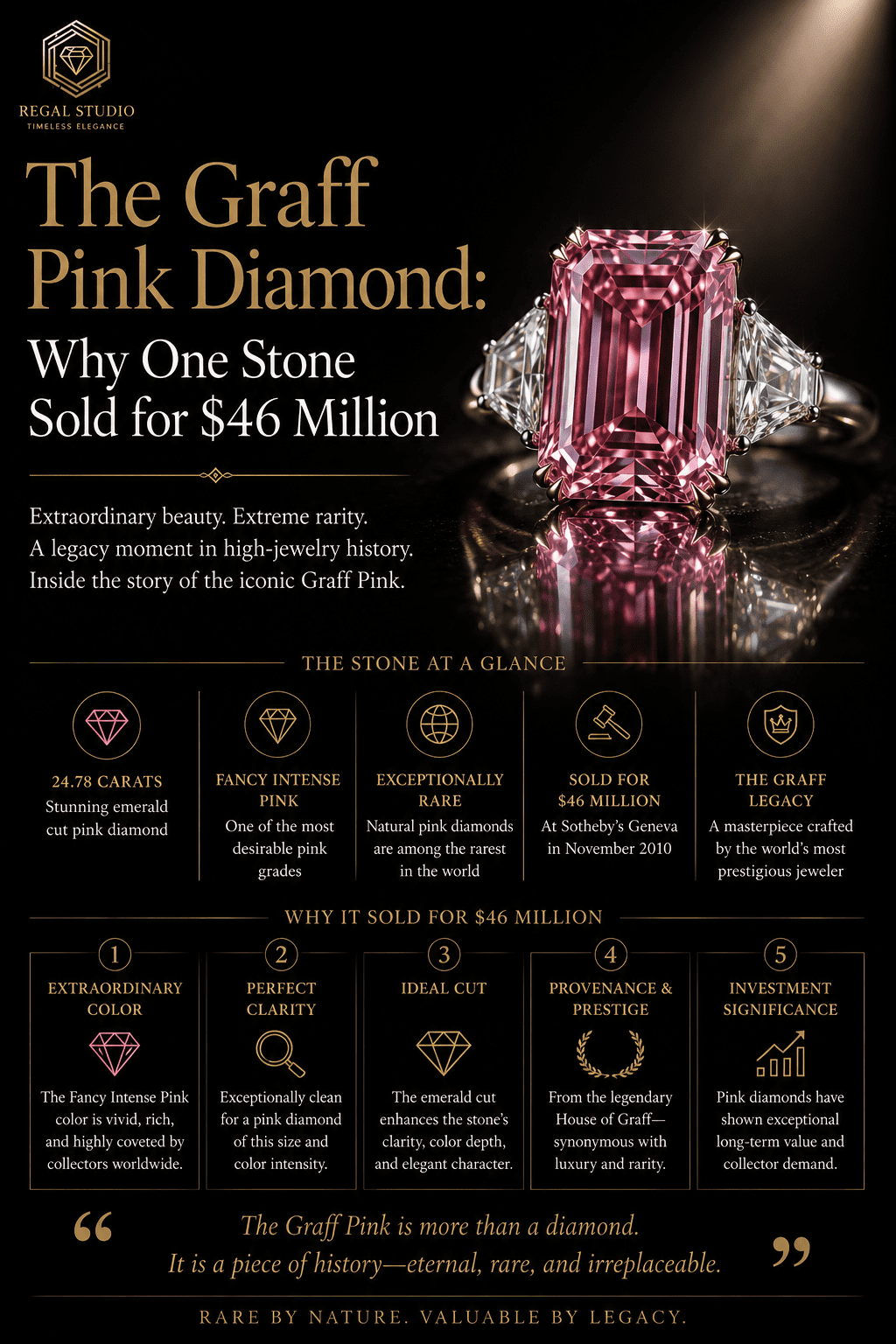


The Graff Pink Diamond: Why One Stone Sold for $46 Million
The Graff Pink diamond sold for $46,158,674 at Sotheby’s Geneva on November 16, 2010, making it the most expensive single jewel ever sold at auction at that time. The 24.78-carat Fancy Intense Pink, emerald-cut, Type IIa diamond was purchased by British jeweler Laurence Graff, who immediately named the stone “The Graff Pink” and later made the controversial decision to recut it. The recut sacrificed 0.9 carats but elevated the diamond from VS1 clarity to Internally Flawless and from Fancy Intense Pink to Fancy Vivid Pink, transforming an already record-breaking stone into a true masterpiece. Its sale fundamentally changed how the world valued pink diamonds and set the stage for every record-breaking pink diamond auction that followed.
In our market observations across more than four decades of diamond grading and the high-end colored stone market, the Graff Pink is one of the three most influential pink diamond transactions in modern history, alongside the Pink Star and the Williamson Pink Star. Experience has shown that understanding why this single stone sold for $46 million teaches more about the real economics of investment-grade pink diamonds than almost any other auction in the past 30 years.
The Graff Pink Diamond at a Glance
Before exploring the full story, here are the essential facts every collector should know.
Attribute | Detail |
Original carat weight | 24.78 carats |
Post-recut weight | 23.88 carats |
Original GIA color grade | Fancy Intense Pink |
Post-recut color grade | Fancy Vivid Pink |
Original clarity | VS1 (Very Slightly Included 1) |
Post-recut clarity | Internally Flawless (IF) |
Cut | Modified emerald cut, rectangular |
Diamond type | Type IIa (chemically purest) |
Auction date | November 16, 2010 |
Auction house | Sotheby’s Geneva |
Auction venue | Beau Rivage Hotel, Geneva |
Final hammer price | $46,158,674 USD ($45.6M / 45.44M CHF) |
Buyer | Laurence Graff (Graff Diamonds) |
Active bidders | Four (intense bidding war) |
Original owner | Harry Winston (1950s) |
Previous private owner | Anonymous collector (1950s-2010, ~60 years) |
Estimated current value | $50-60 million+ |
A key insight often overlooked: the Graff Pink was completely unnamed for nearly 60 years before its 2010 auction. Laurence Graff was the first to give the stone a public identity, and that naming itself became part of why the diamond now commands such cultural recognition.
Why the Graff Pink Diamond Sold for $46 Million
The Graff Pink price was not arbitrary. It reflected six interlocking factors that combined to make this stone genuinely exceptional in 2010.
The six factors driving the Graff Pink diamond price:
- Carat weight: at 24.78 carats, exceptionally large for a pink diamond
- Color grade: Fancy Intense Pink, second-highest GIA pink intensity
- Clarity grade: VS1, with documented potential to reach Internally Flawless
- Diamond type: Type IIa, chemically pure (less than 2% of all diamonds)
- Provenance: previous Harry Winston ownership, 60 years in private collection
- Auction context: four active bidders driving competitive pricing
Experience has shown that no single factor alone justified the $46 million price. The combination of all six in one stone is what made the Graff Pink record-breaking.
The Full Auction Story: November 16, 2010
The Graff Pink’s auction at Sotheby’s Geneva on November 16, 2010, was one of the most consequential single-jewel sales in modern auction history.
Pre-Auction Expectations
Sotheby’s specialists estimated the diamond would sell between $27 million and $38 million. The pre-auction tour took the stone to multiple international cities, generating significant collector and media attention.
David Bennett, head of Sotheby’s jewelry division, conducted the auction at the luxurious Beau Rivage Hotel in Geneva. Industry expectations were high but no one anticipated what would happen next.
The Bidding War
Four active bidders competed for the diamond. The bidding pushed dramatically past the high estimate. When the hammer finally fell at $46,158,674 to Laurence Graff (bidding by phone, reportedly from his Gstaad resort), the auction room erupted in applause.
The price almost doubled the previous record for a single jewel: the $24.3 million paid for the Wittelsbach-Graff Diamond, also bought by Laurence Graff in 2008.
The Larger Sale Context
The Graff Pink’s $46.2 million sale was part of a single Sotheby’s session that totaled $105.1 million, itself a world record for a single sale. Other jewels in the session included pieces previously owned by Christina Onassis (daughter of Aristotle Onassis) and Cristina Ford (second wife of Henry Ford II).
A key insight often overlooked: the Graff Pink’s sale signaled that a new tier of colored diamond pricing had arrived. The world had moved from “expensive” to “investment asset” thinking on pink diamonds in a single auction night.
The Pre-Graff History: From Harry Winston to Anonymous Collector
Before becoming the Graff Pink, the diamond had a quieter but significant history.
The Harry Winston Connection
The diamond was originally owned by Harry Winston, the legendary American jeweler known as “The King of Jewellers and Jeweller to Kings.” Winston specialized in extraordinary stones and had handled some of the most famous diamonds of the 20th century, including the Hope Diamond and the Vargas Diamond.
In the 1950s, Harry Winston sold the diamond, mounted as a ring with two shield-shaped white diamond shoulders, to a private collector. The piece was characteristic of Harry Winston’s 5th Avenue Manhattan workshop design.
60 Years in Private Hands
The anonymous collector who purchased the diamond from Harry Winston held it for nearly 60 years, keeping it entirely out of public view. The diamond never appeared at auction during this period and was not photographed in jewelry publications.
This 60-year private ownership added significant mystique by the time the stone resurfaced in 2010. The market reaction reflected not just the diamond’s quality but its rediscovery story.
Why the Diamond Was Never Named
Unlike most diamonds of comparable size and quality, the Graff Pink had no name when it appeared at the 2010 Sotheby’s auction. This is genuinely unusual. Most major diamonds carry names tied to their first prominent owner, weaving region, or historical event.
In our professional assessment, the absence of a name made the 2010 sale even more dramatic. Laurence Graff’s first official act after purchasing the stone was naming it “The Graff Pink,” instantly establishing brand association with one of the world’s most prestigious jewelry houses.

The Daring Recut: Sacrificing 0.9 Carats for Perfection
After acquiring the Graff Pink, Laurence Graff made a decision that divided the jewelry world: he ordered the diamond to be recut and repolished.
The GIA Recommendation
The GIA report accompanying the original sale included a critical note: the diamond’s clarity grade of VS1 had a “potentially Internally Flawless” designation, meaning expert repolishing could elevate the clarity to the highest possible grade.
Graff entrusted the diamond to his master cutters and gemologists, likely working in Antwerp, for several weeks of careful study followed by precision recutting.
The Risk Involved
Recutting a $46 million diamond carries enormous risk. Any miscalculation could:
- Damage the stone irreversibly
- Reduce carat weight beyond projections
- Introduce new clarity flaws
- Lower the GIA color grade
- Destroy 60 years of stable provenance
Graff had taken similar risks before. In 2008, he recut the historic 35.52-carat Wittelsbach Diamond (purchased for $24.3 million), sacrificing 4.45 carats to elevate the color grade from Fancy Deep Grayish-Blue to Fancy Deep Blue and the clarity from VS2 to Internally Flawless. Purists called this an “act of vandalism.” Graff considered it perfection.
The Result
After several weeks of painstaking work, the recut was complete. The Graff Pink had transformed:
- Weight: 24.78 carats → 23.88 carats (sacrifice of 0.9 carats)
- Clarity: VS1 → Internally Flawless (IF)
- Color: Fancy Intense Pink → Fancy Vivid Pink (the highest pink grade)
The recut elevated the Graff Pink from a record-breaking auction stone to a true masterpiece in the highest possible grade categories for a pink diamond.
A key insight often overlooked: a Fancy Vivid Pink Internally Flawless 23.88-carat Type IIa diamond is, by current GIA standards, one of the most perfect natural pink diamonds ever documented.
The Graff Pink in Context: Most Expensive Pink Diamonds
To fully appreciate the Graff Pink’s significance, see how it ranks among the world’s most valuable pink diamonds.
Diamond | Carats | Year Sold | Price | Per Carat |
Pink Star (CTF Pink) | 59.60 | 2017 | $71.2M | $1.19M |
Williamson Pink Star | 11.15 | 2022 | $57.7M | $5.18M |
Winston Pink Legacy | 18.96 | 2018 | $50.7M | $2.67M |
Graff Pink | 24.78 | 2010 | $46.2M | $1.86M |
Princie Diamond | 34.65 | 2013 | $39.3M | $1.13M |
Eternal Pink | 10.57 | 2023 | $34.8M | $3.29M |
Pink Promise | 14.93 | 2017 | $32.5M | $2.18M |
Sweet Josephine | 16.08 | 2015 | $28.5M | $1.77M |
Spirit of the Rose | 14.83 | 2020 | $26.6M | $1.79M |
In our market observations, the Graff Pink remains a top-five most expensive pink diamond by total price more than 15 years after its sale. It also held the world record for “most expensive jewel ever sold at auction” until the Pink Star surpassed it in 2017.
Why Type IIa Designation Matters for the Graff Pink
The Graff Pink is classified as a Type IIa diamond, which is part of why the stone commanded such an extraordinary price.
What Type IIa Means
Type IIa diamonds are the chemically purest form of diamond, free from nitrogen impurities (which create yellow tints) and boron (which creates blue color). Less than 2% of all natural diamonds qualify as Type IIa.
Famous Type IIa diamonds include:
- The Cullinan Diamond and its descendants
- The Koh-i-Noor
- The Centenary Diamond
- The Pink Star
- The Graff Pink
- The Williamson Pink Star
For a pink diamond to also be Type IIa is exceptional. Most pink diamonds are Type Ia (containing nitrogen). The Graff Pink’s Type IIa designation places it among the rarest of an already extraordinarily rare category.
In our professional assessment, Type IIa pink diamonds command meaningful premiums over Type Ia pinks of comparable color and clarity. The Graff Pink’s chemistry is part of what makes it irreplaceable.
Pink Diamond Color Grading: Where the Graff Pink Sits
GIA grades pink diamonds across a structured intensity scale. The Graff Pink crossed two important thresholds.
The full GIA pink diamond intensity scale:
- Faint Pink: barely perceptible
- Very Light Pink
- Light Pink
- Fancy Light Pink
- Fancy Pink
- Fancy Intense Pink ← Graff Pink’s original grade
- Fancy Vivid Pink ← Graff Pink’s grade after recut
- Fancy Deep Pink
- Fancy Dark Pink
Among Type IIa pink diamonds specifically, only about 2 percent earn the Fancy Vivid grade. The Graff Pink’s recut elevation to Fancy Vivid Pink placed it in this elite 2 percent of an already rare category.
Why Pink Diamonds Like the Graff Pink Are So Rare
Pink diamonds get their color from a unique geological process that no other diamond category shares.
The science behind pink diamond color:
- Unlike yellow diamonds (nitrogen) or blue diamonds (boron), pink color is not caused by chemical impurities
- Pink color results from structural distortions in the crystal lattice during formation
- Extreme pressure during the diamond’s geological formation creates the necessary defects
- These defects absorb green light and reflect pink light to the viewer
Less than 0.15 percent of diamonds submitted to GIA display a predominantly pink color. Within that already rare population, only a tiny fraction achieve the size, color saturation, and clarity grades that define investment-grade stones like the Graff Pink.
The historical primary source for pink diamonds was the Argyle mine in Western Australia, which closed permanently in November 2020. Smaller production has historically come from India’s Golconda region (the source of many pre-20th century pinks), Russia, and a few African mines.
Where Is the Graff Pink Diamond Today?
The Graff Pink has remained in Laurence Graff’s private collection since the 2010 purchase and subsequent recut.
Current status of the Graff Pink:
- Privately held by Laurence Graff and Graff Diamonds
- Occasionally exhibited at high-profile Graff Diamonds events
- Not on permanent public display at any museum
- Estimated current value: $50 million to $60 million+
- Insurance valuation likely significantly higher
- No announced plans for resale
In our market observations, the Graff Pink is unlikely to appear at auction again in the foreseeable future. Stones of this caliber typically remain in private collections for generations once acquired by serious collectors.

What the Graff Pink Teaches About Diamond Investing
For collectors and investors, the Graff Pink story offers four practical lessons that apply at any budget level.
Four lessons from the Graff Pink:
- Provenance documentation increases value. Two visually identical pink diamonds can sell for dramatically different prices based on documented ownership history alone. Always preserve and pass forward all documentation.
- Type IIa designation matters. A Type IIa pink diamond commands meaningful premiums over a Type Ia pink of similar appearance. Always confirm Type designation on any pink diamond purchase.
- GIA “potential” notations carry real value. The Graff Pink’s original VS1 grade with “potentially Internally Flawless” notation gave Laurence Graff confidence to invest in recutting. These professional assessments are valuable signals.
- Master craftsmanship can elevate already-perfect stones. Even at $46 million, the Graff Pink became more valuable after expert recutting. Cutting and polishing decisions affect long-term investment returns at every level.
A key insight often overlooked: these same lessons apply to every quality diamond purchase, whether $5,000 or $50 million. Provenance, chemistry, professional documentation, and craftsmanship are universal value drivers.
Expert Analysis: Five Truths About the Graff Pink Diamond
In our market observations across more than four decades of diamond expertise, the Graff Pink represents five patterns that shape colored diamond economics.
Five insights from the bench:
- The Graff Pink redefined what was possible at auction. Before the 2010 sale, no single jewel had ever exceeded $25 million at auction. The Graff Pink nearly doubled that ceiling and signaled a new era of fancy color diamond pricing.
- Recutting a record-breaking stone is genuinely controversial. Experience has shown that even master jewelers debate whether historic diamonds should be modified. Laurence Graff’s willingness to recut both the Wittelsbach and the Graff Pink is the exception, not the rule.
- Naming a diamond is a value-creation event. The Graff Pink had been anonymous for 60 years. Within minutes of purchase, naming the stone after his company gave Laurence Graff lasting brand association with one of the world’s most valuable diamonds.
- Pre-Argyle-closure pink diamonds carry historical context. The Graff Pink sold in 2010, ten years before the Argyle mine closed in November 2020. Stones with documented pre-closure provenance are increasingly valued as the supply environment transforms permanently.
- A trusted jeweler relationship matters more for pink diamonds than for any other category. The technical complexity of fancy color grading, treatment risks, and per-carat market dynamics demand expertise no individual buyer can match alone.
How GIA Experts Authenticate Investment-Grade Pink Diamonds
Beyond standard diamond authentication, professional pink diamond evaluation includes:
- Color origin determination: natural vs. treated (5-10x value difference)
- Color modifier analysis: pure pink vs. orangish vs. brownish
- Intensity grade verification: Faint through Fancy Vivid
- Type designation: Type Ia vs. Type IIa chemistry
- Argyle origin verification when applicable
- Spectroscopic analysis: confirms natural color origin
- UV fluorescence testing: identifies treatment indicators
- Provenance documentation: prior appraisals, auction records, custom paperwork
Buyers can learn the basics. Mastering investment-grade pink diamond authentication takes years of dedicated study. That is why a relationship with a GIA Certified Diamond Grader is essential for any serious pink diamond purchase.
Frequently Asked Questions About the Graff Pink Diamond
How much did the Graff Pink diamond sell for?
The Graff Pink sold for $46,158,674 USD (45.44 million CHF) at Sotheby’s Geneva on November 16, 2010. At the time, this was the highest price ever paid for a single jewel at auction, nearly doubling the previous record of $24.3 million held by the Wittelsbach-Graff Diamond. The price has since been surpassed by other diamonds, most notably the Pink Star at $71.2 million in 2017.Who owned the Graff Pink diamond before Laurence Graff?
The Graff Pink was originally owned by American jeweler Harry Winston, who sold it in the 1950s to an anonymous private collector. The diamond remained in private hands for nearly 60 years, never appearing publicly, until the 2010 Sotheby’s auction. After Laurence Graff purchased the stone, it became part of his private Graff Diamonds collection.Why did Laurence Graff recut the Graff Pink diamond?
The original GIA report indicated that the diamond’s VS1 clarity could potentially be elevated to Internally Flawless with expert repolishing. Laurence Graff entrusted the diamond to his master cutters, who sacrificed 0.9 carats to achieve two improvements: clarity went from VS1 to Internally Flawless, and color elevated from Fancy Intense Pink to the highest pink grade, Fancy Vivid Pink. The post-recut diamond weighs 23.88 carats.What is the Graff Pink diamond worth today?
The Graff Pink is currently estimated to be worth $50 million to $60 million or more, accounting for its post-recut elevation to Fancy Vivid Pink Internally Flawless and the dramatic appreciation of pink diamond prices since the November 2020 Argyle mine closure. The diamond remains in Laurence Graff’s private collection and is unlikely to appear at auction in the foreseeable future.Why are pink diamonds like the Graff Pink so rare?
Pink diamonds are extraordinarily rare because their color comes from a unique geological process: structural distortions in the crystal lattice caused by extreme pressure during formation, rather than chemical impurities. Less than 0.15 percent of diamonds submitted to GIA display predominantly pink color. Among Type IIa pink diamonds (chemically purest), only about 2 percent earn the Fancy Vivid grade. The Graff Pink combines all of these rarity factors in one stone.
Key Takeaways: The Graff Pink Diamond
- The Graff Pink sold for $46,158,674 at Sotheby’s Geneva on November 16, 2010
- It was the most expensive jewel ever sold at auction at that time
- The 24.78-carat Fancy Intense Pink was originally owned by Harry Winston in the 1950s
- After 60 years in private hands, it sold to Laurence Graff after a four-bidder battle
- Graff recut the diamond, elevating it to 23.88 carats, Internally Flawless, Fancy Vivid Pink
- The Graff Pink is a Type IIa diamond, the chemically purest category
- It remains in Laurence Graff’s private collection with estimated value of $50-60 million+
Final Thoughts: What the Graff Pink Story Means for Today’s Pink Diamond Buyers
The Graff Pink diamond is more than a record-breaking auction story. It is a masterclass in how the diamond market actually values rarity, craftsmanship, provenance, and the willingness to make bold decisions about already-perfect stones. The same six factors that drove the Graff Pink to $46 million also shape the price of every quality engagement ring, anniversary piece, and heirloom commission made today, just on a dramatically different scale.
You may never own a 24.78-carat Type IIa Fancy Vivid Pink. But the principles that made the Graff Pink a record-breaker apply to your next colored diamond purchase as much as they applied to Laurence Graff’s winning bid in Geneva. Color matters. Clarity matters. Type designation matters. Cutting craftsmanship matters. Provenance matters. And the right expert guidance turns those principles into a piece you actually want to own.
That is exactly what Mack has spent more than four decades doing at Regal Studio in Buckhead, Atlanta. As a GIA Certified Diamond Grader with 45+ years of experience, Mack personally evaluates every diamond that enters the studio, from classic colorless stones to fancy color selections for clients seeking the rarest categories. He has crafted custom pieces for everyday couples, celebrities, and professional athletes alike, applying the same rigor to a $5,000 engagement ring that auction houses apply to museum-grade stones like the Graff Pink.
At Regal Studio, every piece carries Mack’s personal signature mark. Every diamond is selected for color, clarity, cut, and craftsmanship. Every client receives the same honest guidance about what makes a diamond truly exceptional, including ethical sourcing, color authentication, treatment disclosure, Type designation verification, and the difference between a stone that holds value and a stone that simply costs money.
Ready to work with the same diamond expertise that record-breaking pieces deserve?
Visit Regal Studio on Peachtree Road in Buckhead, Atlanta, or get in touch to schedule your private consultation with Mack. Whether you are designing a custom engagement ring, sourcing a rare colored diamond, or restoring a family heirloom, you work directly with a master jeweler who knows the difference between every grade, every cut, and every story a diamond can tell.
You may not own the Graff Pink. But you can own something built with the same standards.
Mack’s motto says it all: “You Dream It, We Make It.”
Read More:
Red vs Pink vs Blue Diamonds: Which Is the Rarest and Most Valuable?