
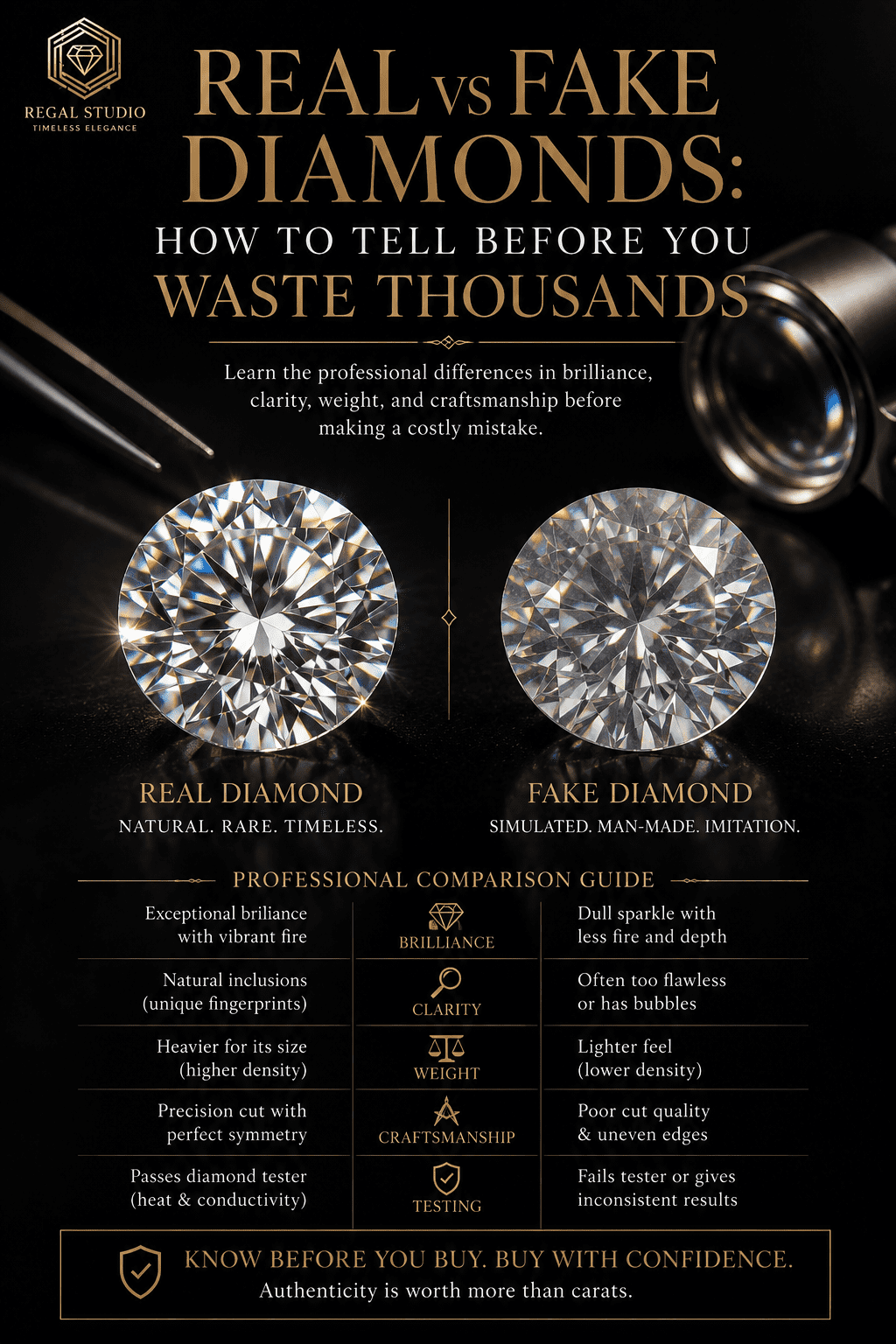


Real vs Fake Diamonds: How to Tell Before You Waste Thousands
The fastest way to tell if a diamond is real is to run four quick at-home tests: the fog test (real diamonds clear instantly), the water test (real diamonds sink immediately), the newspaper read-through test (real diamonds distort text and never let you read clearly through them), and the magnification test (real diamonds show natural inclusions, fakes look perfect). For final confirmation, professional thermal and electrical conductivity testers, plus a GIA grading report, deliver definitive answers. Together these methods catch over 95% of fakes and substitutes, including cubic zirconia, glass, and even moissanite, the most convincing diamond simulant in the market.
In our market observations across more than four decades of working with diamonds at the bench, the question of authenticity is the single most expensive question buyers fail to ask. Experience has shown that a buyer who learns these tests once will save thousands of dollars across a lifetime of jewelry purchases.
How to Tell If a Diamond Is Real at a Glance
Before walking through each test, here is the practical snapshot every buyer should commit to memory.
Test | What to Check | Time Required | Reliability |
1. Fog test | Breath should clear instantly on real diamonds | 10 seconds | High |
2. Water test | Real diamond sinks immediately | 30 seconds | High |
3. Newspaper read-through | Real diamonds distort text completely | 15 seconds | High |
4. Magnification check | Natural inclusions vs. perfect clarity | 1 minute | Very high |
5. GIA report verification | Definitive professional authentication | Instant if available | Definitive |
A key insight often overlooked: no single home test is perfect on its own. Real authentication confidence comes from running multiple tests together and matching the results.
Why Real vs Fake Diamond Confusion Costs Buyers So Much
The diamond market has more high-quality fakes than at any point in history. Three categories dominate.
Three categories of “fake” diamonds in the market:
- Cubic zirconia (CZ): synthetic, inexpensive, easy to spot
- Moissanite: lab-created, brilliant, much harder to spot than CZ
- Glass and crystal: rare in jewelry, but still present in fashion pieces
A separate category, lab-grown diamonds, is not technically fake at all. These are real diamonds chemically and structurally, just grown in a lab rather than mined. They behave identically to natural diamonds in every test and require lab equipment to distinguish.
Experience has shown that the most expensive mistakes happen with moissanite. The stone passes most home tests, looks brilliant under almost any lighting, and is sometimes sold as a diamond by dishonest sellers at full diamond prices.
Test 1: The Fog Test
The fog test is the fastest authenticity check available. It works because real diamonds disperse heat efficiently, while fakes hold heat and condensation.
How to Run the Fog Test
Hold the stone between two fingers. Bring it close to your mouth and breathe gently on it the way you would breathe on a mirror.
On a real diamond:
- The fog clears almost instantly, within 1 to 2 seconds
- The stone returns to its original clarity immediately
- This happens because real diamonds disperse heat efficiently
On a fake (CZ, glass):
- The fog lingers for 4 to 10 seconds
- The stone takes noticeably longer to clear
- Heat retention is much higher than real diamonds
What This Test Will NOT Catch
The fog test is reliable for cubic zirconia and glass. It is less reliable for moissanite, which has thermal properties closer to real diamonds. For high-end fakes, you need additional tests.
In our professional assessment, the fog test is the right starting point but never the final answer for any expensive purchase.
Test 2: The Water Test
The water test relies on diamond’s exceptional density to separate real stones from most simulants.
How to Run the Water Test
Fill a regular drinking glass two-thirds with water. Drop the loose stone into the water and watch what happens.
On a real diamond:
- The stone sinks immediately to the bottom
- It moves quickly through the water without floating or hovering
- This happens because diamonds have a high density of about 3.52 g/cm³
On a fake (CZ, glass):
- The stone may sink more slowly
- Glass stones especially can hover or float briefly
- Lower density gives away the substitute
Important Limitations
This test only works on loose stones. Mounted diamonds in rings or settings cannot be tested this way without removing the stone, which we do not recommend.
A key insight often overlooked: cubic zirconia is also dense (5.6 g/cm³), so it sinks too. The water test is most useful for ruling out glass and crystal substitutes, not CZ specifically.

Test 3: The Newspaper Read-Through Test
Also called the refractivity test, this method uses a real diamond’s exceptional light-bending properties.
How to Run the Newspaper Test
Take a loose stone and place it flat-side down on a sheet of newspaper or magazine text. Look down through the top of the stone.
On a real diamond:
- Text directly below is completely impossible to read
- Light bends so sharply through the diamond that text becomes unrecognizable
- You may see scattered light, but no readable letters
On a fake (CZ, glass):
- Text is partially or fully readable through the stone
- Light passes more straight through with less refraction
- Glass especially will show clear text
Why This Test Works
Diamonds have a refractive index of 2.42, one of the highest of any natural material. Cubic zirconia is 2.15 to 2.18. Glass is around 1.5. The differences are large enough that the human eye can detect them through the newspaper test.
Experience has shown that this test is one of the most reliable for loose stones over 0.5 carat. Smaller stones can be harder to assess this way.
Test 4: The Magnification Test
This is where amateur detective work crosses into expert territory. With a basic 10x loupe (available for under $30), you can see things invisible to the naked eye.
What to Look For With a Loupe
On a real diamond:
- Natural inclusions: tiny mineral spots, feathers, clouds, or pinpoints
- Slight color variations within the stone
- Natural growth patterns
- Sharp, well-defined facet edges
On a fake:
- Cubic zirconia: often perfectly clean (suspicious in itself)
- Moissanite: shows “doubling” of facet lines (a key giveaway)
- Glass: may have rounded facet edges and visible bubbles
The Moissanite Doubling Effect
This is the single most important authentication signal for spotting moissanite. Moissanite is doubly refractive, meaning when you look through the top of the stone with magnification, you can see the back facets appearing as doubled lines.
Real diamonds are singly refractive and never show this doubling. If you see doubled facet lines under a 10x loupe, the stone is moissanite, not a diamond.
A key insight often overlooked: a “perfectly clean” stone in your engagement ring is statistically rare in real diamonds. If a stone shows zero inclusions under magnification, that itself can be a warning sign.
Test 5: GIA Report Verification
This is the gold standard. A GIA (Gemological Institute of America) grading report is the most respected diamond authentication document in the world.
What a GIA Report Confirms
- Stone is a real diamond (natural or lab-grown, clearly stated)
- Exact carat weight, color, clarity, and cut grades
- Measurements and proportions
- Any treatments or enhancements
- Unique laser inscription number on the diamond’s girdle (for stones over 0.18 carat)
How to Verify a GIA Report
Every GIA report has a unique number. You can verify any report by visiting the GIA Report Check tool on the GIA website and entering the report number. The report will display online with all original grading details.
If the report number does not match the actual diamond’s measurements, or if the report does not exist in the GIA database, you are looking at a fake document.
In our market observations, requesting a GIA report is the single most powerful step a buyer can take. Any diamond over $1,000 should come with a current GIA report. Sellers who cannot or will not provide one are signaling something important.
Comparison Table: Real Diamond vs Common Fakes
This table summarizes how each common fake fails or passes specific tests.
Test | Real Diamond | Cubic Zirconia | Moissanite | Glass |
Fog test | Clears instantly | Lingers 4-10 sec | Clears quickly | Lingers significantly |
Water test | Sinks immediately | Sinks (also dense) | Sinks (also dense) | Floats or sinks slowly |
Newspaper test | Distorts text completely | Partial distortion | Partial distortion | Text mostly readable |
Magnification | Natural inclusions | Often too clean | Doubling effect | Bubbles, rounded facets |
Heat test (pro) | Conducts heat well | Poor conduction | Conducts heat well | Poor conduction |
Electrical test (pro) | Does not conduct | Does not conduct | Conducts electricity | Does not conduct |
GIA report | Available | Not available | Available (lab report) | Not available |
A key insight often overlooked: moissanite passes the fog test, water test, and even thermal tests because its physical properties are remarkably close to diamond. The combination of magnification (doubling effect) and electrical conductivity testing is the only reliable way to spot it without lab equipment.
Lab-Grown Diamonds: A Different Conversation Entirely
Lab-grown diamonds are not fake. They are real diamonds, chemically and structurally identical to natural diamonds, just grown in controlled laboratory conditions instead of formed deep in the Earth.
Key facts about lab-grown diamonds:
- Same chemistry as natural diamond (pure carbon)
- Same hardness, brilliance, fire, and durability
- Pass every traditional diamond test
- Require specialized lab equipment to distinguish from natural
- Cost 40 to 90 percent less than equivalent natural diamonds
- Receive GIA grading reports specifically labeled “Laboratory-Grown”
In our professional assessment, the lab-grown vs natural conversation is about value preference, not authenticity. Both are real diamonds. The choice depends on your budget, ethical preferences, and whether long-term resale value matters to your purchase decision.
A key insight often overlooked: lab-grown diamonds have laser inscriptions on the girdle identifying them as lab-grown. Always look for this inscription if you are paying for a stone advertised as natural.

Professional Authentication Tools and What They Cost
For buyers wanting more than home tests, two professional tools deliver near-definitive answers without needing a full lab.
Diamond Thermal Tester
A handheld electronic device that measures how quickly a stone dissipates heat. Real diamonds conduct heat exceptionally well; CZ does not.
- Cost: $100 to $300
- What it catches: cubic zirconia, glass, most simulants
- What it misses: moissanite (which conducts heat similarly to diamond)
Combined Thermal/Electrical Tester (Diamond/Moissanite Tester)
A more advanced device that adds electrical conductivity testing. Moissanite conducts electricity; real diamond does not.
- Cost: $150 to $500
- What it catches: all common fakes including moissanite
- What it misses: lab-grown vs natural diamond distinction
When to Use Professional Tools at Home
For buyers planning to purchase multiple diamonds, evaluate estate jewelry, or consider second-market stones, owning a combined thermal/electrical tester is a sensible investment. For one-time engagement-ring buyers, working with a GIA Certified Diamond Grader is faster and more comprehensive than DIY testing.
How to Spot Common Fakes in Different Settings
Where you encounter the diamond changes how you should test it.
In a Mounted Ring
Loose-stone tests like the water test and newspaper test become impossible. Use:
- The fog test (still works on mounted stones)
- The magnification test (with a loupe)
- Examining the setting for marks indicating real precious metals (10K, 14K, 18K, PT, 950)
- Requesting GIA documentation
Online Purchases
Never buy a diamond over $500 from an online source without:
- Verified GIA report number you can check against the GIA database
- Multiple high-resolution photos showing the stone from all angles
- Magnified back-and-forth video of the stone in motion
- A clear return policy with at least 14 days for inspection
Estate or Vintage Jewelry
Older pieces often combine real diamonds with synthetic accent stones. Always test:
- Each significant stone individually
- The metal stamps on the setting
- The cutting style (old European cuts and old mine cuts indicate authentic vintage work)
- The wear pattern (genuine vintage wear differs from artificially aged pieces)
Common Mistakes When Testing Diamond Authenticity
In our market observations, even careful buyers make the same mistakes during home testing.
- Trusting the seller’s word without performing any tests
- Running only one test when a combination is more reliable
- Skipping the magnification step which catches moissanite
- Confusing lab-grown with fake (they are different categories)
- Buying online without verified GIA documentation
- Believing inflated original prices at clearance or going-out-of-business sales
- Assuming all “diamond simulant” listings are honest (some are sold deceptively)
- Forgetting that real diamonds occasionally have visible inclusions
Expert Analysis: Five Truths About Telling Real From Fake Diamonds
In our market observations across more than four decades of bench work and diamond grading, five patterns separate confident buyers from confused ones.
Five insights from the bench:
- No single test is enough on its own. Real authentication confidence requires running multiple tests and matching the results. Buyers who rely on one test alone are the buyers who get fooled.
- Moissanite is the modern challenge, not cubic zirconia. CZ has been around for decades and is well-understood. Moissanite is the high-end fake that catches more buyers off-guard in 2026 than any other simulant.
- GIA documentation is non-negotiable above $1,000. Experience has shown that any diamond purchased without a current GIA report carries authentication risk that no home test can eliminate.
- Lab-grown is real, but priced differently. A lab-grown diamond is not a fake. It is a real diamond at a different price point. Knowing what you are buying matters more than choosing one over the other.
A trusted jeweler relationship saves more than the discount you would get without one. Buyers who work with an experienced GIA Certified Diamond Grader almost never end up with fake or misrepresented diamonds. The expertise is part of what you are paying for.

How GIA Certified Experts Authenticate Diamonds
Beyond the home tests above, professional authentication includes:
- Microscopic inspection at 30x to 60x magnification
- Spectroscopic analysis for color treatment detection
- UV fluorescence testing to identify treated stones
- Laser inscription verification matching the GIA certificate
- Refractive index measurement with calibrated equipment
- Specific gravity testing for definitive density confirmation
- Crown and pavilion proportion analysis for cut authenticity
Buyers can learn the home tests. Mastering professional-level authentication takes years. That is why the smartest diamond purchases go through a GIA-certified expert before money changes hands.
Frequently Asked Questions About How to Tell If a Diamond Is Real
What is the fastest way to tell if a diamond is real at home?
The fog test is the fastest. Hold the stone between your fingers and breathe on it like you would on a mirror. A real diamond disperses heat so efficiently that the fog clears within 1 to 2 seconds. Fakes like cubic zirconia and glass hold the fog for 4 to 10 seconds. Combine this with the newspaper read-through test (real diamonds distort text completely) for stronger confidence.Can moissanite pass as a real diamond?
Yes, moissanite is the most convincing diamond simulant on the market. It passes the fog test, the water test, and even thermal conductivity tests. The two reliable ways to spot moissanite are the magnification test (look for “doubling” of facet lines through a 10x loupe, which real diamonds never show) and an electrical conductivity tester (moissanite conducts electricity, real diamonds do not).How do I tell if a diamond is real or lab-grown?
You cannot tell with home tests. Lab-grown diamonds are real diamonds chemically and structurally, so they pass every traditional test. The only way to distinguish lab-grown from natural is through GIA grading documentation (which clearly labels lab-grown stones), specialized spectroscopic equipment, or by checking for the laser inscription on the girdle identifying the stone as laboratory-grown.Should I trust a diamond without a GIA report?
For any diamond purchase over $1,000, a current GIA report is essential. The report verifies authenticity, grades the 4Cs (cut, color, clarity, carat), discloses any treatments, and includes the unique laser inscription number on the diamond. Sellers who cannot or will not provide GIA documentation are signaling something important. You can verify any GIA report number on the GIA website’s Report Check tool.What is the most common diamond fake in 2026?
Moissanite is the most prevalent and most concerning fake in the modern market because it passes most home tests and looks visually similar to real diamonds at first glance. Cubic zirconia is still common in fashion jewelry but is easier to spot. Glass and crystal substitutes are rare in serious jewelry but appear in costume pieces. Lab-grown diamonds are not fake at all but are sometimes mislabeled and sold at natural-diamond prices, which is its own form of misrepresentation.
Key Takeaways: How to Tell If a Diamond Is Real
- Run the fog, water, newspaper, and magnification tests for at-home authentication
- Real diamonds clear fog instantly, sink immediately, distort text completely, and show natural inclusions
- Moissanite is the hardest fake to spot and requires magnification or electrical testing
- Lab-grown diamonds are real diamonds, just grown in labs and priced differently
- A current GIA report is essential for any diamond purchase over $1,000
- No single home test is definitive; combine multiple tests for confidence
- The smartest diamond purchases involve a GIA Certified Diamond Grader
Final Thoughts: Why the Right Jeweler Eliminates the Guesswork
The home tests in this guide give you confidence to evaluate any diamond yourself. But here is the truth most buyers learn the hard way: the fastest path to a real diamond at a fair price is not the test you run after purchase. It is the relationship you build before purchase.
When you work with a GIA Certified Diamond Grader who personally inspects every stone in their inventory, the authentication question is answered before you ever pick up a loupe. You see verified GIA reports. You see actual inclusions under magnification. You hear honest explanations of color, clarity, cut, and price. The whole process turns from a defensive exercise into an informed conversation.
That is what Mack has built at Regal Studio in Buckhead, Atlanta over more than four decades. As a GIA Certified Diamond Grader with 45+ years of experience, Mack personally selects every diamond that enters the studio, designs every piece, and crafts every ring at the bench himself. No mass production. No mystery stones. Just transparent diamonds that pass every test on the first try.
Mack has guided everyday couples, celebrities, and professional athletes through the diamond-buying process with the same standards. Every piece carries his personal signature mark, which is itself a guarantee that the stones inside are real, the grading is honest, and the craftsmanship will last for generations.
Ready to buy a diamond you do not have to test?
Visit Regal Studio on Peachtree Road in Buckhead, Atlanta, or get in touch to schedule your private consultation with Mack. Whether you are sizing your first engagement ring, evaluating an estate diamond, or restoring a family heirloom, you will work with a master jeweler whose entire career has been dedicated to one promise: every diamond you see is exactly what we say it is.
The five tests in this guide work on every diamond. Every diamond at Regal Studio passes all five.
Mack’s motto says it all: “You Dream It, We Make It.”
Read More:
Giant 11,000-Carat Ruby Discovered in Myanmar: What This Historic Find Really Means
Pink Star Diamond Price Breakdown: Why It Sold for $71 Million