

Old European Cut Diamonds: What They Are and Why Collectors Love Them
Quick answer: An Old European cut diamond is an antique round diamond, hand-cut mostly between 1890 and 1930, with 58 facets, a small table, a high crown, and a distinctive large open cutlet visible from the top. Unlike the modern round brilliant, which maximizes white-light sparkle, the Old European emphasizes “fire,” the flashes of colored light that glow beautifully in candlelight. Collectors prize them for their hand-cut character, history, sustainability, and the fact that no two are exactly alike.
So here is everything to know about Old European cut diamonds, from an Atlanta master jeweler who works with them.
A Note on Where This Guidance Comes From
This guide comes from Regal Studio in Buckhead, Atlanta. Our founder, Mack, began at the jeweler’s bench at just fourteen, trained across Europe, and is today a GIA Certified Diamond Grader with over 45 years of experience.
For 20 years on Peachtree Road, we have evaluated, set, and restored Old European-cut diamonds in antique and custom pieces.
So this is not a generic encyclopedia entry. It is how a master jeweler actually reads these remarkable stones.
What Is an Old European Cut Diamond?
Let us define it precisely, because the term gets used loosely.
An Old European cut is the antique predecessor to the modern round brilliant. It was the round diamond of its age, cut largely between 1890 and 1930, during the late Victorian, Edwardian, and Art Deco eras.
It evolved from the even earlier Old Mine cut, as cutting tools improved and diamonds became rounder and more refined.
A key insight often overlooked: every Old European cut was shaped by hand, often by candlelight. There were no computers or lasers. That human touch is exactly why collectors treasure them today.
The Defining Characteristics
Here is how to recognize an Old European cut, and what makes it so distinctive to the eye.
Old European Cut: Signature Features
Feature | Detail |
Facets | 58, but larger than a modern brilliant’s |
Culet | Large and open, visible as a “hole” from the top |
Table | Small, roughly 38–45% of the diameter |
Crown | Tall and high |
Girdle | Often thick, sometimes unpolished |
Shape | Round, but with charming slight asymmetry |
A key insight often overlooked: the open culet is the fastest way to spot one. Look straight down at the stone and you will see a small window or circle at the bottom, where a modern diamond would come to a sharp point. It is a signature, not a flaw.
Fire vs. Brilliance: The Key Difference
This is the heart of why an Old European looks so different from a modern diamond. It comes down to how it handles light.
Modern round brilliants are engineered for brilliance, the intense white-light sparkle you see under bright, modern lighting.
Old European cuts, with their larger facets, emphasize fire, the flashes of rainbow-colored light. They were designed for a world lit by candles and gas lamps.
Experience has shown that this gives them a softer, warmer, more romantic glow. Rather than a sharp sparkle, they seem to glow from within, a quality many people find more captivating.
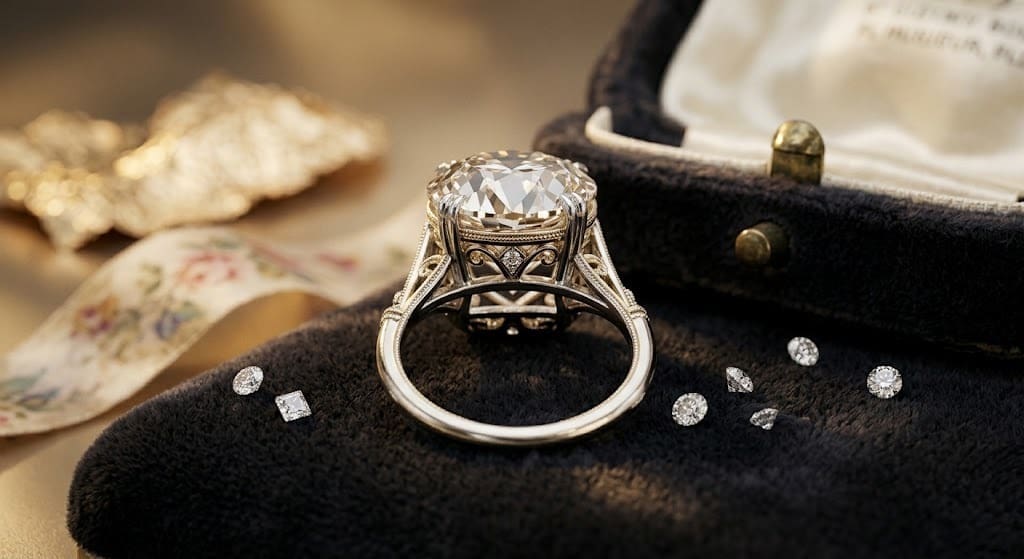
Old European vs. Modern Round Brilliant
Let us compare them directly, since this is the decision many buyers weigh.
Old European vs. Round Brilliant
Factor | Old European Cut | Modern Round Brilliant |
Era | 1890–1930, antique | Today’s standard |
Cutting | Hand-cut, unique | Machine-precise, uniform |
Light | Fire, colored flashes | Brilliance, white sparkle |
Culet | Large, open | Pointed, closed |
Character | One-of-a-kind, warm glow | Consistent, maximum sparkle |
Best lighting | Soft, warm, candlelight | Bright, modern light |
A key insight often overlooked: neither is “better,” they are built for different purposes. The modern brilliant wins on pure sparkle under bright light. The Old European wins on character, warmth, and history.
Why Collectors Love Them
The appeal runs deeper than it looks. Several factors make these stones genuinely coveted.
- They are irreplaceable. Each was hand-cut, so no two are identical. You own a true one-of-a-kind.
- They carry history. An Old European cut is a tangible piece of the early 20th century.
- They are sustainable. As already-mined antique stones, they carry no new environmental impact, a growing priority for buyers.
- They are increasingly rare. They are no longer cut this way, so the supply is fixed and finite.
- They glow uniquely. That warm, romantic fire simply cannot be replicated by a modern cut.
In our market observations, demand for Old European cuts has climbed alongside the broader vintage and Art Deco revival. Buyers increasingly want a stone with a story.
What They’re Worth Today
Value is where many people are surprised. These are not bargain-bin antiques.
High-quality Old European cut diamonds often command a premium of around 10 to 15% over comparable modern round brilliants. A 1-carat example can range widely, roughly $3,000 to $16,000 or more, depending on color and clarity.
A key insight often overlooked: because each stone is unique and the supply is finite, exceptional Old European cuts can appreciate. Their rarity, not just their beauty, supports their value.
How to Buy an Old European Cut Wisely
A few expert pointers protect your investment and your satisfaction.
- Judge it in person and in warm light. These stones are meant to be seen as they were designed, in soft lighting.
- Embrace the asymmetry. Slight irregularities are signs of authenticity and hand-craftsmanship, not defects.
- Prioritize the open culet and cut character. This is what you are paying for; do not expect modern-brilliant precision.
- Get expert verification. An experienced jeweler or grader can confirm it is a genuine antique cut, not a modern imitation.
- Consider the setting. Old European cuts shine in vintage-inspired, Art Deco, and solitaire settings that honor their era.
As a GIA Certified Diamond Grader, Mack can authenticate an Old European cut, assess its quality, and design a setting that lets its unique character glow.
Frequently Asked Questions
What is an Old European cut diamond?
It is an antique round diamond, hand-cut mostly between 1890 and 1930, with 58 facets, a small table, a high crown, and a large open culet. It is the direct predecessor to today’s modern round brilliant, prized for its warm, fiery character.How can I identify an Old European cut diamond?
The clearest sign is the large open culet, a small circle or window visible when you look straight down at the stone, where a modern diamond would have a sharp point. Other clues are a small table, a high crown, larger facets, and slight hand-cut asymmetry.What is the difference between an Old European cut and a modern round brilliant?
Both have 58 facets, but Old European cuts have larger facets that emphasize fire (colored light), while modern brilliants have smaller facets maximizing white-light brilliance. Old Europeans are hand-cut and unique; modern brilliants are machine-precise and uniform.Are Old European cut diamonds valuable?
Yes. High-quality examples often command a 10 to 15% premium over comparable modern round brilliants. Their value is driven by rarity, hand-craftsmanship, history, and a fixed, finite supply, since they are no longer cut this way.Why do collectors prefer Old European cut diamonds?
For their one-of-a-kind hand-cut character, their historical significance, their sustainability as already-mined stones, and their uniquely warm, romantic glow. Each one is irreplaceable, which modern mass-cut diamonds cannot match.
Discover Antique and Old European Cut Diamonds in Atlanta
An Old European cut diamond is more than a gem, it is a hand-crafted piece of history with a glow no modern stone can replicate. Appreciating one fully takes an expert eye.
At Regal Studio in Buckhead, every stone is evaluated by Mack, a GIA-certified diamond grader with over 45 years of experience and the trust of more than 400 five-star clients. Whether you are sourcing an antique Old European cut or designing a setting to showcase one, we guide you with complete transparency.
Our motto says it all: “You Dream It, We Make It.”
Visit Regal Studio on Peachtree Road in Buckhead, or get in touch to book a consultation. Let a seasoned master jeweler help you find or set a diamond with genuine history.
Read More:
Turning a Family Heirloom Into a Custom Engagement Ring
Art Deco Engagement Rings: History, Features, and Modern Designs