


How to Spot a Fake Diamond
Diamonds are timeless, luxurious, and often one of the most significant purchases you’ll make. But with the rise of diamond imitations and synthetic alternatives, it’s more important than ever to know how to spot a fake diamond. Whether you’re buying a diamond for an engagement ring or a special occasion, understanding how to identify fake diamonds can save you from making a costly mistake.
At Regal Studio, we’ve been helping clients in Atlanta, GA, for over 45 years, offering expert guidance on diamonds and custom jewelry. In this guide, we’ll share practical tips and tests to help you determine whether a diamond is real or fake.
How to Spot a Fake Diamond: Key Tests
Here are some of the most reliable ways to determine if a diamond is genuine:
1. The Fog Test
- How it works: Hold the diamond close to your mouth and breathe on it, creating a fog.
- What to look for: A real diamond will clear up almost instantly because it doesn’t retain heat. A fake diamond, such as cubic zirconia, will stay foggy for a few seconds.
- Why it works: Diamonds have excellent thermal conductivity, meaning they disperse heat quickly .
2. The Water Test
- How it works: Fill a glass with water and drop the diamond into it.
- What to look for: A real diamond will sink to the bottom due to its high density, while a fake diamond may float or sink slowly.
- Why it works: Diamonds are denser than most imitation materials.
3. The Scratch Test
- How it works: Use a piece of glass and gently scratch it with the diamond.
- What to look for: A real diamond will scratch the glass without being damaged, while a fake diamond may not leave a mark or could even chip.
- Caution: This test can damage fake diamonds, so proceed carefully .
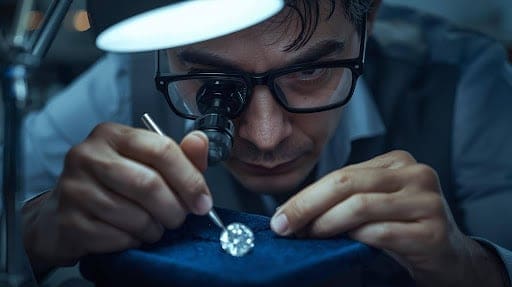
4. The Loupe Test
- How it works: Use a jeweler’s loupe to inspect the diamond under magnification.
- What to look for: Real diamonds often have natural imperfections (inclusions), while fake diamonds like cubic zirconia are usually flawless. Additionally, real diamonds have sharp, crisp edges, while fakes may appear rounded or blurry.
5. UV Light Test
- How it works: Place the diamond under UV light (blacklight).
- What to look for: Many real diamonds emit a blue fluorescence under UV light, while fake diamonds may not glow at all. However, not all real diamonds fluoresce, so this test isn’t foolproof.
6. Thermal Conductivity Test
- How it works: Use a diamond tester, a device that measures thermal conductivity.
- What to look for: A real diamond will conduct heat effectively, while fake diamonds like moissanite or cubic zirconia will not.
Why it works: Diamonds are excellent heat conductors, making this one of the most reliable tests.

Common Diamond Imitations to Watch Out For
- Cubic Zirconia (CZ): A popular diamond alternative that’s much less expensive but lacks the brilliance and durability of a real diamond.
- Moissanite: A high-quality imitation that’s often mistaken for a diamond due to its brilliance. However, it has a different refractive index and thermal conductivity.
- Glass: Some fake diamonds are made of glass, which is much softer and less durable than a real diamond.
- Synthetic Diamonds: Lab-grown diamonds are chemically identical to natural diamonds but are created in a lab. While not fake, they are not mined diamonds.
Why Choose Regal Studio for Diamond Expertise?
At Regal Studio, we pride ourselves on helping clients make informed decisions about their diamond purchases. Here’s why you can trust us:
- Expert Guidance: With over 45 years of experience, we can help you distinguish between real and fake diamonds.
- Certified Diamonds: All our diamonds are GIA-certified, ensuring authenticity and quality.
Custom Jewelry: Whether you’re designing an engagement ring or a unique piece, we’ll guide you through the process with care and expertise.
FAQs About Spotting Fake Diamonds
1. Can I spot a fake diamond at home?
Yes, you can perform simple tests like the fog test, water test, and scratch test at home. However, for accurate results, it’s best to consult a professional jeweler.
2. What’s the most reliable way to identify a fake diamond?
The most reliable method is using a diamond tester to measure thermal conductivity. Professional jewelers can also perform advanced tests to confirm authenticity.
3. Do all real diamonds have imperfections?
Most natural diamonds have inclusions or imperfections, but lab-grown diamonds and some high-quality natural diamonds may appear flawless. A loupe test can help identify these characteristics.
4. Can moissanite pass as a real diamond?
Moissanite is a high-quality diamond imitation that can look very similar to a real diamond. However, it has a different refractive index and thermal conductivity, which can be detected with a diamond tester.
5. Should I always ask for a diamond certificate?
Yes! A diamond certificate, such as one from GIA, verifies the diamond’s authenticity, quality, and characteristics. Always request certification when purchasing a diamond.
Call to Action
Don’t take chances with your diamond purchase. Whether you’re buying a new diamond or want to verify the authenticity of an existing one, Regal Studio is here to help.
📞 Call or Text: +1 (404) 643-8855
📧 Email: in**@***al.studio
📍 Visit Us: 3384 Peachtree Rd NE #120, Atlanta, GA 30326
Let us help you make an informed decision and ensure your diamond is as genuine as your love.
Read More: Top Jewelry Designers to Know