

Ancient Diamond Trade Routes: How India Dominated Early Diamond Supply
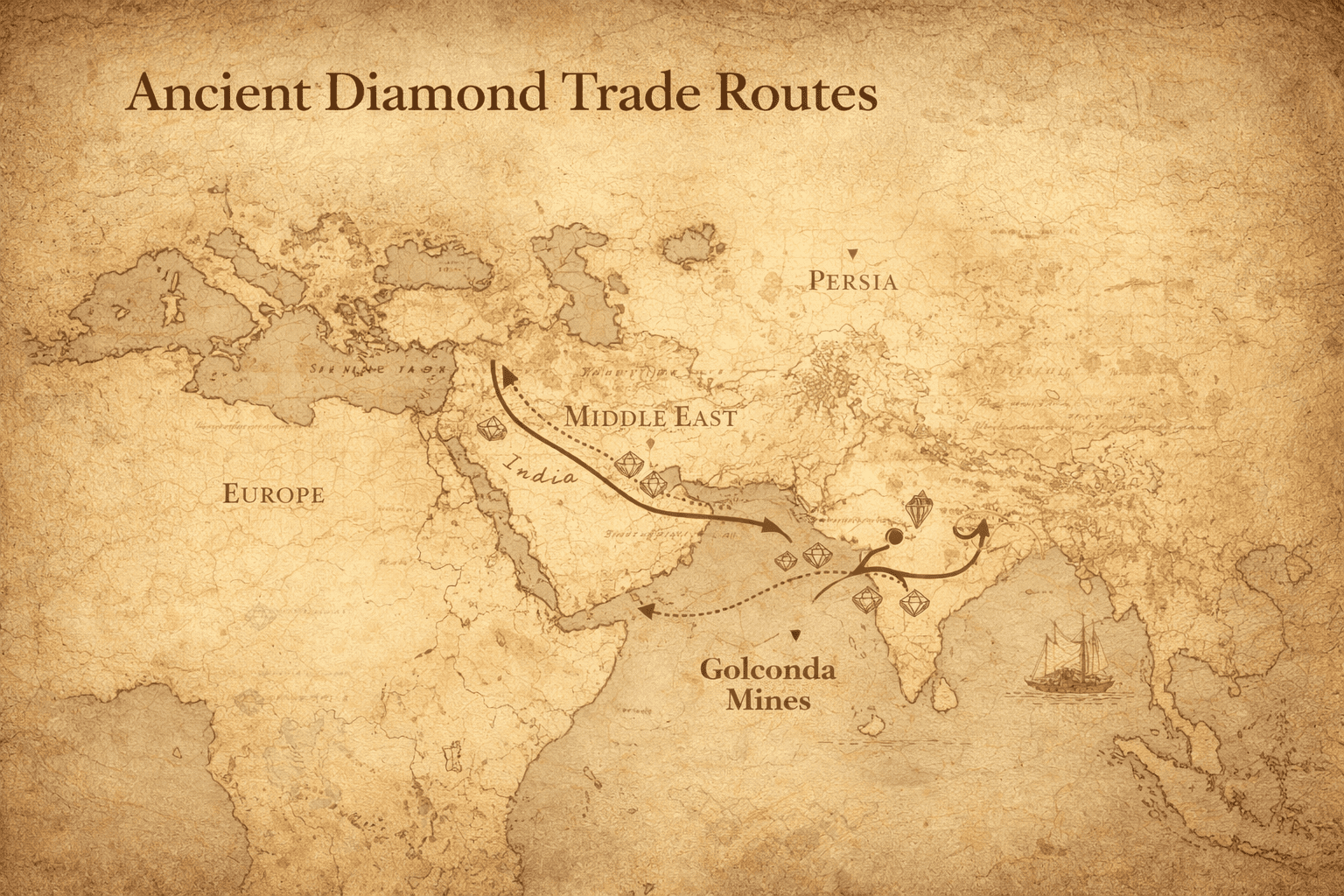
The ancient diamond trade routes were a network of overland and maritime corridors that connected India’s diamond mines to Rome, Persia, China, and the Mediterranean from roughly 400 BCE to 1700 CE. For over 2,000 years, India was the world’s only meaningful source of diamonds channeled westward through the Silk Road and the Indian Ocean maritime circuit, and eastward to Han and Tang China. This monopoly ended only when Brazilian deposits were discovered in the 1720s.
In our market observations across historical gem research, the ancient diamond trade routes represent the single longest-running commodity monopoly in recorded history. Experience has shown that understanding these routes is essential for authenticating any pre-modern diamond claim the provenance chain always begins in India.
Ancient Diamond Trade Routes at a Glance
Before unpacking the full picture, here are the essential facts every historian, collector, or enthusiast should know.
Attribute | Detail |
Duration of Indian Monopoly | ~400 BCE – 1720s CE (roughly 2,100 years) |
Primary Source Region | Golconda, Krishna River, Cuddapah, Panna (India) |
Earliest Written Reference | Arthashastra by Kautilya (~300 BCE) |
Key Maritime Document | Periplus of the Erythraean Sea (~50 CE) |
Main Overland Route | Silk Road (via Persia, Central Asia) |
Main Maritime Route | Red Sea → Arabian Sea → Indian Ocean |
Primary Roman Ports | Myos Hormos, Berenice (Egypt) |
Primary Indian Ports | Muziris, Barygaza, Arikamedu |
Trigger for Decline | Brazilian diamond discoveries (1720s) |
Largest Surviving Ancient Diamond | ~7-carat uncut brown diamond, Syrian ring (c. 300–350 CE) |
A key insight often overlooked is that India was not merely a transit hub it was the exclusive producer. Every diamond set into a Roman ring, a Persian hilt, or a Chinese imperial ornament before the 18th century came from Indian soil.
Ancient Diamond Trade Routes: A Compressed Timeline
For readers who want the headlines before the full narrative, here is the ancient diamond trade routes chronology at a glance.
- ~800 BCE : Earliest Indian diamond mining (likely in northern India)
- ~300 BCE : Arthashastra documents diamond classification and taxation
- 3rd c. BCE : Mauryan Empire consolidates overland trade to Persia
- ~47 CE : Hippalus discovers the monsoon route from Egypt to India
- ~50 CE : Periplus of the Erythraean Sea records diamond exports
- 1st–3rd c. CE : Kushan Empire bridges India with Rome and China
- ~300–350 CE : Earliest surviving diamond jewellery in the Roman world
- 5th c. CE : Fall of Western Rome reduces diamond imports
- ~1200 CE : European demand revives via Venetian and Genoese merchants
- 1292 CE : Marco Polo describes diamond mining in the Deccan
- 16th c. CE : Portuguese establish direct maritime access via Goa
- 17th c. CE : Jean-Baptiste Tavernier documents Golconda mines
- 1720s CE : Brazilian diamond discoveries end India’s monopoly
Why India Was the Only Diamond Source
Until the 18th century, India had a natural geological monopoly. Diamonds were found in the alluvial deposits of river systems in four main regions:
- Golconda the most famous, in the Deccan Plateau near modern Hyderabad
- Krishna River Basin source of many Roman-era exports
- Cuddapah Region southern India, worked from antiquity
- Panna in central India, likely the earliest mined area
Indian lapidaries developed sophisticated techniques for grading, cutting, and setting diamonds centuries before European craftsmen. The ancient text Arthashastra (c. 300 BCE) by Kautilya, chief advisor to Emperor Chandragupta Maurya already classified diamonds by color, weight, and defect.
In our professional assessment, this is the point most modern histories underplay. By the time Roman traders arrived in Indian ports, they were buying from a mature industry with 500+ years of documented practice.
The Four Traditional Indian Diamond Grades
The Arthashastra and later Sanskrit gem treatises (Ratnapariksha) graded diamonds by caste color associations:
- Brahmin colorless, highest grade
- Kshatriya reddish or brownish
- Vaishya yellowish
- Shudra grey or darker
Experience has shown that this system predates any equivalent Western grading by nearly two millennia.

The Overland Silk Road Diamond Route
The overland arm of the ancient diamond trade routes ran from northern India through the Khyber Pass, across Bactria and Parthia, into Persia and Anatolia, and finally to the Mediterranean.
Key transit cities included:
- Taxila (modern Pakistan) : Buddhist and trade hub
- Balkh (Afghanistan) : caravan crossroads
- Merv (Turkmenistan) : key Silk Road city
- Ctesiphon (Iraq) : Parthian and Sasanian capital
- Palmyra (Syria) : Roman-era trading oasis
This route carried smaller, lighter cargo than the maritime circuit. Diamonds, being compact and high-value, were ideal for caravan transport. A single diamond could fund an entire season’s expenses without taking up more space than a coin.
A key insight often overlooked is that the Silk Road was never a single road, it was a braided network. Diamonds moved through multiple parallel paths depending on seasonal politics.
The Maritime Route: The Periplus of the Erythraean Sea
Around 50 CE, an anonymous Greek-speaking Egyptian merchant compiled the Periplus of the Erythraean Sea, the most important surviving document of the ancient diamond trade routes.
The Periplus describes the sea journey from Roman Egypt to India:
- Depart from Myos Hormos or Berenice on the Red Sea
- Sail south to Mouza (Yemen), then Kane
- Cross the Arabian Sea using the monsoon winds (discovered by Hippalus, c. 47 CE)
- Arrive at Indian ports along the Malabar and Coromandel coasts
The Periplus explicitly records diamonds among the exports from the southern Indian coast: “great quantities of fine pearls, ivory, silk cloth… transparent stones of all kinds, diamonds and sapphires, and tortoise-shell.”
This single passage is the oldest surviving Greco-Roman eyewitness reference to the Indian diamond supply.
Major Ports on the Ancient Diamond Trade Routes
Three Indian ports dominated the maritime arm of the ancient diamond trade routes.
Muziris (Kerala)
Pliny the Elder called Muziris the “primum emporium Indiae” , the first market of India. Located on the Malabar Coast, it was the primary landing point for Roman traders arriving via the monsoon route.
Archaeological evidence includes Roman gold coin hoards, amphorae fragments, and references in Tamil Sangam poetry describing the arrival of the Yavanas (Westerners).
Barygaza (Modern Bharuch, Gujarat)
Barygaza handled the northern half of the maritime trade. Goods arrived here from the Gangetic plain, the Deccan, and Central Asia before shipping westward. The Periplus describes it as the distribution center for Western India.
Arikamedu (Tamil Nadu)
Arikamedu was the major lapidary center on the east coast. Excavations have uncovered Roman pottery, beads, and evidence of a sustained Roman trading settlement from at least the 1st century BCE.
In our market observations, Arikamedu is the site that best illustrates the bidirectional nature of the ancient diamond trade routes Indian gems flowed west, while Roman coral, wine, and gold flowed east.
What Romans Paid for Indian Diamonds
The trade balance was famously one-sided. Pliny the Elder complained that Rome hemorrhaged 100 million sesterces per year to Indian and Eastern trade, a figure that likely included diamonds, pearls, pepper, and silk.
Primary Roman exports to India included:
- Gold and silver coinage (aurei, denarii)
- Red coral from the Mediterranean prized as highly as Indians prized it
- Fine glass from Alexandria
- Wine from Italy and Greece
- Topaz and emerald from Egyptian mines
Primary Indian exports via the ancient diamond trade routes included:
- Diamonds, sapphires, beryl, pearls
- Black pepper (the era’s most valuable spice)
- Cotton and fine muslins
- Ivory and tortoise shell
- Spikenard and malabathrum
The oldest surviving diamond-set jewellery in the Roman world is a c. 300–350 CE ring found in Syria, set with a ~7-carat uncut brown diamond almost certainly of Indian origin.
Comparison Table: Ancient Diamond Trade Routes at a Glance
Route | Primary Era | Direction | Key Stops | Risk Profile |
Silk Road (Northern) | 200 BCE – 1400 CE | India → Persia → Rome/China | Taxila, Balkh, Merv, Ctesiphon | Political instability, banditry |
Maritime (Red Sea) | 50 CE – 400 CE | Egypt → India | Myos Hormos, Berenice, Muziris | Monsoon timing, piracy |
Persian Gulf Route | 500 BCE – 1500 CE | India → Mesopotamia | Ormuz, Basra | Sasanian/Arab intermediaries |
Chinese Overland | 100 BCE – 1200 CE | India → Central Asia → China | Kashgar, Dunhuang, Chang’an | Harsh terrain, Xiongnu raids |
Post-1500 Maritime | 1500 – 1720 CE | India → Europe (Cape route) | Goa, Lisbon, Antwerp | Storms, European naval rivalry |
Expert Analysis: Five Lessons From the Ancient Diamond Trade Routes
In our market observations, the ancient diamond trade routes teach lessons that still shape the modern gem market. Understanding them separates informed collectors from casual buyers.
Five insights from our research:
- Monopolies create premium, but also fragility. India’s 2,000-year dominance ended almost overnight when Brazil entered the market. A key insight often overlooked is that every historical monopoly from Indian diamonds to Ceylon sapphires eventually corrected.
- The oldest provenance is the most valuable. Diamonds with documented pre-1725 Indian provenance (Golconda in particular) command a premium over equivalent modern stones that can exceed 30–50% at auction.
- Trade routes produced grading systems, not just gems. The Indian caste-color grading tradition is the direct ancestor of modern color grading. Recognizing this lineage is critical when authenticating antique Indian jewellery.
- Maritime routes reshaped the gem market twice. The first time was in the 1st century CE when Roman traders reached Muziris. The second was in the 16th century when the Portuguese bypassed the Arab middlemen via the Cape route.
Bidirectional trade built Indian lapidary excellence. Roman coral and gold funded Indian cutting workshops. Experience has shown that trade corridors build industries, not just exchanges.

How Experts Authenticate Claims of Ancient Indian Diamond Provenance
When evaluating a stone claiming pre-modern Indian provenance, we look for:
- Cut signature : pre-18th century Indian cuts (point, table, rose) predate the brilliant
- Inclusion profile : Golconda stones have distinctive low-nitrogen characteristics (Type IIa)
- Documentation chain : court inventories, Mughal treasury records, colonial-era appraisals
- Stylistic setting : Indian kundan or polki settings vs. European mounts
- Historical plausibility : does the claimed ownership align with known trade corridors?
The 7-carat Syrian ring mentioned above passes every test: cut style, approximate weight consistent with rough nodules traded at the time, and location on a known Roman-era trade spur.
Frequently Asked Questions About Ancient Diamond Trade Routes
Where did ancient diamonds come from before Brazil was discovered?
All diamonds in the ancient and medieval world came from India. Four regions supplied the global market: Golconda (Deccan), the Krishna River basin, Cuddapah, and Panna. This monopoly lasted over 2,000 years and only ended when Brazilian deposits were confirmed in the 1720s.What was the most important document recording ancient diamond trade routes?
The Periplus of the Erythraean Sea, written around 50 CE by an anonymous Greek-speaking Egyptian merchant, is the most important surviving eyewitness account. It explicitly mentions diamonds as an export from India’s southern ports and describes the monsoon-driven maritime route from Egypt.Did the Silk Road carry diamonds?
Yes. The overland Silk Road carried Indian diamonds westward to Persia, Rome, and the Mediterranean, and eastward to China. Because diamonds were compact and high-value, they were ideal caravan cargo. The overland route predates large-scale maritime trade by several centuries.Which was the biggest Indian port for the ancient diamond trade?
Muziris, on the Malabar Coast (modern Kerala), was the most important. Pliny the Elder called it the “first market of India.” Barygaza (modern Bharuch, Gujarat) was the major northern port, while Arikamedu (Tamil Nadu) served the east coast.How did ancient diamond trade routes shape modern diamond grading?
The Indian caste-color grading system, codified in the Arthashastra (c. 300 BCE) and later Sanskrit gem treatises, classified diamonds by color and defect nearly 2,000 years before modern grading. Contemporary GIA color and clarity scales are descended through Persian, Arab, and European intermediaries from this Indian tradition.
Key Takeaways From the Ancient Diamond Trade Routes
- India held a 2,000-year monopoly on the global diamond supply, ending only with Brazilian discoveries in the 1720s.
- The ancient diamond trade routes operated on two main arms: the overland Silk Road and the maritime Indian Ocean circuit.
- The Periplus of the Erythraean Sea (~50 CE) is the key surviving document of the maritime arm.
- Muziris, Barygaza, and Arikamedu were the dominant Indian ports.
- Indian caste-color grading (Arthashastra, ~300 BCE) is the ancestor of modern diamond grading.
- Pre-1725 Indian provenance, especially Golconda, carries significant modern auction premiums.
Final Thoughts: From Ancient Trade Routes to Modern Craftsmanship
The ancient diamond trade routes are more than a historical curiosity. They are the foundation of every modern assumption about diamond value, rarity, and provenance. Six thousand years of mining, two thousand years of Indian monopoly, and a thousand years of grading practice still shape how stones are authenticated and priced today.
For serious buyers, the practical lesson is this: a diamond without a credible provenance chain is a diamond without a ceiling on its discount. Understanding how ancient diamond trade routes operated gives you the framework to evaluate any claim with the rigor it deserves.
But here is a key insight often overlooked: the same principles that governed the ancient diamond trade, careful sourcing, expert grading, and trusted craftsmanship, are exactly what define a custom piece made today. The diamond in your engagement ring is the modern endpoint of a trade tradition that began 2,400 years ago. The question is whether it has been handled with the same expertise.
That is where Regal Studio comes in. Led by Mack, a GIA Certified Diamond Grader with over 45 years of experience, Regal Studio has been Atlanta’s most trusted custom jewelry designer for two decades on Peachtree Road in Buckhead. Mack brings the full weight of GIA expertise to every stone he selects, applying rigorous standards to diamond grading, sourcing, and design that few Atlanta jewelers can match.
What sets Regal Studio apart:
- Every piece is personally designed and handcrafted by Mack, not mass-produced
- GIA-certified expertise in diamond grading, selection, and the 4 Cs
- 20+ years of trusted service in the heart of Buckhead
- Clients include everyday couples, celebrities, and professional athletes
- A family legacy now carried forward by Mack’s son Shervin
- Complete transparency from diamond sourcing to final delivery
Whether you are searching for the perfect diamond engagement ring, designing a custom piece to mark a milestone, or restoring a cherished family heirloom, Regal Studio applies the same principle to your piece that ancient Indian lapidaries applied to theirs: genuine craftsmanship, verified quality, and work built to be passed down for generations.
Ready to begin your own story? Visit Regal Studio in Buckhead, Atlanta or get in touch to schedule your private consultation with Mack. Our motto says it all: “You Dream It, We Make It.”
Read More:
Red Diamond History: From Ancient Mystery to Modern Marvel (Complete Guide)
Famous Historic Diamonds: How Legendary Gems Became Global Icons


