
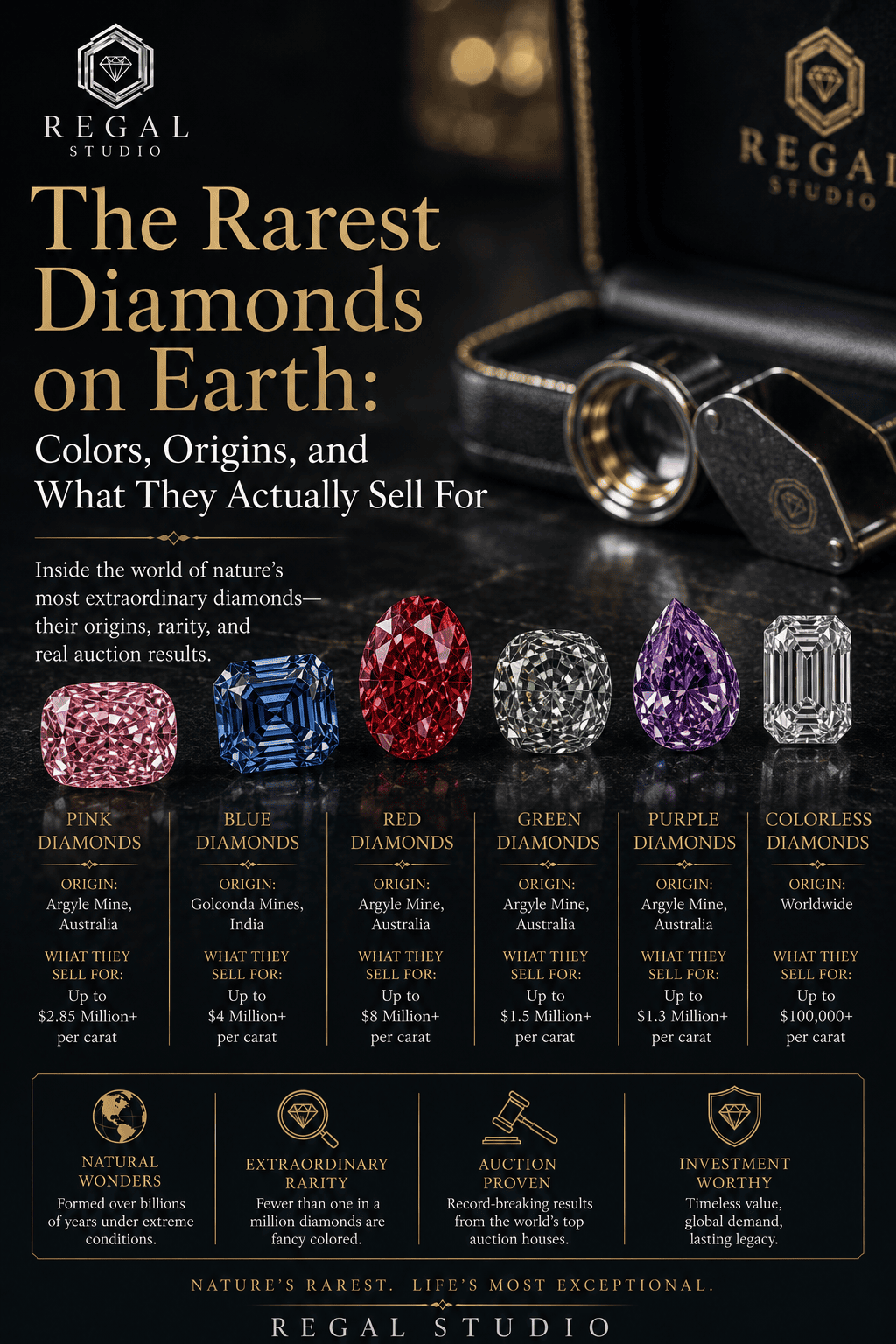


The Rarest Diamonds on Earth: Colors, Origins, and What They Actually Sell For
The rarest diamond on Earth is the red diamond—fewer than 20–30 are known to exist worldwide, and they sell for $1 million to $2.68 million per carat. Pink and blue follow, then green and pure orange. Only about 1 in 10,000 natural diamonds shows any color at all, and the record price for any diamond remains the Pink Star at $71.2 million. Color, not size, is what drives these stones into the stratosphere.
So here is the honest, expert breakdown of the rarest diamonds, where they come from, and what they truly fetch.
A Note on Where This Analysis Comes From
This guide comes from Regal Studio in Buckhead, Atlanta. Our founder, Mack, is a GIA Certified Diamond Grader with over 45 years of experience. We have handled, graded, and sourced fancy color diamonds throughout a long career, so what follows reflects real familiarity with how these stones are valued, not just auction headlines.
What Makes a Diamond Truly Rare
Rarity in colored diamonds comes down to one thing: how the color forms, and how rarely nature pulls it off.
Only about 0.1% of all mined diamonds are naturally colored. Within that sliver, some colors are far scarcer than others. The GIA grades them on a scale from Faint up to Fancy Vivid, and a single step up that intensity ladder can raise the price per carat by 50% or more. A Fancy Vivid stone is the holy grail.
A key insight often overlooked: with fancy color diamonds, the color matters more than the 4Cs you’d prioritize in a white diamond. A small stone with extraordinary color can outvalue a large one with weak color.
The Rarity Ranking: From Rarest to “Most Accessible”
1. Red Diamonds — The Rarest of All
Red is the undisputed king of rarity. Fewer than 20–30 notable red diamonds exist on the entire planet, and only a handful exceed 5 carats.
Their color does not come from a chemical impurity. It comes from a rare plastic deformation of the crystal lattice as the stone formed deep in the mantle.
- Origin: Australia (Argyle), Brazil, Africa
- Famous example: The Moussaieff Red, 5.11 carats
- Price: $1,000,000 to $2,680,000+ per carat
2. Pink Diamonds — Scarcer by the Year
Pink shares the same plastic-deformation origin as red. And the supply just got dramatically tighter.
The Argyle mine in Western Australia, which produced over 90% of the world’s pink diamonds, closed permanently in 2020. That closure pushed prices firmly upward.
- Origin: Australia (Argyle), India, Brazil, South Africa
- Famous example: The Pink Star, 59.60 carats, sold for $71.2 million in 2017 (the all-time record)
- Price: $100,000 to $700,000+ per carat for high-quality stones
3. Blue Diamonds — Rare and Regal
Blue diamonds get their color from trace boron and form astonishingly deep—sometimes hundreds of miles below the surface.
- Origin: South Africa (Cullinan mine), India, Australia
- Famous example: The Hope Diamond (45.52 ct, est. $250 million); the Oppenheimer Blue sold for $57.5 million
- Price: $200,000 to $3,000,000+ per carat at the top of the market
4. Green Diamonds — Color That Hides on the Surface
Green is one of the hardest colors to certify. The hue comes from millions of years of natural radiation, but it often lives only on the surface of the rough. Cut the stone, and the green can vanish.
- Origin: Africa, South America, India (Golconda)
- Famous example: The Dresden Green, 41 carats; the Aurora Green sold for $3.3M/carat in 2016
- Price: $50,000 to $3,000,000+ per carat depending on saturation
5. Orange Diamonds — The Quiet Rarity
Pure orange is genuinely rare, though collector demand sits below red, pink, and blue. The color comes from a specific nitrogen arrangement.
- Origin: South Africa, Australia
- Famous example: The Pumpkin Diamond, 5.54 carats, sold for ~$1.3 million
- Price: $400,000 to $700,000+ per carat for top-quality vivid stones

Famous Rare Diamonds At a Glance
Diamond | Color | Carats | Price / Record |
Pink Star | Vivid Pink | 59.60 | $71.2M (record, 2017) |
Oppenheimer Blue | Vivid Blue | 14.62 | $57.5M |
Moussaieff Red | Red | 5.11 | ~$8M (~$1.6M/ct) |
Aurora Green | Vivid Green | 5.03 | $16.8M ($3.3M/ct) |
Pumpkin Diamond | Vivid Orange | 5.54 | ~$1.3M |
Hope Diamond | Deep Blue | 45.52 | Est. $250M (not for sale) |
What Actually Drives the Price
In our market observations, four factors move a fancy color diamond’s value far more than buyers expect.
- Color intensity: The jump from Fancy to Fancy Vivid can double the per-carat price.
- Carat weight: Larger stones are exponentially rarer. A 3-carat vivid pink can cost 10–20× a 1-carat, not 3×.
- Cut and shape: Cushion and radiant cuts are favored because they deepen and preserve color.
- GIA certification: Without a GIA report confirming natural color origin, a stone is nearly impossible to sell at the top of the market.
A Buyer Warning: Natural vs Treated Color
Experience has shown this is where uninformed buyers lose money.
Not every vivid colored diamond formed that way. Lab treatments like irradiation or HPHT processing can mimic rare colors at a fraction of the cost.
These are legitimate products. But they are not naturally colored diamonds, and the price difference is enormous. A key insight often overlooked: always demand a GIA report stating the color is of natural origin before paying natural-color prices.
Frequently Asked Questions
What is the rarest diamond color on Earth?
Red. Fewer than 20–30 notable red diamonds exist worldwide, and they regularly sell for over $1 million per carat.
Which diamond holds the record for the highest price ever paid?
The Pink Star, a 59.60-carat vivid pink, sold for $71.2 million at auction in 2017—still the record for any diamond.
Why are pink diamonds getting more expensive?
The Argyle mine in Australia, source of over 90% of the world’s pink diamonds, closed permanently in 2020. With supply essentially fixed, prices have climbed.
What causes a diamond to be colored?
It varies by color: boron creates blue, nitrogen creates yellow and orange, natural radiation creates green, and a rare crystal-lattice distortion creates red and pink.
Are colored diamonds a good investment?
The rarest can appreciate, but they require expertise, GIA certification, and patience to resell. Treat them as collectibles, not guaranteed returns, and never buy without natural-origin certification.
See Rare and Fancy Color Diamonds in Atlanta
Fancy color diamonds reward expertise more than almost any purchase in jewelry. The difference between natural and treated color, or Fancy and Fancy Vivid, can mean a fortune.
At Regal Studio in Buckhead, every piece is designed and handcrafted by Mack, a GIA Certified Diamond Grader with over 45 years of experience. Whether you are collecting, investing, or designing something extraordinary, we will help you source and verify the right stone with complete transparency.
Our motto says it all: “You Dream It, We Make It.” Visit Regal Studio on Peachtree Road in Buckhead, or get in touch to book a consultation.
Read More:
Ancient Diamond Trade Routes: How India Dominated Early Diamond Supply