

CAD & 3D Rendering for Custom Fine Jewelry in Atlanta: See It Before It’s Made
Quick answer: CAD (computer-aided design) turns your idea into a photorealistic 3D model of your ring, pendant, or earrings. You review it from every angle and request changes before any gold is cast or any stone is set. For custom fine jewelry in Atlanta, it is the step that makes the process low-risk, because you approve the piece on screen before it becomes real.
So here is the complete guide to CAD and 3D rendering, from an Atlanta master jeweler.
A Note on Where This Guidance Comes From
This guide comes from Regal Studio in Buckhead, Atlanta. Our founder, Mack, began at the jeweler’s bench at just fourteen, trained across Europe, and is today a GIA Certified Diamond Grader with over 45 years of experience.
So this is not a generic explainer. It is how a master jeweler uses CAD to make sure the piece you approve is the piece you receive.
What Is CAD in Custom Fine Jewelry?
CAD is software that lets a designer build a piece of jewelry digitally, down to the prong thickness, the band profile, and how each stone sits. A rendering is the realistic image produced from that model, showing metal color, stone cut, and proportions.
This is where a loose idea, such as “a bold ring with a blue sapphire and an old European cut diamond,” becomes something you can actually judge.
Sketch vs. CAD Rendering: What’s the Difference?
A hand sketch captures mood and style. A CAD rendering captures accuracy. Both have a place in the process.
| Hand Sketch | CAD Rendering | |
|---|---|---|
| Best for | Exploring mood and style | Checking exact proportions |
| Scale accuracy | Approximate | Exact dimensions |
| Views | Usually one angle | Top, side, and angled |
| Metal and stone | Suggested | Realistic metal color and stone cut |
| When it’s used | First consultation | Before any material is cast |
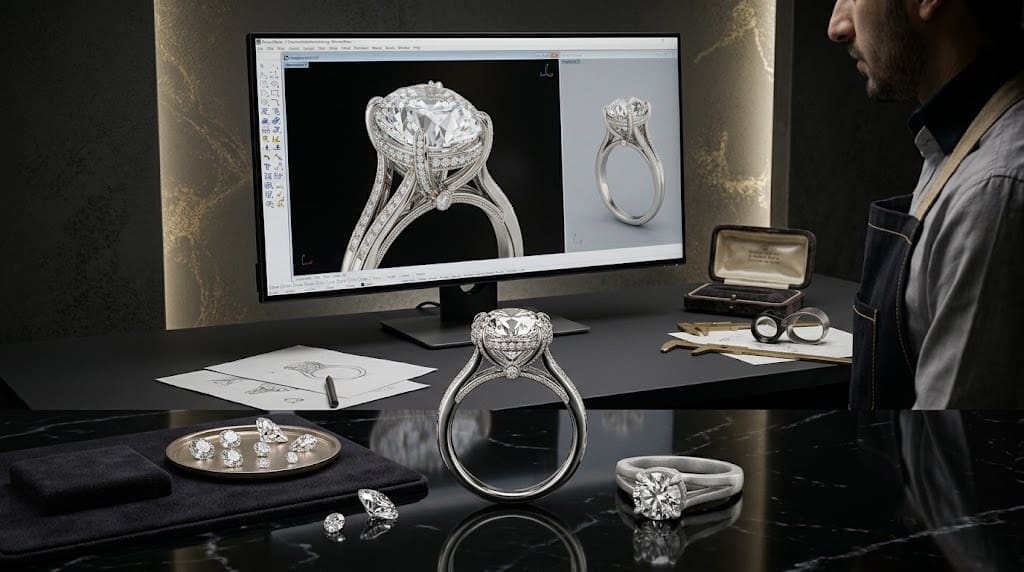
At Regal Studio, the process starts with a consultation, moves to sketches and a photorealistic 3D rendering, and only then to material selection and crafting.
What to Check in Your 3D Rendering
A good rendering is more than a pretty picture. When Mack walks you through it, these are the details worth reviewing:
- Proportions. How high the setting sits, how wide the band is, and how the center stone looks next to the side stones.
- Stone shape and size. An oval, an old European cut, and a round brilliant of the same carat weight look quite different on the finger. Still choosing? See our oval engagement rings guide.
- Setting style. A hidden halo, a bezel, or classic prongs change both the look and everyday wear. Our hidden halo guide explains one popular option.
- Band comfort and profile. Delicate, substantial, or tapered toward the shoulders.
- Metal color. Yellow gold, white gold, rose gold, or platinum can be compared side by side.
- Fit with other jewelry. How the ring sits beside a wedding band, or how a pendant hangs.
Why CAD Matters Most for Custom Design Jewelry
With ready-made jewelry, you can try the piece on. With custom design jewelry, the rendering is your try-on.
- Fewer surprises. Changes are easy on screen and expensive in metal.
- Clearer communication. Instead of describing what you want, you point at it.
- Confidence for gifts. If you are designing a piece for someone else, you can check the design with a trusted friend or family member before you commit.
- Design freedom. Layouts such as Toi et Moi or Art Deco geometry are easier to plan precisely.
From Rendering to Finished Piece
Once you approve the design, the process continues:
- Material selection. Together, we choose the metal, center stone, and accent stones from inventory, or source them to your specification. Unsure which center stone fits? Read our guide to lab-grown vs. natural diamonds for custom engagement rings.
- Crafting. Mack and our master jewelers cast, set, and polish the piece by hand in our Buckhead studio.
- Final review and delivery. Every piece is inspected to Mack’s standard before it leaves the studio.
Most custom pieces are finished in 4 to 8 weeks, depending on complexity. If you are starting from an inherited stone, see how turning a family heirloom into a custom engagement ring works, since the design usually begins by building around the existing stone.
How to Prepare for Your Design Consultation
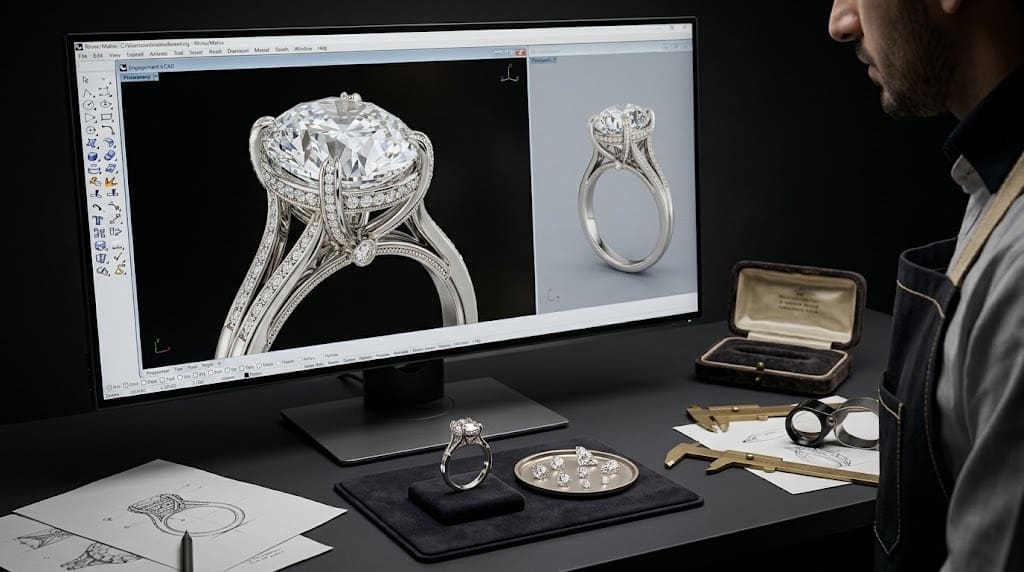
You do not need to be a designer. Bring:
- Inspiration photos, even if they are only partly right. “I like this setting but not this band” is useful.
- A rough budget. Mack will show you how metal, stones, and design complexity each affect cost.
- Details about the wearer: lifestyle, ring size, and the metals they usually wear.
- Any stones or old jewelry you would like to reuse.
- Your deadline, if there is one, so the timeline can be planned from the start.
Frequently Asked Questions
Do I see the design before it is made?
Yes. At Regal Studio you review a photorealistic 3D rendering and approve it before any material is cast.
Can I ask for changes after seeing the rendering?
That is exactly what the review stage is for. Discuss how revisions work for your piece during your consultation.
Is CAD only for engagement rings?
No. It works for rings, pendants, earrings, bracelets, and wedding bands.
Can the design be built around a stone I already own?
Yes. The design is planned around your stone’s size and shape, which is common for heirloom redesigns.
How much does custom fine jewelry cost in Atlanta?
It depends on your metal, your stones, and the complexity of the design, not on a fixed price. During the consultation, Mack shows you how each choice changes the cost so you can decide where to invest.
See Your Custom Fine Jewelry Before It Becomes Real
The best way to start is a conversation. Share your idea, and we will show you what it can look like.
At Regal Studio in Buckhead, every piece is designed with Mack, a GIA Certified Diamond Grader with over 45 years of experience. Our motto says it all: “You Dream It, We Make It.”
Book your free design consultation, or call/text (404) 643-8855.
Regal Studio, 3384 Peachtree Rd NE #120, Atlanta, GA 30326. Explore our custom fine jewelry design process.
Read More: