

Oval Engagement Rings: What to Know About Bow Tie, Ratio, and Setting
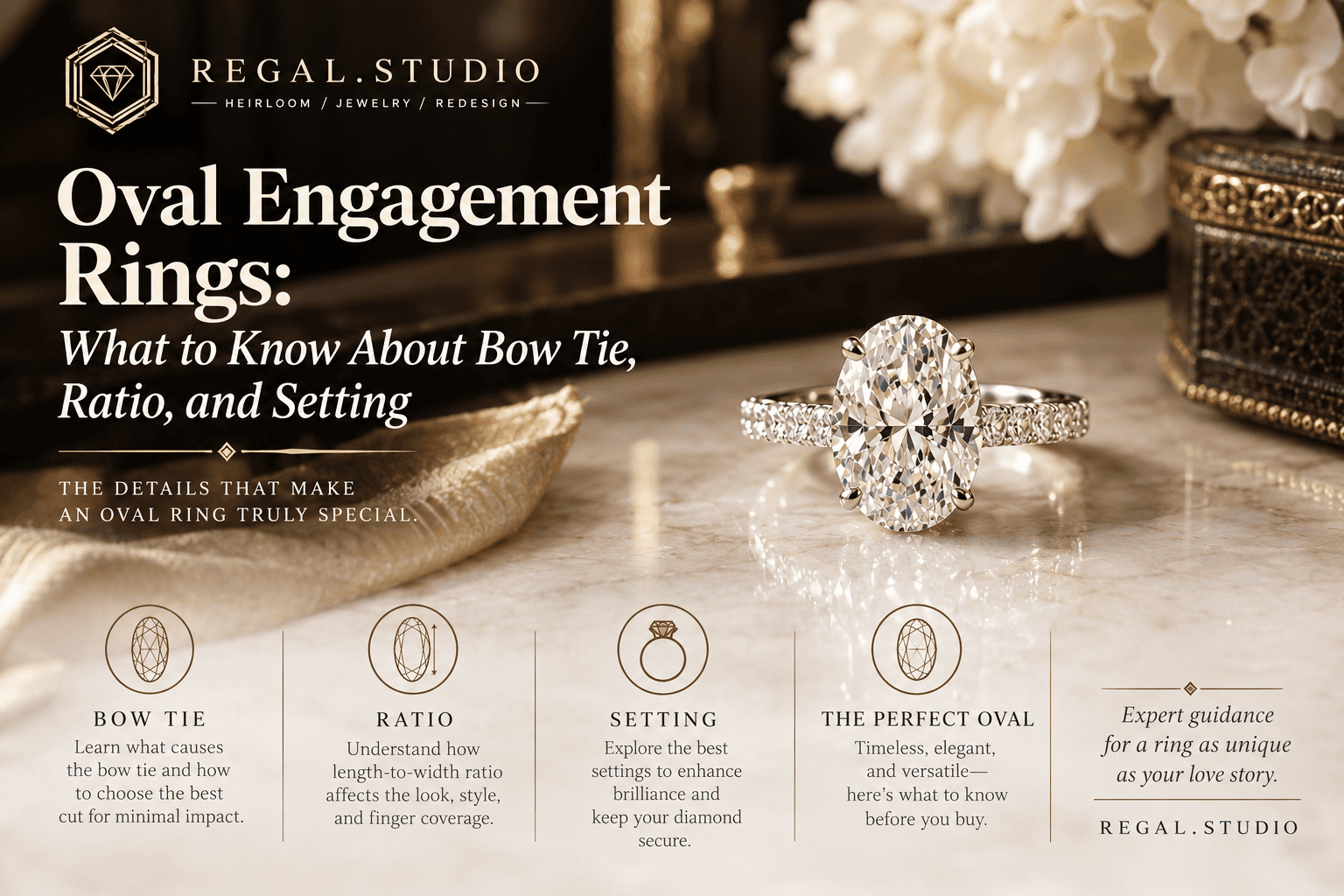
Quick answer: For an oval engagement ring, aim for a length-to-width ratio of 1.35 to 1.50 (around 1.44 is the sweet spot), choose a stone whose bow-tie shadow is faint rather than a fixed dark band, and set it in a four-prong, half-bezel, or east-west setting that protects the pointed ends. Ovals look 7 to 12% larger than a round of the same carat weight and elongate the finger beautifully, which is why they are one of 2026’s most popular shapes.
So here is everything to know before choosing an oval engagement ring, from an Atlanta master jeweler.
A Note on Where This Guidance Comes From
This guide comes from Regal Studio in Buckhead, Atlanta. Our founder, Mack, began at the jeweler’s bench at just fourteen, trained across Europe, and is today a GIA Certified Diamond Grader with over 45 years of experience.
For twenty years on Peachtree Road, we have hand-selected and set countless oval diamonds for custom engagement rings.
So this is not a generic shape overview. It is how a master jeweler actually evaluates an oval.
Why Ovals Are So Popular in 2026
Let us start with why everyone wants one. The oval has surged to the top of the shape rankings.
Ovals now account for roughly 23% of engagement rings purchased, second only to the round brilliant. Their appeal is practical as much as aesthetic.
An oval offers three real advantages:
- It looks bigger. An oval shows 7 to 12% more surface area face-up than a round of the same carat weight.
- It flatters the finger. Its length runs along the finger, making the hand look longer and more slender.
- It sparkles brilliantly. As a brilliant-cut shape, it has the fire and brilliance of a round, just stretched.
A key insight often overlooked: because the eye reads length as size, an oval punches above its carat weight. You get more visual impact per dollar than with a round.
The Length-to-Width Ratio: Getting the Shape Right
This is the single most important number when choosing an oval, and most buyers never hear about it.
The length-to-width ratio describes how elongated the stone is. It is calculated by dividing the length by the width.
Oval Length-to-Width Ratio Guide
Ratio | Appearance |
Below 1.35 | Stubby, reads almost like a soft round |
1.35 – 1.50 | The ideal range, classic balanced oval |
~1.44 | The popular “sweet spot” |
Above 1.55 | Noticeably elongated, more prone to bow-tie |
A key insight often overlooked: the ratio is personal preference within that range. A 1.35 oval looks fuller and rounder; a 1.50 looks longer and more dramatic. There is no wrong choice, but outside 1.35 to 1.55, most people find the shape looks off.
The Bow-Tie Effect: What It Is and How to Judge It
Here is the one thing every oval buyer must understand. It is the most common oval mistake.
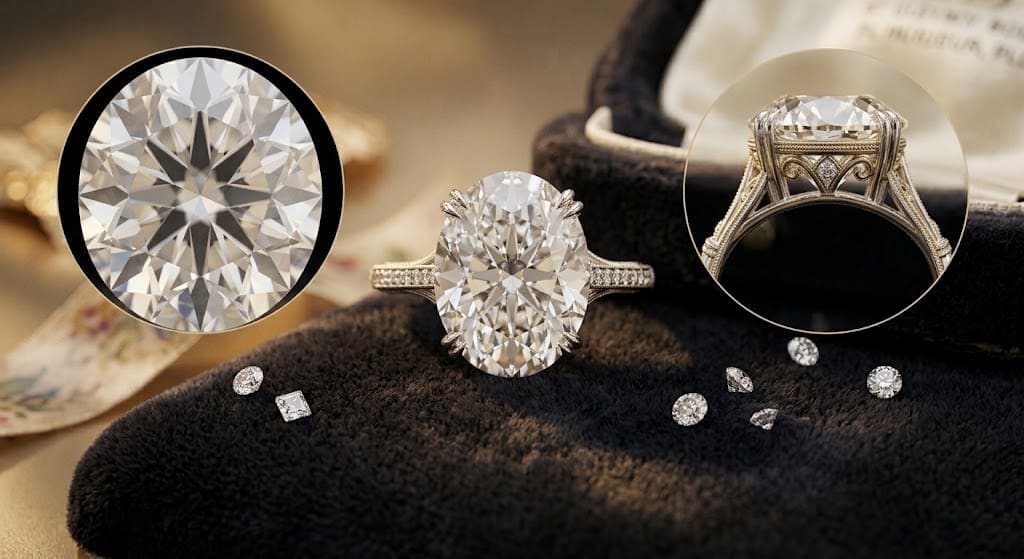
The bow-tie effect is a shadow that stretches across the center of the stone, shaped like a bow tie. It happens because your own head blocks light from reflecting off the pavilion facets as you look down at the diamond.
Every oval has some degree of bow tie. The question is how much.
- In a well-cut stone, the shadow is faint and flickers, appearing and disappearing as the hand moves.
- In a poorly cut stone, it is a fixed, dark band that never goes away.
Experience has shown this is the single biggest difference between a stunning oval and a disappointing one. And here is the catch: a grading report does not measure the bow tie.
A key insight often overlooked: because certificates do not capture it, you must see the actual stone, ideally in a video or in person, before buying. Two ovals with identical specs can look completely different.

How to Minimize the Bow Tie
Good news: you can steer toward a softer bow tie with a few proportions.
In our market observations, these guidelines help:
- Depth under 65%. Overly deep stones cast stronger shadows.
- Table around 55 to 62%. Balanced proportions distribute light more evenly.
- Stay within the ideal ratio. Ovals above 1.50 are more prone to a pronounced bow tie.
- Choose an excellent cut. Precision in the pavilion facets is what tames the shadow.
As a GIA Certified Diamond Grader, Mack evaluates each oval for its bow tie by eye, not just by certificate, which is exactly the step that protects you.
Best Settings for an Oval Engagement Ring
The setting does more than hold the stone. For an oval, it protects the vulnerable ends and shapes the whole look.
Oval-Friendly Setting Styles
Setting | Why It Works for Ovals |
Four-prong solitaire | Shows the full outline, prongs sit at the shoulders |
Cathedral / tulip | Elegant, lifts and secures the stone |
Halo | Adds sparkle and makes the oval look even larger |
Half-bezel | Protects the pointed ends while showing the long sides |
East-west | Sets the oval horizontally for a modern, low-profile look |
Three-stone | Flatters the oval with complementary side stones |
A key insight often overlooked: the pointed ends (the tips) of an oval are its most vulnerable spots. A good setting shields them, which is why four-prong and half-bezel designs are so popular for active wearers.
A Note on Color and the Oval
One quirk of elongated shapes is worth knowing before you buy.
Ovals, like other elongated brilliant cuts, can show color more readily at the ends than a round does. A faint tint may concentrate in the tips.
Experience has shown that choosing G-H color usually keeps an oval looking white and bright, while spending up to colorless D-F is rarely necessary once the stone is set. It is a smart place to let your budget breathe.
Oval Pricing in 2026
A quick word on value, since it is part of the oval’s appeal.
Ovals typically cost slightly more than a round brilliant of the same specs, but less than rarer shapes like marquise. However, because they look larger, you can often choose a slightly lower carat weight and still get the presence you want.
With lab-grown options, an oval has never been more accessible, letting you maximize size and setting quality within your budget. We can walk you through the full cost picture during a consultation.
Frequently Asked Questions
What is the best length-to-width ratio for an oval engagement ring?
The ideal range is 1.35 to 1.50, with about 1.44 being the most popular sweet spot. Below 1.35 an oval looks stubby and round; above 1.55 it looks very elongated and shows the bow-tie effect more. Within the range, it is personal preference.
What is the bow-tie effect in oval diamonds?
It is a shadow across the center of the stone, shaped like a bow tie, caused by your head blocking light from the pavilion facets. Every oval has some. In a well-cut stone it is faint and flickers; in a poorly cut one it is a fixed dark band. Grading reports do not measure it, so you must see the stone.
What is the best setting for an oval engagement ring?
Four-prong solitaire, cathedral, halo, half-bezel, east-west, and three-stone settings all suit ovals well. The key is protecting the vulnerable pointed ends, which four-prong and half-bezel settings do especially well.
Do oval diamonds look bigger than round diamonds?
Yes. An oval shows 7 to 12% more surface area face-up than a round of the same carat weight, and its length along the finger makes it read as larger. This is a major reason for its popularity.
Are oval engagement rings more expensive than round?
Ovals typically cost slightly more than rounds of the same specs but less than marquise cuts. Because they look larger, you can often choose a slightly smaller carat and still get strong presence, which helps balance the cost.
Design Your Oval Engagement Ring in Atlanta
The right oval comes down to the details, a flattering ratio, a faint bow tie, and a setting that protects and elevates the stone. Getting them right takes an expert who evaluates each diamond by eye.
At Regal Studio in Buckhead, every oval is hand-selected by Mack, a GIA Certified Diamond Grader with over 45 years of experience and the trust of more than 278 five-star clients. We check each stone’s bow tie and proportions in person, then design a setting that makes it shine, with complete transparency.
Our motto says it all: “You Dream It, We Make It.”
Visit Regal Studio on Peachtree Road in Buckhead, or get in touch to book your consultation. Let a seasoned master jeweler help you find the perfect oval.
Read More:
Old European Cut Diamonds: What They Are and Why Collectors Love Them
Art Deco Engagement Rings: History, Features, and Modern Designs