
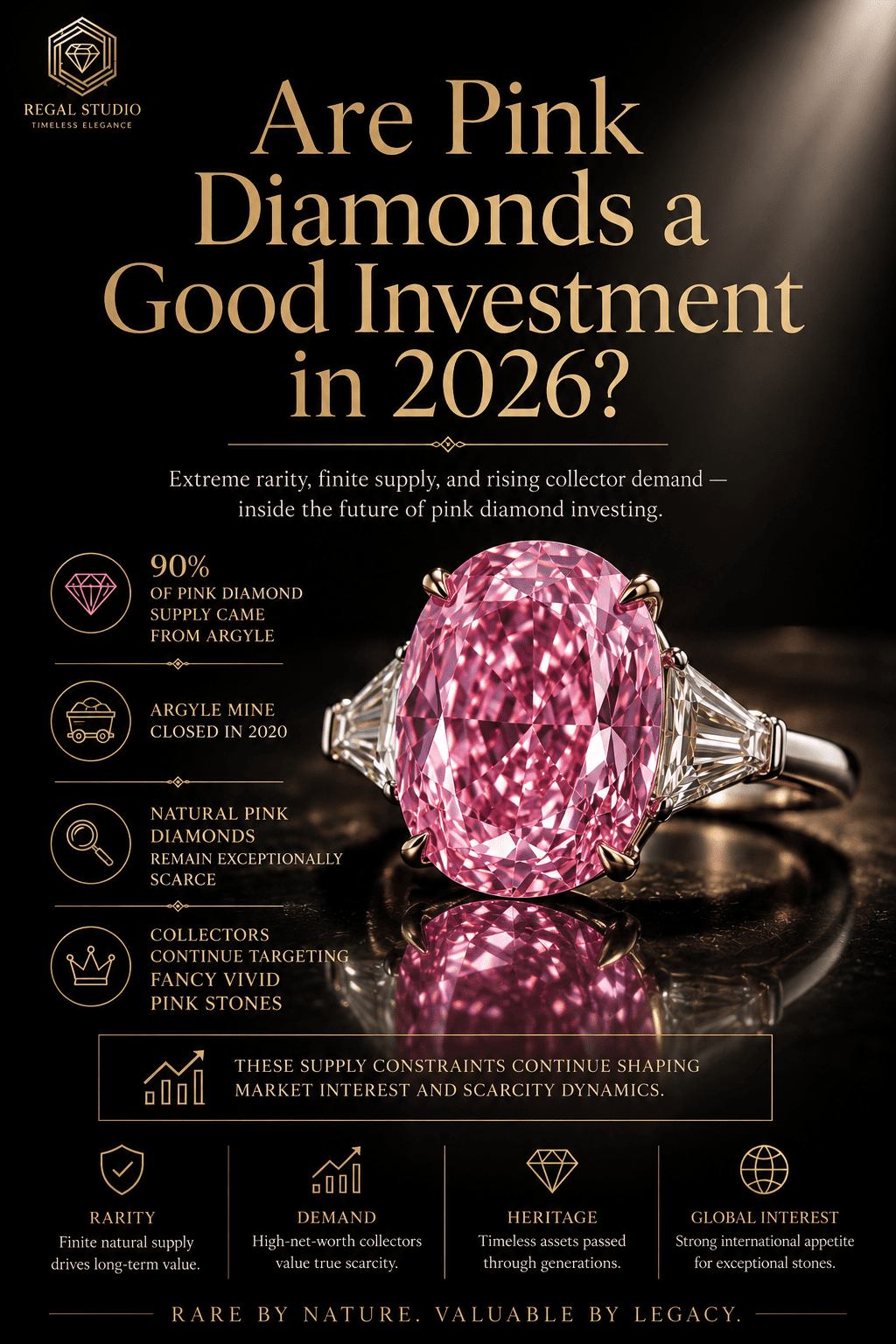


Are Pink Diamonds a Good Investment in 2026?
The short answer to are pink diamonds a good investment in 2026 is yes for most well-documented natural pink diamonds, particularly those with verified Argyle origin. Top-grade pink diamonds have appreciated approximately 500% over the past 20 years, with annual appreciation accelerating to 18-30% since the Argyle mine’s permanent closure in November 2020. Fancy Vivid Pink stones have outperformed gold, the S&P 500, fine art, and classic cars over the same period. However, pink diamonds are not a beginner-friendly investment; they require GIA documentation, ideally Argyle provenance papers, long holding periods, and expert guidance to deliver the projected returns.
In our market observations across more than four decades of diamond grading and the high-end colored stone market, pink diamonds are the single most consistently appreciating asset class in the entire fine diamond category. Experience has shown that the closure of the Argyle mine in 2020 has fundamentally restructured pink diamond economics in ways that will continue to drive prices upward for the foreseeable future.
Are Pink Diamonds a Good Investment at a Glance
Before diving into the full analysis, here is the practical 2026 snapshot every investor should know.
Factor | 2026 Data |
20-year appreciation | Approximately 500% for top-grade pink diamonds |
Annual appreciation (5-year avg) | 18% per year (Fancy Color Research Foundation) |
Post-Argyle annual appreciation | 20-30% per year for premium grades |
Top per-carat record | $5.18 million (Williamson Pink Star, 2022) |
Argyle mine status | Permanently closed November 2020 |
Global pink supply lost | 90% of world’s pink diamond production |
Best investment grade | Fancy Vivid Pink and Fancy Intense Pink |
Recommended minimum carat | 0.50 carat for serious investment positions |
Typical holding period | 5-15 years for meaningful appreciation |
Liquidity timeline | 3-12 months through specialty channels |
Documentation requirement | GIA + ideally Argyle provenance certificate |
Best for | Long-term wealth preservation, portfolio diversification |
A key insight often overlooked: the 2020 Argyle mine closure is the single most important supply event in colored diamond history. It permanently capped global pink diamond supply in a way that no future mine discovery can replicate within any meaningful investment timeframe.
Why Pink Diamonds Have Become a Serious Investment Asset
Pink diamonds are no longer just luxury jewelry. Over the past two decades, they have evolved into a recognized alternative investment class held by ultra-high-net-worth individuals, family offices, and private wealth funds.
Five reasons pink diamonds work as investments:
- Permanent supply scarcity following Argyle’s 2020 closure
- Documented appreciation outpacing major equity benchmarks
- Non-correlation with traditional financial markets
- Tangible physical asset with no counterparty risk
- Generational transferability with negligible storage costs
Experience has shown that the most successful pink diamond investors approach the asset like fine art or rare wine: long holding periods, proper authentication, and acceptance that liquidity takes time to convert into cash.
The Argyle Mine Closure: The Supply Event That Changed Everything
To understand pink diamonds as an investment in 2026, you have to understand what happened in November 2020.
What the Argyle Mine Was
The Argyle Diamond Mine, located in the remote East Kimberley region of Western Australia, operated for nearly four decades after its 1979 discovery. During its lifetime, the mine:
- Produced approximately 865 million carats of rough diamonds
- Supplied over 90% of the world’s natural pink diamonds
- Hosted the legendary annual Argyle Pink Diamonds Tender (since 1984)
- Released roughly 50 carats of pink diamonds per year at peak production
Why the Closure Was Permanent
In November 2020, Rio Tinto ended Argyle operations because the geological reserves were exhausted. This is not a temporary suspension. The mine is permanently decommissioned, with site rehabilitation expected to complete in 2026.
Three reasons the closure cannot be reversed:
- The geological deposit itself is finished
- Site infrastructure has been decommissioned and rehabilitated
- No comparable pink diamond deposit exists anywhere else on Earth
A key insight often overlooked: even if a new pink diamond mine were discovered tomorrow, it would take 10-15 years minimum to reach production. Argyle’s supply gap is permanent in any practical investment timeframe.
The Supply Vacuum That Followed
After November 2020, pink diamond supply dynamics shifted dramatically:
- Other mines now contribute less than 5% of global pink and red diamond supply
- No new substantial source has emerged
- Existing inventory in dealer hands becomes more valuable each year
- Authenticated Argyle-origin stones command premium “provenance pricing”
In our market observations, the Argyle closure created what economists call “terminal scarcity,” supply that can only decrease over time, never expand.

Pink Diamond Appreciation Data: The Numbers Investors Should Know
The investment case for pink diamonds rests on documented price appreciation across multiple measurement periods.
Long-Term Appreciation (2000-2025)
Top-grade pink diamonds have appreciated approximately 500% over the past 20 years, according to Fancy Color Research Foundation data and major auction house records. This translates to roughly 9-10% annual compound appreciation across the long-term period.
Five-Year Appreciation (2020-2025)
Following the Argyle closure, appreciation has accelerated significantly:
- Fancy Pink: approximately 23% in the year following closure
- Fancy Intense Pink: approximately 29% in the same period
- Fancy Vivid Pink: approximately 39% in the same period
- Continued 20-30% annual appreciation in subsequent years
15-Year Appreciation (2010-2025)
Cumulative appreciation across a full 15-year window:
- Fancy Pink: 310% gains
- Fancy Intense Pink: 380% gains
- Fancy Vivid Pink: 413% gains
Comparison Against Other Asset Classes
Asset Class | 5-Year Annual Appreciation |
Fancy Vivid Pink Diamonds | 18-30% |
Fine Art | 10% |
Classic Cars | 8% |
Gold | 7-12% |
S&P 500 | 10-12% |
Real Estate (US) | 5-8% |
In our market observations, pink diamonds have outperformed every traditional alternative investment category over the past five years, though with the important caveat that pink diamonds also carry meaningful liquidity friction that traditional assets do not.
Pink Diamond Auction Records That Set Investment Benchmarks
Auction prices set the floor for private market valuations. Here are the records that shape current pink diamond economics.
Diamond | Carats | Year | Total Price | Per Carat |
Pink Star (CTF Pink) | 59.60 | 2017 | $71.2M | $1.19M |
Williamson Pink Star | 11.15 | 2022 | $57.7M | $5.18M |
Winston Pink Legacy | 18.96 | 2018 | $50.7M | $2.67M |
Graff Pink | 24.78 | 2010 | $46.2M | $1.86M |
Princie Diamond | 34.65 | 2013 | $39.3M | $1.13M |
Pink Promise | 14.93 | 2017 | $32.5M | $2.18M |
Sweet Josephine | 16.08 | 2015 | $28.5M | $1.77M |
The Williamson Pink Star’s 2022 sale at $5.18 million per carat established a new world record per-carat price for any diamond of any color. This benchmark has set the trajectory for serious pink diamond pricing through 2026.
Which Pink Diamonds Make the Best Investments
Not every pink diamond is a good investment. The category includes wide quality variations that dramatically affect appreciation potential.
The Investment-Grade Hierarchy
Tier 1: Investment-grade pinks
- Fancy Vivid Pink (any size, ideally 0.50 carat or larger)
- Fancy Intense Pink (0.75 carat or larger)
- Argyle-certified provenance stones
- GIA-graded with all 4Cs documented
Tier 2: Quality pinks with growth potential
- Fancy Pink (1 carat or larger)
- Fancy Light Pink with strong color saturation
- Modern non-Argyle pinks with verified origin
- GIA-graded natural color origin
Tier 3: Decorative pinks (limited investment value)
- Faint Pink to Light Pink range
- Treated or color-enhanced pinks
- Stones without GIA documentation
- Stones with significant clarity issues
What Color Modifiers Do to Investment Value
Pink diamond color modifiers significantly affect both current price and appreciation potential:
- Pure pink: most valuable, strongest appreciation
- Purplish pink: very valuable, strong appreciation
- Orangey pink: less valuable, moderate appreciation
- Brownish pink: least valuable, slowest appreciation
A key insight often overlooked: a 1-carat pure Fancy Vivid Pink can outperform a 2-carat brownish Fancy Intense Pink in long-term appreciation. Color quality matters more than carat for investment-grade pink diamonds.
The Argyle Provenance Premium
Authenticated Argyle-origin stones command premium pricing above non-Argyle pinks of similar grade.
What an Argyle certificate provides:
- Verified origin from the now-closed Western Australia mine
- Unique tender number documenting the stone’s history
- Color pedigree confirmation
- Provenance traceability for resale and insurance
- Premium positioning in collector and auction markets
In our market observations, Argyle-certified stones typically command 20-50% premiums over comparable non-Argyle pinks. This premium has grown since the 2020 closure and is expected to continue widening as Argyle inventory becomes increasingly scarce.
How to Buy Pink Diamonds for Investment in 2026
Successful pink diamond investing requires a structured approach. Here is the practical process serious investors follow.
Step 1: Define Your Investment Profile
Before buying, clarify your goals:
- Capital preservation: focus on Fancy Vivid Pink in the 0.50-1.50 carat range
- Long-term growth: focus on Fancy Intense and Fancy Vivid Pink with Argyle provenance
- Portfolio diversification: smaller allocation across multiple intensity grades
- Generational transfer: focus on rare large stones with documented provenance
Step 2: Establish Authentication Standards
For any pink diamond investment, require:
- Current GIA grading report (must state “Natural” color origin)
- Type designation (most pinks are Type Ia or Type IIa)
- Argyle certificate when applicable (significantly increases value)
- Independent appraisal if buying from non-specialist dealer
Step 3: Work With Specialist Dealers
Pink diamonds trade in specialized markets, not traditional retail jewelry channels. Successful investors typically work with:
- GIA Certified Diamond Graders with colored diamond expertise
- Established colored diamond dealers with auction relationships
- Master jewelers who personally evaluate every stone in their inventory
- Specialty insurers who understand colored diamond valuations
Step 4: Plan for Liquidity Timeline
Pink diamond liquidity is dramatically slower than traditional investments:
- Sotheby’s, Christie’s, Phillips auctions: 3-12 months from consignment to sale
- Specialist dealer purchase: 30-90 days for fair-market offers
- Private collector sales: highly variable, often 6-24 months
- Plan to hold for 5-15 years minimum for full appreciation realization
A key insight often overlooked: pink diamond investors should never need to sell quickly. Forced sales rarely achieve full market value.

The Risks Every Pink Diamond Investor Should Understand
Pink diamonds are not risk-free investments. Five risks deserve serious consideration.
Five risks of pink diamond investing:
- Liquidity friction: cash conversion takes months, sometimes longer
- Authentication risk: treated or misrepresented stones lose 80-90% of value
- Storage and insurance costs: ongoing carrying costs reduce net returns
- Market timing: appreciation is non-linear, with multi-year flat periods
- Concentration risk: single-stone investments lack diversification
Experience has shown that the investors who succeed in pink diamonds are the ones who understand they are buying art-like assets, not stock-like assets. The mental model matters as much as the stone itself.
Comparison Table: Pink Diamond Investment vs Traditional Assets
Factor | Pink Diamonds | Stocks (S&P) | Gold | Real Estate |
Annual appreciation (5-yr) | 18-30% | 10-12% | 7-12% | 5-8% |
Liquidity timeline | 3-12 months | Same day | 1-3 days | 3-6 months |
Storage cost | Negligible | None | Low | High (taxes, maintenance) |
Counterparty risk | None | Moderate | None | Low |
Inflation hedge | Excellent | Moderate | Excellent | Excellent |
Generational transfer | Easy | Easy | Moderate | Complex |
Income generation | None | Dividends possible | None | Rental income possible |
Volatility | Low | High | Moderate | Low |
Minimum entry point | $50K-$250K | $10 | $50 | $100K+ |
In our market observations, pink diamonds belong in a balanced portfolio as a wealth preservation and inflation hedge component, not as a primary growth asset. They complement rather than replace traditional investments.
Common Pink Diamond Investment Mistakes
In our market observations across thousands of colored diamond transactions, the same mistakes repeat across new pink diamond investors.
- Buying without GIA documentation for stones over $10,000
- Skipping Argyle provenance verification when applicable
- Confusing treated pink diamonds with natural color (10-20x value difference)
- Choosing carat over color quality in investment-grade pinks
- Buying online without independent authentication
- Underestimating liquidity timelines when cash needs arise
- Storing valuable stones without proper insurance riders
- Selling too quickly during market consolidation periods
Expert Analysis: Five Truths About Pink Diamonds as Investments in 2026
In our market observations across more than four decades of colored diamond expertise, five patterns separate successful pink diamond investors from disappointed ones.
Five insights from the bench:
- The Argyle closure permanently changed the math. Pink diamonds are no longer a “scarce” investment. They are a “terminally scarce” investment. That distinction is the foundation of every modern pink diamond investment thesis.
- Color quality outperforms carat weight for investment returns. A Fancy Vivid Pink at 1 carat consistently outperforms a Fancy Pink at 3 carats over 10-year holding periods. Always prioritize intensity grade over size.
- Argyle provenance is becoming the single most important value modifier. Experience has shown that authenticated Argyle stones now command 20-50% premiums over non-Argyle equivalents, with the gap widening each year as supply contracts.
- Liquidity friction is real and underappreciated. Pink diamonds are not stocks. Selling takes months, often longer. Investors who need quick cash should not buy pink diamonds. Investors planning 5-15 year holds find them genuinely rewarding.
- A trusted jeweler relationship is the single most valuable asset for pink diamond investors. The technical complexity of fancy color grading, authentication risks, and per-carat market dynamics demand expertise no individual investor can match alone.
How GIA Experts Authenticate Investment-Grade Pink Diamonds
Beyond standard diamond authentication, professional pink diamond evaluation includes:
- Color origin determination: natural vs. treated (5-10x value difference)
- Color modifier analysis: pure pink vs. orangish vs. brownish
- Intensity grade verification: Faint through Fancy Vivid
- Type designation: Type Ia vs. Type IIa chemistry
- Argyle origin verification: tender numbers, certificate authenticity
- Spectroscopic analysis: confirms natural color origin
- UV fluorescence testing: identifies treatment indicators
- Provenance documentation: prior appraisals, auction records, custom paperwork
Buyers can learn the basics. Mastering investment-grade pink diamond authentication takes years of dedicated study. That is why a relationship with a GIA Certified Diamond Grader is essential for any serious pink diamond investment.
Frequently Asked Questions About Pink Diamonds as Investments
Are pink diamonds a good investment in 2026?
Yes, for well-documented natural pink diamonds with proper authentication. Top-grade pink diamonds have appreciated approximately 500% over the past 20 years, with annual appreciation of 18-30% since the Argyle mine closure in November 2020. Pink diamonds work best as long-term holds (5-15 years) for portfolio diversification and inflation protection rather than short-term gains.How much do pink diamonds appreciate per year?
According to the Fancy Color Research Foundation, fancy pink diamonds have appreciated by an average of 18% annually over the past five years. Since the Argyle mine closure, premium grades (Fancy Intense and Fancy Vivid Pink) have appreciated 20-30% per year. This compares favorably to approximately 10% for fine art, 8% for classic cars, and 7-12% for gold over the same period.Why are pink diamonds so valuable?
Pink diamonds are extremely rare in nature, with the now-closed Argyle mine in Western Australia historically producing approximately 90% of the world’s pink diamond supply. The mine’s permanent closure in November 2020 has fundamentally restructured pink diamond economics. Combined with growing global demand from ultra-high-net-worth collectors, this scarcity has driven sustained price appreciation that outperforms most major equity benchmarks.What is the minimum budget for investing in pink diamonds?
Serious pink diamond investment positions typically start at $50,000 to $250,000 for a 0.50 carat Fancy Vivid Pink with proper documentation. Smaller pinks (0.25 carat range) can be acquired for $15,000-$50,000 but have less investment-grade liquidity. For meaningful portfolio impact, investors typically allocate $250,000 or more across one or two stones with strong provenance.How do I sell a pink diamond when I want to liquidate?
Pink diamond liquidity follows a slower timeline than traditional investments. Major auction houses (Sotheby’s, Christie’s, Phillips) typically take 3-12 months from consignment to sale. Specialist dealers can purchase immediately but may offer below auction-realized prices. Private collector networks offer the strongest pricing but the slowest timelines (6-24 months). Investors should plan to hold pink diamonds for 5-15 years minimum to realize full appreciation.
Key Takeaways: Are Pink Diamonds a Good Investment in 2026?
- Pink diamonds have appreciated approximately 500% over the past 20 years
- Annual appreciation of 18-30% since the November 2020 Argyle mine closure
- Argyle’s closure permanently capped 90% of global pink diamond supply
- Fancy Vivid Pink and Fancy Intense Pink offer the strongest investment returns
- Argyle-certified provenance commands 20-50% premiums over non-Argyle stones
- Liquidity timelines run 3-12 months minimum, longer for premium pricing
- Authentication via GIA documentation is non-negotiable for any serious purchase
Final Thoughts: Why the Right Jeweler Determines Pink Diamond Investment Success
Pink diamonds are arguably the most rewarding alternative investment available to private investors in 2026. They are also the most expert-dependent. The combination of authentication complexity, treatment risks, Argyle provenance verification, and the fundamental shift caused by the 2020 mine closure makes pink diamond investing dramatically different from any other asset class.
You can read every guide on pink diamonds ever published, and the single most important decision will still be the expert you work with. A GIA Certified Diamond Grader who personally evaluates fancy color diamonds, knows the difference between natural and treated, and understands current per-carat market dynamics is the person who turns pink diamond investing from a gamble into a guided wealth-building strategy.
That is what Mack has built at Regal Studio in Buckhead, Atlanta over more than four decades. As a GIA Certified Diamond Grader with 45+ years of experience, Mack personally evaluates every diamond that enters the studio, including investment-grade fancy color stones for clients building serious colored diamond portfolios. He has guided everyday couples, celebrities, and professional athletes through every kind of diamond purchase, applying the same rigor to a $5,000 engagement ring that institutional investors apply to multi-million-dollar pink diamond positions.
At Regal Studio, every piece carries Mack’s personal signature mark. Every diamond is selected for color, clarity, cut, and craftsmanship. Every client receives the same honest guidance about what makes a diamond truly exceptional, including ethical sourcing, color authentication, treatment disclosure, Argyle provenance verification when applicable, and the difference between a stone that holds value and a stone that simply costs money.
Ready to explore pink diamonds as a serious investment?
Visit Regal Studio on Peachtree Road in Buckhead, Atlanta, or get in touch to schedule your private consultation with Mack. Whether you are sourcing your first investment-grade pink, evaluating an Argyle-certified stone for your portfolio, or building a generational colored diamond collection, you work directly with a master jeweler who understands what makes pink diamonds the most consistently appreciating asset class in the entire fine diamond market.
You may not own the Pink Star. But you can own something built with the same standards.
Mack’s motto says it all: “You Dream It, We Make It.”
Read More:
Red vs Pink vs Blue Diamonds: Which Is the Rarest and Most Valuable?
How Many Red Diamonds Are Left in the World? The Complete 2026 Count