



The Sancy Diamond: How One Stone Survived Centuries of War and Revolution
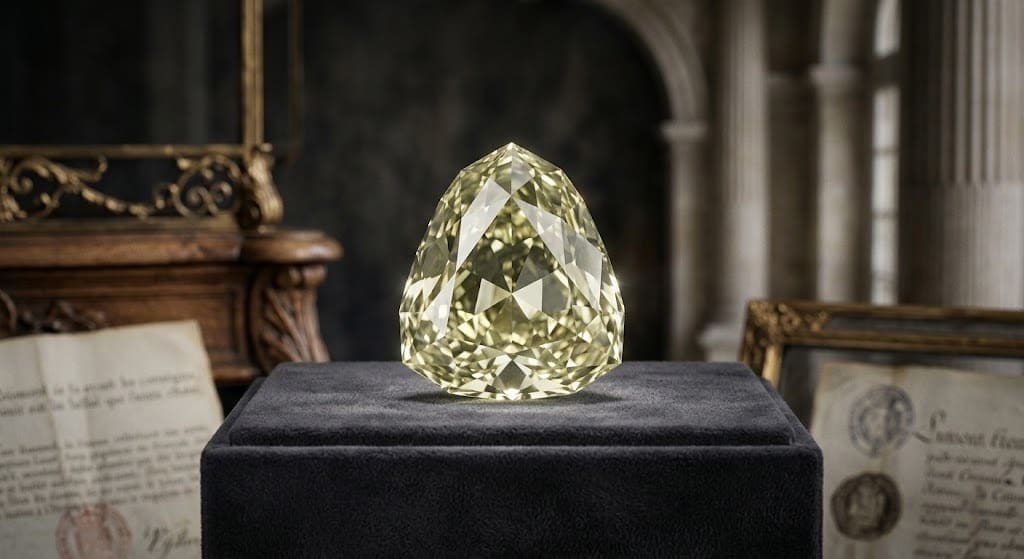
Quick answer: The Sancy Diamond is a 55.23-carat pale-yellow, shield-shaped diamond of Indian origin, one of the great survivors of history. Over more than 600 years it was lost on a battlefield by Charles the Bold, owned by English and French kings, hidden inside a murdered servant’s body, stolen during the French Revolution, and passed through the Astor family before reaching the Louvre in 1978, where it remains. Few gems have survived so much upheaval intact.
So here is the remarkable survival story of the Sancy, from an Atlanta master jeweler’s view of why it endures.
A Note on Where This Analysis Comes From
This guide comes from Regal Studio in Buckhead, Atlanta. Our founder, Mack, began at the jeweler’s bench at just fourteen, trained across Europe, and is today a GIA Certified Diamond Grader with over 45 years of experience.
We have spent a career studying the great historic stones. Few can match the Sancy for sheer endurance.
So this is not a recycled encyclopedia entry. It is an expert’s look at how one diamond outlasted empires.
The Sancy Diamond at a Glance
Let us start with the facts, since the stone itself is as unusual as its history.
Feature | Detail |
Weight | 55.23 carats |
Color | Pale yellow, faint yellow-green at the rim |
Cut | Shield-shaped, faceted on both sides (~68 facets) |
Origin | Golconda region, India |
Current home | Galerie d’Apollon, Louvre, Paris |
Acquired by Louvre | 1978, for about $1 million |
A key insight often overlooked: the Sancy is double-faceted with no pavilion, cut brilliantly on both the top and bottom. This unusual construction, rare for its era, is one reason experts believe it was cut in India, and it makes the stone almost glow.
An Origin Lost to Time
The Sancy’s beginnings are shrouded in mystery, fitting for a stone that would spend centuries vanishing and reappearing.
It was mined in the legendary Golconda region of India, likely in the 14th century. Its unusual cut points to Indian craftsmanship long before it reached Europe.
By tradition, the stone may have entered Europe as early as 1389, possibly through Valentina Visconti’s dowry, though this is uncertain.
A key insight often overlooked: the Sancy’s early history is a patchwork of legend. What is certain is that by the 1400s, it had reached the courts of Europe, where its survival story truly begins.
Lost on a Battlefield: Charles the Bold
The first great chapter is one of war, and the stone’s first brush with loss.
Charles the Bold, Duke of Burgundy, wore the diamond as a talisman. The Dukes of Burgundy believed it made them invincible in battle and carried it into war for luck.
That belief failed him. At the Battle of Grandson in 1476, and again decisively at the Battle of Nancy in 1477, Charles was defeated and killed.
Experience has shown that legends attach to great stones. The diamond was reportedly looted from the battlefield, said to have been picked up by a Swiss soldier who sold it for a single florin, unaware of its worth.
The Diamond in a Servant’s Body
Here is the Sancy’s most extraordinary survival tale, and it is genuinely part of the historical record.
The stone eventually came to Nicolas de Harlay, Seigneur de Sancy, a French diplomat and financier, who gave the diamond its lasting name.
According to the famous account, de Sancy sent the diamond by messenger. The messenger never arrived. De Sancy, certain the man was loyal, had the body searched, and the diamond was found inside the servant’s stomach, swallowed to protect it from thieves who had murdered him.
A key insight often overlooked: whether embellished or true, this story captures the Sancy’s defining theme. Again and again, the stone survived by the loyalty, cunning, or luck of those who guarded it.
Passing Through the Crowns of Europe
The Sancy’s middle chapters read like a map of European power. It served king after king.
Its documented owners are a roll call of history:
- Henry III of France wore it in his cap.
- Henry IV of France pledged it as collateral to fund his army.
- King James I of England bought it in 1605 and set it in the Mirror of Great Britain.
- Charles I and James II of England held it during the turmoil of civil war.
- Cardinal Mazarin acquired it, then bequeathed it to the French Crown in 1661.
Experience has shown that great diamonds often served as more than ornaments. The Sancy was repeatedly used as collateral and treasure, funding armies and royal ambitions across two nations.
Revolution: Stolen and Vanished Again
Then came the upheaval that claimed so many crown jewels. The Sancy nearly disappeared for good.
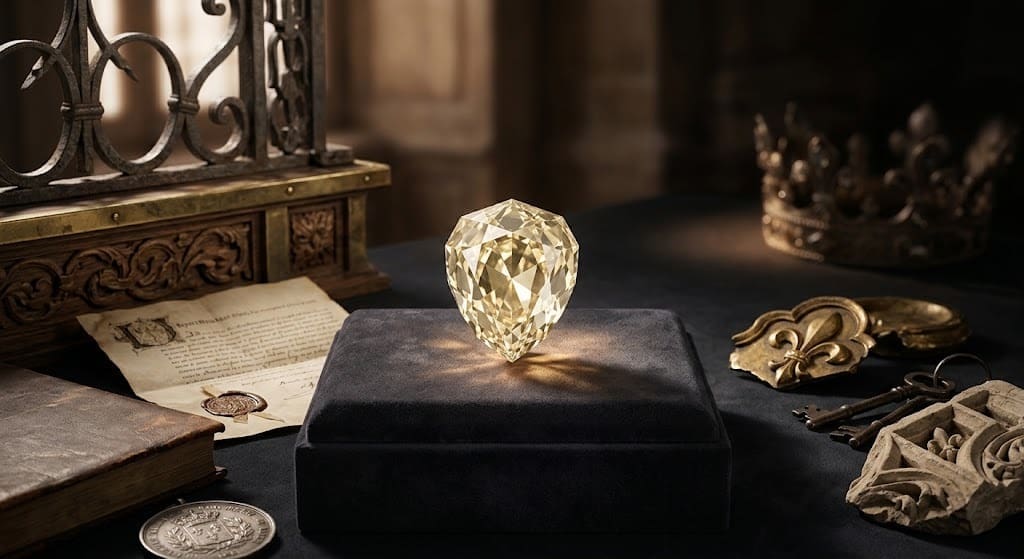
The Sancy formed the heart of the fleur-de-lis atop the coronation crown of Louis XV in 1722. But in September 1792, during the French Revolution, the royal treasury (the Garde-Meuble) was looted.
The Sancy vanished, along with the Regent Diamond and the French Blue (later recut into the Hope). Some stolen jewels funded the Revolution itself.
A key insight often overlooked: unlike the Regent, which was found in a Paris garret within two years, the Sancy stayed lost far longer, drifting through private hands and resurfacing decades later. Its survival through this period was far from guaranteed.
From Russian Princes to the Astors
The Sancy’s final journey took it across the globe before it came to rest.
After resurfacing, it passed through Prince Anatole Demidoff of Russia, then the Indian industrialist Sir Jamsetjee Jeejeebhoy, and eventually the British Astor family, who acquired it in 1906.
The Sancy remained an Astor treasure for over seventy years. Finally, in 1978, the 4th Viscount Astor sold it to the Louvre for about $1 million, returning it to France for good.
Still Standing Today
The Sancy’s endurance continues into the present.
It now rests in the Galerie d’Apollon of the Louvre, among the surviving French Crown Jewels, the same gallery that houses the Regent Diamond.
A key insight often overlooked: in October 2025, thieves struck that very gallery, escaping with eight pieces of crown jewels. As it has for six centuries, the Sancy endured, surviving yet another threat that claimed treasures around it.
Why the Sancy Is History’s Great Survivor
Put its journey together and no diamond has survived more.
- A battlefield loss under Charles the Bold.
- A servant’s sacrifice to keep it hidden.
- The crowns of France and England.
- The French Revolution’s looting of the crown jewels.
- A global journey through Russia, India, and Britain.
- Six centuries later, still intact in the Louvre.
Experience has shown that some diamonds are famous for size, others for color. The Sancy is famous for something rarer: it simply refused to be lost.
Frequently Asked Questions
How big is the Sancy Diamond?
It weighs 55.23 carats and is pale yellow with a shield-like shape, faceted on both top and bottom. Its unusual double-faceted cut, rare for its time, suggests it was originally cut in India.Why is the Sancy Diamond historically significant?
Because it survived more than 600 years of war, revolution, and upheaval. It was lost in battle by Charles the Bold, owned by English and French kings, used to fund armies, stolen in the French Revolution, and passed through the Astor family before reaching the Louvre.Is it true the Sancy was found inside a servant’s body?
According to a famous historical account, yes. A messenger carrying the diamond for Nicolas de Sancy was robbed and murdered. Believing the man loyal, de Sancy had the body searched, and the diamond was found in his stomach, swallowed to protect it.Where is the Sancy Diamond now?
It is in the Galerie d’Apollon at the Louvre in Paris, among the French Crown Jewels. The Louvre purchased it from the Astor family in 1978 for about $1 million.How did the Sancy get its name?
From Nicolas de Harlay, Seigneur de Sancy, a French diplomat and financier who owned the diamond in the late 16th century and gave it the name it still carries today.
Discover Rare and Historic Diamonds in Atlanta
Legendary stones like the Sancy remind us that a great diamond can outlast empires, carrying its story across centuries. Understanding what makes a stone exceptional is what separates a fine diamond from an ordinary one.
At Regal Studio in Buckhead, every piece is designed and handcrafted by Mack, a GIA Certified Diamond Grader with over 45 years of experience and the trust of more than 278 five-star clients. Whether you are drawn to historic cuts, rare color, or a flawless classic, we help you understand and source the finest stones with complete transparency.
Our motto says it all: “You Dream It, We Make It.”
Visit Regal Studio on Peachtree Road in Buckhead, or get in touch to book a consultation. Let a seasoned master jeweler help you find a diamond worthy of its own story.
Read More:
The Rarest Diamonds on Earth: Colors, Origins, and Prices Explained
Lab-Grown vs. Natural Diamonds for Custom Engagement Rings