
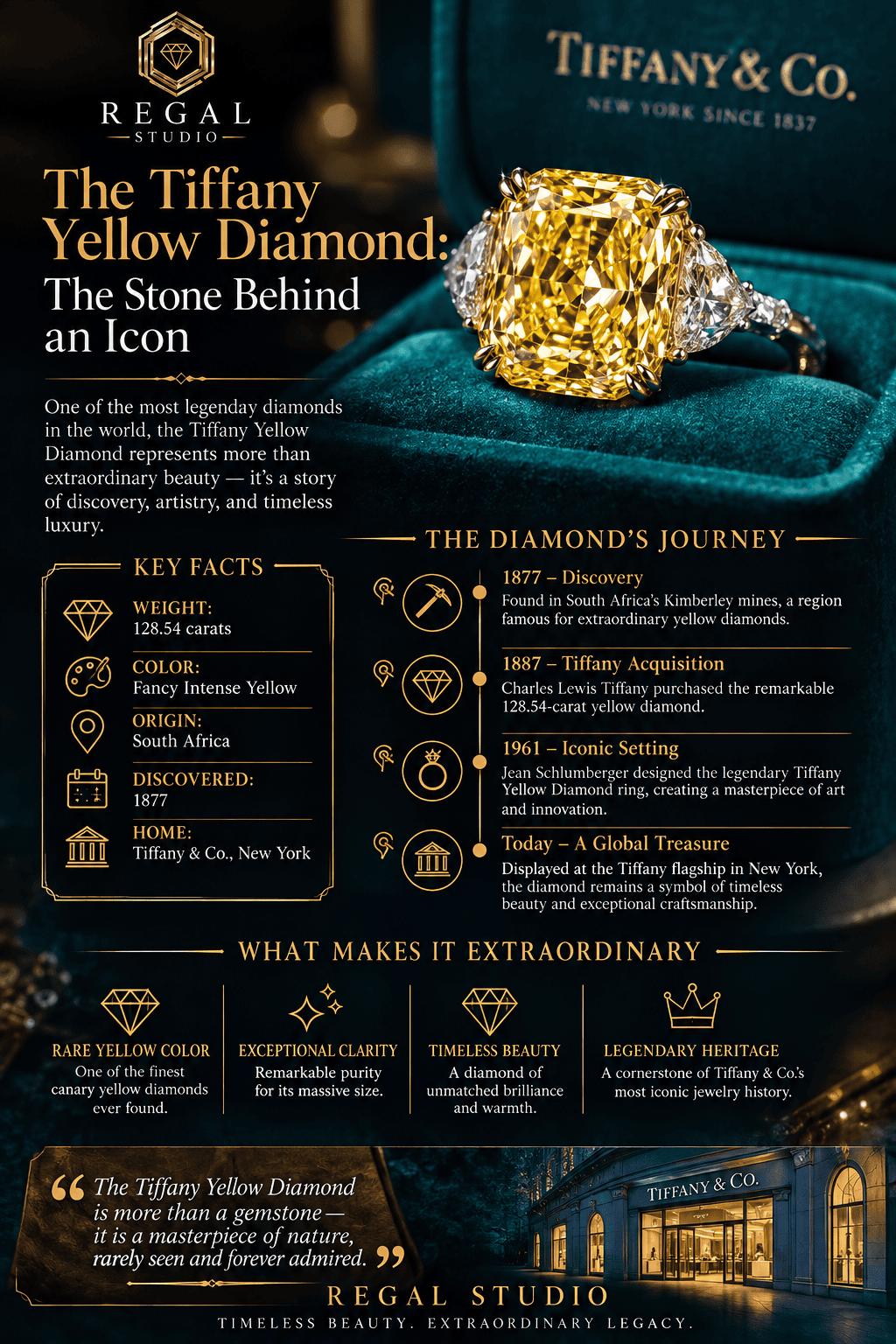


The Tiffany Yellow Diamond: The Stone Behind an Icon
Quick answer: The Tiffany Yellow Diamond is a 128.54-carat fancy yellow diamond, one of the largest ever discovered. It was found in South Africa’s Kimberley Mine in 1877, bought by Charles Lewis Tiffany for $18,000, and cut from a 287.42-carat rough into a cushion brilliant with an unprecedented 82 facets. Estimated at around $30 million, it has been publicly worn by only four women: Mary Whitehouse, Audrey Hepburn, Lady Gaga, and Beyoncé. It has never been sold and remains the cornerstone of Tiffany & Co.
So here is the full story of the stone that turned a jeweler into a legend.
A Note on Where This Analysis Comes From
This guide comes from Regal Studio in Buckhead, Atlanta. Our founder, Mack, began at the jeweler’s bench at just fourteen, trained across Europe, and is today a GIA-certified diamond grader with over 45 years of experience.
We have spent a career studying the stones that define our craft. Few are as culturally iconic as Tiffany.
So this is not a recycled brand story. It is an expert’s look at why this diamond became more than a gem.
The Tiffany Yellow Diamond at a Glance
Let us start with the essential facts, since the numbers are remarkable.
Feature | Detail |
Weight (cut) | 128.54 carats |
Weight (rough) | 287.42 carats |
Color | Fancy Yellow |
Cut | Modified antique cushion brilliant, 82 facets |
Origin | Kimberley Mine, South Africa (1877) |
Estimated value | ~$30 million |
Owner | Tiffany & Co. |
A key insight often overlooked: at 128.54 carats, the Tiffany is more than two and a half times the size of the famous Hope Diamond. It is among the largest fancy yellow diamonds the world has ever seen.
The Discovery: A South African Giant
The story begins in the diamond fields of South Africa.
In 1877, an enormous yellow crystal weighing 287.42 carats in the rough was unearthed at the Kimberley Mine. Its size and rich color were extraordinary.
The following year, Tiffany & Co. founder Charles Lewis Tiffany acquired the stone for $18,000. It was a bold purchase that would define his legacy.
Experience has shown that a single acquisition can transform a house. This one earned Charles Tiffany the nickname “The King of Diamonds.”
The Cut: A Young Genius and 82 Facets
Here is where craftsmanship enters the story, and it is the part experts admire most.
Tiffany entrusted the stone to his gemologist, Dr. George Frederick Kunz, who was just 23 at the time. Kunz studied the rough for an entire year before making a single cut.
His decision was daring. He sacrificed more than half the diamond’s weight, reducing it from 287 carats to 128.54, all in pursuit of beauty over size.
Kunz gave it a cushion shape with an unprecedented 82 facets, far more than the 58 typical of the era. Those extra facets were designed to maximize the diamond’s fire.
A key insight often overlooked: this was visionary for 1878. Larger diamonds with comparable brilliance would not be fashioned until deep into the 20th century. Kunz was decades ahead of his time.

Why the Extra Facets Matter
To a jeweler, this is the heart of Tiffany’s genius. Let us explain what those 82 facets actually do.
Facets are the flat, polished surfaces that catch and return light. More facets, cut precisely, mean more paths for light to bounce and scatter.
The result is fire, the flashes of color you see when the stone moves. Kunz’s 24 extra facets were a deliberate choice to make the yellow diamond blaze.
In our market observations, the marriage of a rare color and a masterful cut is what elevates a diamond from valuable to legendary. Tiffany has both.
Worn by Only Four Women in History
Part of Tiffany’s mystique is its rarity of wear. In nearly 150 years, only four women have worn it publicly.
- Mary Whitehouse (1957). The first, at the Tiffany Ball in Newport, Rhode Island.
- Audrey Hepburn (1961). In publicity images for Breakfast at Tiffany’s, forever linking the stone to the film.
- Lady Gaga (2019). At the Academy Awards, the night she won an Oscar for Best Original Song.
- Beyoncé (2021). For the House’s “About Love” campaign.
A key insight often overlooked: the diamond was not even set in a wearable piece until 1957, nearly 80 years after its discovery. For most of its life, it was admired, not worn.
A Diamond That Keeps Changing Its Setting
Tiffany has never had a single permanent home on the body. It has been reset five times.
Designer Jean Schlumberger created two of its most famous settings: the Ribbon Rosette necklace (1961) and the whimsical Bird on a Rock brooch (1995), a jeweled bird perched atop the yellow stone.
For Tiffany’s 175th anniversary in 2012, it became the centerpiece of a necklace with more than 100 carats of white diamonds. That is the setting Lady Gaga and Beyoncé wore.
Experience has shown that a great diamond outlives every setting placed around it. The Tiffany has been reimagined for each era while the stone itself endures.
The Breakfast at Tiffany’s Connection
No account is complete without the film that cemented the legend.
When Audrey Hepburn wore the diamond in 1961 promotional images for Breakfast at Tiffany’s, the stone and the brand became inseparable in popular culture.
A key insight often overlooked: Tiffany & Co. was already famous in New York long before the film. But Hepburn’s image gave the yellow diamond, and the house, a global mythology it still enjoys today.
Where the Tiffany Yellow Diamond Is Today
The diamond remains the property of Tiffany & Co. and has never been sold. The house calls it the cornerstone of its identity.
It is typically displayed at Tiffany’s flagship store on Fifth Avenue in New York, and has traveled to exhibitions including the Smithsonian and London’s Saatchi Gallery.
In recent years, as Tiffany expanded its diamond traceability and sourcing programs, the stone has remained the symbolic heart of the brand, an emblem of heritage in a changing industry.
What Makes the Tiffany Truly Iconic
Put the pieces together and you see why this stone stands apart.
- One of the largest fancy yellow diamonds ever discovered.
- A visionary 82-facet cut, decades ahead of its time.
- Worn by only four women in nearly 150 years.
- Immortalized by Audrey Hepburn and Breakfast at Tiffany’s.
- Never sold, and priceless to its house.
In our market observations, a diamond becomes an icon when rarity, craftsmanship, and cultural story converge. Tiffany is the textbook example.

Frequently Asked Questions
How big is the Tiffany Yellow Diamond?
It weighs 128.54 carats, cut from a 287.42-carat rough. That makes it one of the largest fancy yellow diamonds in the world, more than two and a half times the size of the Hope Diamond.How much is the Tiffany Diamond worth?
It is estimated at around $30 million, though Tiffany & Co. considers it priceless and has never sold it. It remains the symbolic cornerstone of the brand.Who has worn the Tiffany Yellow Diamond?
Only four women spoke publicly: Mary Whitehouse in 1957, Audrey Hepburn in 1961 publicity for Breakfast at Tiffany’s, Lady Gaga at the 2019 Oscars, and Beyoncé in the 2021 About Love campaign.Where was the Tiffany Diamond found?
It was discovered in 1877 at the Kimberley Mine in South Africa and acquired by Charles Lewis Tiffany the following year for $18,000.Why does the Tiffany Diamond have 82 facets?
Gemologist George Frederick Kunz added 24 facets beyond the traditional 58 to maximize the stone’s fire and brilliance. It was a bold, forward-thinking cut for 1878.
Discover Rare and Fancy Color Diamonds in Atlanta
Icons like the Tiffany remind us that a great diamond is a fusion of rare color, masterful cutting, and story. Understanding those qualities is what separates an ordinary stone from an extraordinary one.
At Regal Studio in Buckhead, every piece is designed and handcrafted by Mack, a GIA Certified Diamond Grader with over 45 years of experience and the trust of more than 278 five-star clients. Whether you dream of a fancy yellow diamond or a flawless classic, we help you understand and source the finest stones with complete transparency.
Our motto says it all: “You Dream It, We Make It.”
Visit Regal Studio on Peachtree Road in Buckhead, or get in touch to book a consultation. Let a seasoned master jeweler help you find a diamond worthy of its own story.
Read More:
How Many Red Diamonds Are Left in the World? The Complete 2026 Count
The Dresden Green Diamond: History’s Rarest Green Gem