
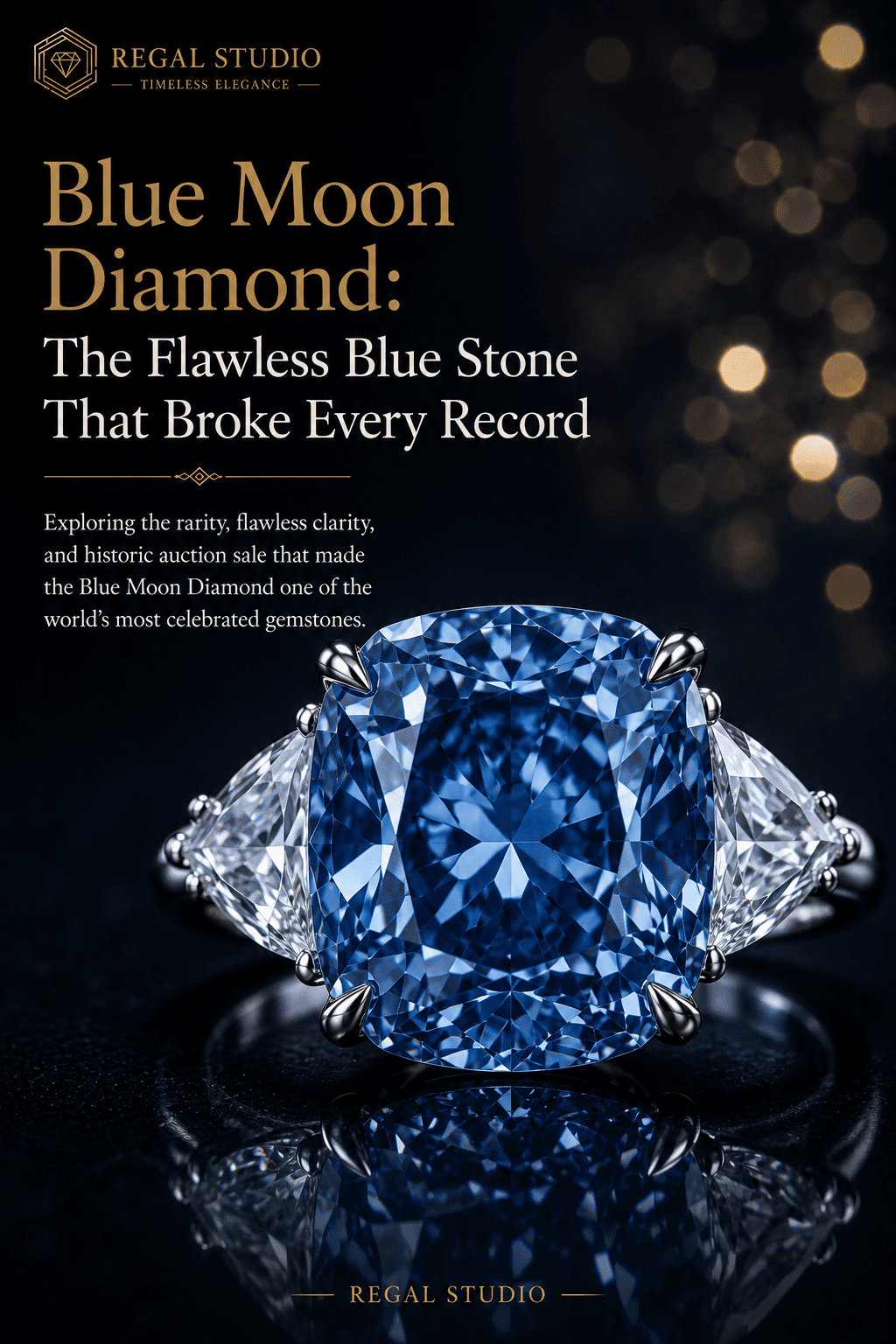


Blue Moon Diamond: The Flawless Blue Stone That Broke Every Record
The Blue Moon Diamond sold for $48,468,158 at Sotheby’s Geneva on November 11, 2015, setting world records as the most expensive jewel ever sold at auction at the time and achieving the highest price per carat ever paid for any gemstone. The 12.03-carat cushion-cut Fancy Vivid Blue Internally Flawless diamond was purchased by Hong Kong billionaire Joseph Lau, who immediately renamed the stone the “Blue Moon of Josephine” after his seven-year-old daughter. Cut from a 29.6-carat rough discovered at South Africa’s Cullinan mine in 2014, the Blue Moon required five months of expert study followed by three months of master cutting and polishing. Its sale fundamentally transformed how the world valued blue diamonds and established a per-carat benchmark that stood for years.
In our market observations across more than four decades of diamond grading and the high-end colored stone market, the Blue Moon Diamond is one of the three most influential blue diamond transactions in modern auction history. Experience has shown that understanding why this single stone broke every contemporary record teaches more about blue diamond economics than almost any other auction in the past two decades.
The Blue Moon Diamond at a Glance
Before exploring the full story, here are the essential facts every collector should know.
Attribute | Detail |
Carat weight | 12.03 carats |
Original rough weight | 29.6 carats |
GIA color grade | Fancy Vivid Blue |
Clarity grade | Internally Flawless (IF) |
Cut | Cushion (modified brilliant) |
Diamond type | Type IIb (boron-induced blue) |
Auction date | November 11, 2015 |
Auction house | Sotheby’s Geneva |
Final hammer price | $48,468,158 USD (48.6 million CHF) |
Pre-auction estimate | $35-55 million |
Buyer | Joseph Lau (Hong Kong billionaire) |
Per-carat record | $4,028,941 per carat (then-world record) |
Renamed to | Blue Moon of Josephine |
Discovery location | Cullinan mine, South Africa |
Discovery date | January 2014 |
Cutter | George Togholian (formerly of Cora International) |
Cutting time | 5 months study + 3 months execution |
Special feature | Red phosphorescence under UV light |
A key insight often overlooked: the Blue Moon Diamond’s per-carat price record of $4 million stood as the highest ever paid for any gemstone of any color until the Williamson Pink Star surpassed it in 2022. For a blue diamond specifically, the Blue Moon’s per-carat figure remained the benchmark for years.
Why the Blue Moon Diamond Sold for $48 Million
The Blue Moon Diamond price was not arbitrary. It reflected six interlocking factors that combined to make this stone genuinely exceptional.
The six factors driving the Blue Moon Diamond price:
- Carat weight: at 12.03 carats, exceptionally large for a Fancy Vivid Blue
- Color grade: Fancy Vivid Blue, the highest possible blue intensity
- Clarity grade: Internally Flawless (IF), the rarest clarity at this size
- Diamond type: Type IIb, boron-induced blue color, less than 0.1% of all diamonds
- Provenance: Cullinan mine origin, the world’s premier blue diamond source
- Auction context: competitive bidding driving the price past pre-auction estimates
Experience has shown that no single factor alone justified the $48 million price. The combination of all six in one stone is what made the Blue Moon record-breaking.
The Cullinan Mine: Where the Blue Moon Was Born
To understand the Blue Moon Diamond, you have to understand the only mine in the world that consistently produces investment-grade blue diamonds.
South Africa’s Cullinan Mine
The Cullinan Diamond Mine, located in Cullinan, South Africa (about 30 miles east of Pretoria), was opened in 1902 and has produced some of history’s most legendary diamonds. The Blue Moon Diamond was unearthed there in January 2014 as a 29.6-carat rough.
Famous diamonds from the Cullinan mine include:
- The Cullinan Diamond (3,106.75 carats rough, source of the British Crown Jewels’ Cullinan I and II)
- The Star of Africa (530.20 carats)
- The Smithsonian’s Blue Heart Diamond (1908)
- The Heart of Eternity (27.64 carats blue)
- The Cullinan Dream (24.18 carats blue)
- The De Beers Cullinan Blue (15.10 carats blue)
- The Blue Moon Diamond (12.03 carats blue)
Sotheby’s stated in pre-auction materials that the Cullinan mine is “the only reliable source in the world for blue diamonds.” This is largely accurate. While occasional blue diamonds have been found in India, Australia, and other African mines, no other source produces blue diamonds with consistent investment-grade quality.
A key insight often overlooked: the Cullinan mine’s continued active operation is one reason blue diamonds, while still extremely rare, have slightly more market availability than pink or red diamonds. The 2020 closure of the Argyle mine (the primary source of pink and red) does not apply to blue diamond supply.
From Rough to Masterpiece
The transformation from 29.6-carat rough to 12.03-carat polished masterpiece took eight months total:
- 5 months of intensive study: gemologists analyzed the rough to determine optimal cutting plan
- 3 months of master cutting and polishing: George Togholian, formerly of Cora International, executed the precision work
The yield from rough to polished was approximately 41%, which is generous for a blue diamond of this quality and color. Most cutting decisions involve sacrificing carat weight to maximize color and clarity, and the Blue Moon’s cutting team prioritized achieving the rare combination of Fancy Vivid Blue color and Internally Flawless clarity.
In our professional assessment, the eight-month cutting timeline reflects the extraordinary care required. Rushing the work could have:
- Reduced color saturation
- Introduced clarity flaws
- Lowered the GIA color grade from Vivid to Intense
- Destroyed potentially $20+ million in eventual value
The Auction Story: November 11, 2015
The Blue Moon Diamond’s sale at Sotheby’s Geneva on November 11, 2015, was one of the most consequential single-jewel auctions in modern history.
Pre-Auction Expectations
Sotheby’s specialists estimated the diamond would sell between $35 million and $55 million. The auction took place at Geneva’s Beau Rivage Hotel under the gavel of David Bennett, head of Sotheby’s jewelry division.
The Sale
Bidding was competitive but ultimately decisive. The hammer fell at $48,468,158 to a phone bidder, who was later confirmed to be Hong Kong billionaire Joseph Lau.
David Bennett’s commentary captured the moment: “Tonight we set a new world record, a new auction record for any diamond, any jewel, any gemstone, with the sale of the Blue Moon diamond. I have never seen a more beautiful stone. The shape, the color, the purity, it’s a magical stone.”

The Records Set
The Blue Moon Diamond established multiple auction records:
- Most expensive jewel ever sold at auction (briefly, until the Pink Star in 2017)
- Highest per-carat price for any gemstone ever ($4,028,941, held until 2022)
- Largest fancy vivid blue diamond at the time to come to public auction
- Most expensive diamond purchased for a child (purchased for Joseph Lau’s 7-year-old daughter)
In our market observations, the Blue Moon’s records signaled that ultra-high-net-worth Asian collectors had become the dominant force in record-breaking diamond auctions, a trend that has continued through 2026.
The Buyer: Joseph Lau and His Diamond Collecting Pattern
The Blue Moon Diamond’s purchase was part of one of the most distinctive diamond collecting patterns in modern history.
Who Joseph Lau Is
Joseph Lau Luen-hung is a Hong Kong-based property developer and former chairman of Chinese Estates Holdings. Forbes has listed him among the world’s wealthiest individuals, with estimated assets of $9-10 billion at the time of the Blue Moon purchase.
Lau is also a fugitive from a Macau corruption conviction, sentenced in absentia in 2014 to over five years in prison for his role in a bribery scheme involving the city’s most prominent corruption case. He has avoided imprisonment by remaining in Hong Kong, which lacks an extradition treaty with Macau.
Lau’s Pattern of Naming Diamonds for His Children
The Blue Moon of Josephine was not Lau’s first diamond purchase or his last. He developed a distinctive pattern of buying record-breaking diamonds and renaming them for his daughters.
Joseph Lau’s documented diamond acquisitions for his children:
- Star of Josephine (2009): 7.03-carat blue diamond, $9.5 million
- Sweet Josephine (2015): 16.08-carat pink diamond, $28.5 million (one day before Blue Moon)
- Blue Moon of Josephine (2015): 12.03-carat blue diamond, $48.5 million (this article’s subject)
- Zoe Diamond (2014): 9.75-carat blue diamond, $32.6 million (named for older daughter Zoe)
- Zoe Red (2014): 10.1-carat ruby and diamond brooch, $8.4 million
The week of November 9-11, 2015, Lau spent over $77 million across just two auctions to acquire the Sweet Josephine pink diamond and the Blue Moon. Both were renamed for his then-7-year-old daughter Josephine.
A key insight often overlooked: Joseph Lau’s collecting pattern has fundamentally shaped modern auction economics. His willingness to pay record prices for fancy color diamonds set new market benchmarks that all subsequent auctions have built on.
Why Type IIb Designation Matters for the Blue Moon
The Blue Moon Diamond is classified as a Type IIb diamond, which is part of why it commanded such an extraordinary price.
What Type IIb Means
Type IIb diamonds are the chemically distinct category of diamonds that contain boron atoms substituted for some carbon atoms in the crystal structure. The boron content is what creates natural blue color in diamonds.
Key facts about Type IIb diamonds:
- Less than 0.1% of all natural diamonds qualify as Type IIb
- Boron content makes Type IIb diamonds electrically conductive (most diamonds are not)
- All major fancy blue diamonds (Hope, Oppenheimer, Cullinan Dream, Blue Moon) are Type IIb
- The blue color saturation is directly proportional to boron concentration
For the Blue Moon to combine Type IIb chemistry with Fancy Vivid Blue color, Internally Flawless clarity, and 12.03-carat size makes it statistically extraordinary. Stones with all four characteristics in combination appear at major auctions perhaps once per decade.
The Red Phosphorescence Phenomenon
The Blue Moon Diamond exhibits red phosphorescence when observed under ultraviolet light. This unusual phenomenon occurs in some Type IIb blue diamonds and is one of their most distinctive features.
When the diamond is exposed to UV light and then the light is removed, the stone glows red for several seconds before the glow fades. This phosphorescent behavior is one of the authentication signals professional gemologists use to verify Type IIb chemistry.
In our professional assessment, the Blue Moon’s red phosphorescence is one of its most fascinating physical properties. Few people will ever see it firsthand, but it is part of what makes Type IIb blue diamonds chemically unique among all diamonds in existence.
The Blue Moon in Context: Most Expensive Blue Diamonds
To fully appreciate the Blue Moon’s significance, see how it ranks among the world’s most valuable blue diamonds.
Diamond | Carats | Year Sold | Price | Per Carat |
Hope Diamond | 45.52 | Smithsonian | Est. $250M | N/A (not for sale) |
Oppenheimer Blue | 14.62 | 2016 | $57.5M | $3.93M |
De Beers Cullinan Blue | 15.10 | 2022 | $57.5M | $3.81M |
Blue Moon of Josephine | 12.03 | 2015 | $48.4M | $4.03M |
Mellon Blue (Zoe Diamond) | 9.75 | 2014 | $32.6M | $3.34M |
Cullinan Dream | 24.18 | 2016 | $25.4M | $1.05M |
Winston Blue | 13.22 | 2014 | $23.8M | $1.80M |
Heart of Eternity | 27.64 | Estimate | $16M | N/A |
In our market observations, the Blue Moon Diamond holds a unique place: although the Oppenheimer Blue and De Beers Cullinan Blue both sold for $57.5 million each, neither matched the Blue Moon’s per-carat figure. The Blue Moon remained the per-carat blue diamond record holder for several years and stood as the highest per-carat figure for any gemstone until 2022.

The Eight-Month Cutting Process: Why It Mattered
The Blue Moon’s transformation from 29.6-carat rough to 12.03-carat polished diamond is one of the most thoroughly documented modern diamond cuts. Here is what those eight months actually accomplished.
Phase 1: Five Months of Study
Gemologists analyzed the rough crystal extensively to:
- Map internal inclusions and stress points
- Determine optimal facet placement
- Project the highest-value cutting outcome
- Plan for maximum color saturation
- Maintain the Internally Flawless potential
A key insight often overlooked: a single miscalculation during planning could have reduced final value by $10-20 million. The five-month study window reflects how cautious cutting teams must be with diamonds of this caliber.
Phase 2: Three Months of Master Cutting
George Togholian, formerly of Cora International, executed the cutting and polishing. Each facet required precision measurement and incremental polishing. The cushion shape was chosen because:
- It maximized visible color across the table
- It preserved the most carat weight while maintaining optimal proportions
- It echoed the rounded shape that gives the diamond its “moon” name reference
- It allowed brilliance and color to work together
The Final Result
The completed Blue Moon was 12.03 carats, Fancy Vivid Blue, Internally Flawless, with proportions that maximized both color and brilliance. The 41% yield from rough is generous for blue diamonds, where cutters typically prioritize color preservation over weight maximization.
Where Is the Blue Moon Diamond Today?
The Blue Moon of Josephine has remained in Joseph Lau’s private collection since the 2015 purchase.
Current status of the Blue Moon Diamond:
- Privately held by Joseph Lau (or possibly his daughter Josephine)
- Not publicly displayed at any museum
- No subsequent auction appearances documented
- Estimated current value: $55-70 million+ (reflecting blue diamond appreciation since 2015)
- Insurance valuation likely significantly higher
- Status as “gift to daughter” makes future sale less likely
In our market observations, diamonds purchased as gifts for family members rarely appear at public auction within the original buyer’s lifetime. The Blue Moon may not resurface in the secondary market for decades.
What the Blue Moon Diamond Teaches Today’s Buyers
For collectors and investors, the Blue Moon story offers four practical lessons that apply at any budget level.
Four lessons from the Blue Moon Diamond:
- Cutting craftsmanship is part of the price. Eight months of study and precision execution transformed a 29.6-carat rough into a $48 million masterpiece. Master cutting work that maximizes color and clarity is reflected in every quality diamond purchase.
- Type IIb chemistry is non-negotiable for genuine fancy blue. Any diamond marketed as “fancy blue” should have GIA documentation confirming Type IIb classification. Without it, the stone is either a fake or has been color-treated.
- Per-carat pricing tells a different story than total price. The Blue Moon’s $4 million per-carat figure was actually higher than larger blue diamonds that sold for more total dollars. Understanding per-carat dynamics is essential for evaluating value across stones of different sizes.
- Provenance enhances value across generations. Documented mine origin (Cullinan), cutting heritage (George Togholian), and notable buyer history (Joseph Lau) all add value beyond the physical stone itself. Always preserve documentation.
A key insight often overlooked: these same lessons apply to every quality diamond purchase, whether $5,000 or $50 million. Cutting craftsmanship, chemistry, per-carat math, and provenance are universal value drivers.

Expert Analysis: Five Truths About the Blue Moon Diamond
In our market observations across more than four decades of diamond expertise, the Blue Moon Diamond represents five patterns that shape colored diamond economics.
Five insights from the bench:
- The Blue Moon set the per-carat ceiling for an entire decade. Before the 2015 sale, no gemstone had ever exceeded $4 million per carat. The Blue Moon’s $4.03 million figure stood as the world record per-carat price for any gemstone until 2022, when the Williamson Pink Star surpassed it.
- Cullinan-mine provenance carries premium value. Experience has shown that documented Cullinan-origin blue diamonds command premiums over comparable blue diamonds without provenance documentation. The Cullinan mine’s ongoing reputation as the world’s premier blue diamond source enhances every stone with verified origin.
- The “named after a child” trend has lasting market impact. Joseph Lau’s pattern of renaming diamonds for his daughters (Josephine, Zoe) created a new collecting model that has been emulated by other ultra-high-net-worth collectors. These naming events become permanent value enhancers.
- Eight months is reasonable for a stone this important. Rushed cutting destroys value. The Blue Moon’s eight-month transformation demonstrates the level of care that genuine masterpieces require. Buyers should be skeptical of stones marketed as “rapidly cut” or with vague provenance histories.
- A trusted jeweler relationship matters more for blue diamonds than almost any colored diamond category. The technical complexity of Type IIb verification, treatment risks, and per-carat market dynamics demand expertise no individual buyer can match alone.
How GIA Experts Authenticate Investment-Grade Blue Diamonds
Beyond standard diamond authentication, professional blue diamond evaluation includes:
- Color origin determination: natural vs. treated (5-10x value difference)
- Color modifier analysis: pure blue vs. grayish vs. greenish
- Intensity grade verification: Fancy through Fancy Vivid
- Type designation: Type IIb confirmation via spectroscopy
- Electrical conductivity testing: Type IIb diamonds conduct electricity
- Phosphorescence observation: red glow under UV light for some Type IIb diamonds
- Provenance verification: Cullinan mine documentation when applicable
- Spectroscopic analysis: confirms natural boron-induced color
Buyers can learn the basics. Mastering investment-grade blue diamond authentication takes years of dedicated study. That is why a relationship with a GIA Certified Diamond Grader is essential for any serious blue diamond purchase.
Frequently Asked Questions About the Blue Moon Diamond
How much did the Blue Moon Diamond sell for?
The Blue Moon Diamond sold for $48,468,158 USD (48.6 million CHF) at Sotheby’s Geneva on November 11, 2015. At the time, this was the highest price ever paid for a single jewel at auction. The sale also set a per-carat world record for any gemstone at $4,028,941 per carat, a figure that stood until 2022 when the Williamson Pink Star surpassed it.Who owns the Blue Moon Diamond now?
The Blue Moon Diamond is owned by Hong Kong billionaire Joseph Lau, who purchased it at the 2015 Sotheby’s auction and immediately renamed it the “Blue Moon of Josephine” in honor of his then-7-year-old daughter Josephine. The diamond remains in his private collection and has not appeared at public auction since.Where was the Blue Moon Diamond found?
The Blue Moon Diamond was discovered at the Cullinan Diamond Mine in South Africa in January 2014. The mine, opened in 1902, has produced many of the world’s most famous blue diamonds, including the Hope Diamond’s relatives, the Heart of Eternity, and the De Beers Cullinan Blue. The original rough weighed 29.6 carats before being cut down to the final 12.03-carat polished stone.Why is the Blue Moon Diamond so valuable?
The Blue Moon combines six rare attributes in one stone: 12.03-carat size (large for blue diamonds), Fancy Vivid Blue color (highest possible blue intensity), Internally Flawless clarity (rarest at this size), Type IIb chemistry (less than 0.1% of all diamonds), Cullinan mine provenance, and competitive auction context that drove the price past pre-auction estimates. No other known diamond combines all six factors at this scale.Why does the Blue Moon Diamond glow red under UV light?
The Blue Moon exhibits red phosphorescence under ultraviolet light, a phenomenon that occurs in some Type IIb blue diamonds because of their unique boron chemistry. When exposed to UV light and then the light is removed, the diamond glows red for several seconds before the glow fades. This is one of the authentication signals professional gemologists use to confirm Type IIb chemistry in blue diamonds.
Key Takeaways: The Blue Moon Diamond
- The Blue Moon Diamond sold for $48,468,158 at Sotheby’s Geneva on November 11, 2015
- It set the world record per-carat price for any gemstone at $4,028,941
- Hong Kong billionaire Joseph Lau renamed it the “Blue Moon of Josephine” for his daughter
- The 12.03-carat Fancy Vivid Blue Internally Flawless diamond is Type IIb (boron-induced)
- It was cut from a 29.6-carat rough discovered at South Africa’s Cullinan mine in 2014
- The cutting process took 8 months total (5 months study, 3 months execution)
- The diamond exhibits unusual red phosphorescence under UV light
Final Thoughts: What the Blue Moon Story Means for Today’s Blue Diamond Buyers
The Blue Moon Diamond is more than a record-breaking auction story. It is a masterclass in how the diamond market actually values rarity, craftsmanship, chemistry, and provenance. The same six factors that drove the Blue Moon to $48 million also shape the price of every quality engagement ring, anniversary piece, and heirloom commission made today, just on a dramatically different scale.
You may never own a 12.03-carat Type IIb Fancy Vivid Blue Internally Flawless diamond. But the principles that made the Blue Moon a record-breaker apply to your next colored diamond purchase as much as they applied to Joseph Lau’s winning bid in Geneva. Color matters. Clarity matters. Type designation matters. Cutting craftsmanship matters. Provenance matters. And the right expert guidance turns those principles into a piece you actually want to own.
That is exactly what Mack has spent more than four decades doing at Regal Studio in Buckhead, Atlanta. As a GIA Certified Diamond Grader with 45+ years of experience, Mack personally evaluates every diamond that enters the studio, from classic colorless stones to fancy color selections for clients seeking the rarest categories. He has crafted custom pieces for everyday couples, celebrities, and professional athletes alike, applying the same rigor to a $5,000 engagement ring that auction houses apply to museum-grade stones like the Blue Moon Diamond.
At Regal Studio, every piece carries Mack’s personal signature mark. Every diamond is selected for color, clarity, cut, and craftsmanship. Every client receives the same honest guidance about what makes a diamond truly exceptional, including ethical sourcing, color authentication, treatment disclosure, Type designation verification, and the difference between a stone that holds value and a stone that simply costs money.
Ready to work with the same diamond expertise that record-breaking pieces deserve?
Visit Regal Studio on Peachtree Road in Buckhead, Atlanta, or get in touch to schedule your private consultation with Mack. Whether you are designing a custom engagement ring, sourcing a rare colored diamond, or restoring a family heirloom, you work directly with a master jeweler who knows the difference between every grade, every cut, and every story a diamond can tell.
You may not own the Blue Moon. But you can own something built with the same standards.
Mack’s motto says it all: “You Dream It, We Make It.”
Read More:
Lab Grown Diamond Price Drop 2026: How Much Have Prices Actually Fallen?