
Diamond Ring Price 2026: What a Real Diamond Ring Costs Today
The average diamond ring price 2026 sits between $5,200 and $6,500 for a mainstream engagement ring in the United States, according to data from BriteCo, The Knot, and other major industry trackers. Natural diamond rings average closer to $7,364 to $10,760, while lab-grown diamond rings average around $4,300 to $5,187. The biggest change this year is that 61% of engagement rings now feature lab-grown center stones, which has pulled the overall market average down while pushing the average ring size up to 1.9 carats.
In our market observations at the bench, pricing in 2026 is less about following a formula and more about understanding four variables: stone type, carat weight, cut quality, and setting complexity. Experience has shown that couples who understand these four levers walk away with a better ring at a lower price, every time.
Diamond Ring Price 2026 at a Glance
Before unpacking the detail, here is a real-market snapshot of what diamond rings actually cost in 2026.
Ring Category | Typical Price Range (2026) | Average Carat | Notes |
Lab-grown diamond engagement ring | $2,500 to $6,000 | 2.0 ct | 61% of current market |
Natural diamond engagement ring | $6,000 to $15,000 | 1.16 ct | Premium, long-term value |
Entry-level custom ring | $2,500 to $3,500 | 0.5 to 1 ct | Lab-grown or smaller natural |
Mid-range custom ring | $5,000 to $10,000 | 1 ct natural | Most popular tier |
High-end custom ring | $10,000 to $25,000+ | 1.5 ct+ natural | Platinum, intricate design |
Luxury tier | $25,000+ | 2 ct+ natural | Rare stones, signature design |
A key insight often overlooked: the “average” diamond ring price 2026 figure is misleading on its own. Two-thirds of couples spend less than $6,000, one-third spend under $3,000, and only 8% spend between $10,000 and $15,000. Most people are spending less than the headline number suggests.
What the Average Diamond Ring Costs in 2026
Industry data from the last twelve months paints a consistent picture. The average has been sliding since 2021.
Recent average engagement ring spend in the US:
- 2021: $6,000
- 2022: $5,800
- 2023: $5,500
- 2024: $5,200
- 2026: $5,500 to $6,500 (depending on source)
In our professional assessment, the apparent stabilization in 2026 hides two opposite movements. Lab-grown ring averages are still dropping. Natural diamond averages are holding firm or rising slightly. The blended number masks what is really happening underneath.
Experience has shown that geographic location matters more than most buyers realize. Washington state averages push above 12% of annual income on the ring, while several Southern states come in below 8%. Atlanta buyers tend to sit in the middle of that range.

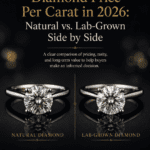
Lab-Grown vs Natural Diamond Ring Price 2026
This is the single biggest price variable in 2026. A chemically identical lab-grown diamond can cost 40% to 90% less than a natural diamond of the same specs.
Real 2026 pricing comparison for a 1-carat round brilliant, G color, VS2 clarity:
Stone Type | Typical Price (Loose Stone) | Price in a 14K Setting |
Lab-grown diamond | $800 to $1,500 | $2,000 to $3,500 |
Natural diamond | $4,000 to $6,500 | $6,000 to $9,500 |
Premium natural (E/VVS1) | $9,000 to $14,000 | $11,000 to $17,000 |
A key insight often overlooked: lab-grown prices have dropped roughly 70% over the last five years and are still falling. A $1,500 lab-grown 1-carat diamond in 2026 would have cost $5,000 in 2020. This is not a minor adjustment. It is a structural shift in the market.
How to choose between lab-grown and natural:
- Lab-grown is ideal if visual impact per dollar is the priority
- Natural is ideal if long-term value retention and tradition matter
- Both receive identical grading standards from GIA and IGI
- The optical and physical properties are indistinguishable to the naked eye
Diamond Ring Price 2026 by Carat Weight
Carat is the most powerful single lever on price. Pricing does not scale linearly. A 2-carat stone typically costs more than twice a 1-carat stone of the same quality, because larger roughs are rarer.
Natural diamond ring price 2026, mid-range quality (G/H color, VS/SI clarity, excellent cut, 14K setting):
- 0.30 carat: $1,500 to $2,500
- 0.50 carat: $2,500 to $4,500
- 0.75 carat: $4,000 to $6,500
- 1.00 carat: $6,000 to $12,000
- 1.50 carat: $10,000 to $20,000
- 2.00 carat: $18,000 to $35,000
- 3.00 carat: $40,000 to $80,000+
Lab-grown diamond ring price 2026, same quality tier:
- 0.50 carat: $1,200 to $2,200
- 1.00 carat: $2,500 to $4,500
- 1.50 carat: $3,500 to $6,500
- 2.00 carat: $5,000 to $9,500
- 3.00 carat: $8,000 to $15,000
In our market observations, the “just under the whole carat” trick still works. A 0.90 carat stone looks virtually identical to a 1.00 carat stone to the naked eye but often costs 20 to 30 percent less.
The 4Cs and How They Impact Your Diamond Ring Price 2026
The 4Cs, carat, cut, color, and clarity, determine what any diamond actually costs. Understanding them is the difference between overpaying and buying intelligently.
Cut has the biggest impact on visual beauty and light return. Always prioritize cut. An ideal or excellent cut in a lower color grade outperforms a poorly cut stone in a higher color grade, every time.
Color runs from D (colorless) to Z (light yellow). In our experience, G and H offer the best balance of value and appearance. Past J, most eyes begin to detect the tint.
Clarity runs from FL (flawless) to I3. VS1 and VS2 are the sweet spot. Inclusions in these grades are typically invisible without magnification.
Carat is literally the weight of the stone. As noted above, prices jump at benchmark sizes like 1.0, 1.5, and 2.0 carats.
Real 4C Trade-Off Example
The same 1.10-carat round brilliant stone:
- D color, flawless clarity: approximately $19,000
- J color, SI2 clarity: approximately $4,200
Both are 1.10 carats. Both are natural diamonds. The price gap is $14,800, and in most settings, the visual difference is modest. Experience has shown that educated buyers land in the middle of this range and get excellent value.

Metal Settings: How Metal Choice Changes Your Diamond Ring Price 2026
The metal band affects both price and longevity. Here is how the major options compare in 2026.
Metal | Price Premium | Durability | Typical Use |
Platinum | Highest (20-40% over 18K gold) | Excellent, dense | Heirloom pieces |
18K Gold (white/yellow/rose) | Premium | Very good | Classic engagement rings |
14K Gold (white/yellow/rose) | Moderate | Good, more durable than 18K | Everyday wear rings |
Palladium | Moderate | Good | Lightweight alternative |
Sterling Silver | Lowest | Soft, not recommended | Fashion jewelry only |
A key insight often overlooked: 14K gold is often a better everyday choice than 18K because it contains more alloy metals and stands up to daily wear better. It also costs less. Unless you specifically want the richer yellow of 18K, 14K is the smarter structural pick.
Custom Design vs Off-the-Shelf: What Changes Your Price
A common myth is that custom rings are dramatically more expensive. That is not always true.
Custom ring price tiers in 2026:
- Entry-level custom: $2,500 to $3,500 (small natural or 1-carat lab-grown)
- Mid-range custom: $5,000 to $10,000 (1-carat natural, standard metals)
- High-end custom: $10,000 to $25,000+ (larger stones, platinum, intricate detail)
Experience has shown that custom design adds roughly 10 to 25 percent in labor cost over a mass-produced equivalent, but eliminates retail markup, branding premiums, and inventory costs that chain stores pass on to buyers. The net difference is often smaller than expected.
What custom gets you that retail does not:
- A piece that fits your partner’s hand, style, and daily life
- Direct conversations with the jeweler about stone selection
- The ability to incorporate heirloom stones or materials
- Documentation of provenance and craftsmanship
- A one-of-one design, not an inventory item
How Much Should You Actually Spend on a Diamond Ring in 2026?
Forget the “two or three months’ salary” rule. It originated in a 1930s De Beers ad campaign and has no grounding in financial planning. In 2026, the question is simpler.
Sensible framework for setting your diamond ring budget:
- Start with what you can pay without taking on debt
- Add what you might comfortably save over three to six months
- Subtract any pre-existing commitments like wedding venue deposits
- That number is your real upper bound
Most couples in our showroom arrive with a figure between $3,000 and $8,000 and walk out with exactly what they wanted. The couples who over-extend almost always regret it within twelve months.
Expert Analysis: Five Insights About Diamond Ring Price 2026
In our market observations, the 2026 market rewards informed buyers and punishes rushed ones. Here is what matters most this year.
Five insights from the bench:
- Lab-grown prices will keep falling. The technology is improving and production is scaling. A buyer today pays less than a buyer twelve months ago, for the same specs. Wait-and-see can save money, but stock turns fast at the lower tiers.
- Natural diamond prices are holding, not collapsing. The narrative that lab-grown is “destroying” natural pricing is overstated. Natural diamond resale and insurance valuations are stable. A key insight often overlooked is that lab-grown resale is near zero while natural diamonds retain meaningful secondary value.
- Cut is the least negotiable of the 4Cs. Color and clarity can be compromised slightly without visible loss. Cut cannot. A poor cut kills brilliance regardless of every other spec.
- Ring size is bigger than it looks. The 1.9 carat market average is skewed by lab-grown. For natural stones, 1.0 to 1.2 carats remains the practical sweet spot for budget and visual impact.
- Certification is non-negotiable. Any diamond over 0.3 carats should carry a GIA or IGI report. Experience has shown that uncertified stones are almost always mispriced, usually in the seller’s favor.
How to Maximize Your Diamond Ring Budget
Practical tactics that actually work:
- Go just under the whole carat mark (0.90 or 1.40, not 1.00 or 1.50)
- Accept G or H color instead of D or E
- Choose VS2 over VVS1, the visual difference is invisible
- Prioritize ideal or excellent cut over everything else
- Consider 14K gold instead of 18K or platinum unless you specifically want the luxury feel
- Work directly with a GIA-certified jeweler instead of a retail chain

Common Mistakes to Avoid in 2026
In our market observations, the same handful of mistakes repeat themselves in this market year after year.
- Overspending on clarity you cannot see: VVS stones cost significantly more than VS, with no visible difference
- Buying at the wrong benchmark: paying for 1.00 instead of 0.90 when the look is nearly identical
- Ignoring the cut grade: accepting “Good” or “Very Good” instead of “Excellent”
- Paying for brand markup: the logo on the box adds 30 to 50% to the price without improving the ring
- Skipping the certification: no GIA or IGI report means no verified specs
Frequently Asked Questions About Diamond Ring Price 2026
- What is the average diamond ring price in 2026? The average sits between $5,200 and $6,500 across the US market. Natural diamond rings average $7,364 to $10,760, while lab-grown diamond rings average $4,300 to $5,187. Most couples spend less than the headline average, with 64% spending under $6,000.
- How much does a 1-carat diamond ring cost in 2026? A natural 1-carat diamond ring in a standard 14K setting typically costs $6,000 to $12,000 depending on color, clarity, and cut. A lab-grown equivalent costs $2,500 to $4,500 in the same setting.
- Is a lab-grown diamond a good buy in 2026? Yes, for buyers prioritizing size and appearance per dollar. Lab-grown diamonds are chemically identical to natural, receive the same grading, and cost 40 to 90 percent less. The main trade-off is resale value, which is currently minimal for lab-grown stones.
- How much should you spend on a diamond ring in 2026? Spend what you can afford without taking on debt. The old “three months’ salary” rule is a 1930s marketing invention with no basis in financial planning. Most 2026 couples spend between $3,000 and $8,000 and are satisfied with the result.
- Does carat size really matter in 2026? Carat matters, but it is not the only factor. A well-cut 1-carat stone in G color looks more impressive than a poorly cut 1.5-carat stone in J color. Prioritize cut quality over raw carat weight for the best visual result per dollar.
Key Takeaways About Diamond Ring Price 2026
- The 2026 average diamond ring price sits between $5,200 and $6,500 in the US market.
- Lab-grown diamonds now represent 61% of engagement ring center stones, pulling averages down.
- Natural diamond rings hold firm around $7,364 to $10,760 on average.
- Cut is the single most important of the 4Cs for visual impact.
- Certification from GIA or IGI is essential for any stone over 0.3 carats.
- Custom design is often less expensive than expected when you factor out retail markup.
Final Thoughts: Why Who You Buy From Matters More Than Where You Buy
The 2026 diamond market has more options and more price transparency than any moment in history. It has also produced more confusion. Online retailers, big chains, influencer ads, and AI-generated “buying guides” all push buyers toward stones that fit their inventory, not the buyer’s actual needs.
The right ring comes from the right expertise. A GIA-certified grader who sits at the bench, knows the difference between a $4,000 and a $12,000 stone by sight, and cares about the piece still looking right in forty years is the person who saves buyers from both overpaying and under-buying.
At Regal Studio in Buckhead, Atlanta, Mack has been that expert for more than four decades. As a GIA Certified Diamond Grader with 45+ years of experience, he personally selects every diamond, designs every piece, and hand-crafts every ring that leaves the studio. No mass production. No pressure to buy inventory that does not fit you. Just honest guidance, real transparency on the 4Cs, and craftsmanship built to outlast trends.
You can spend $3,000 or $30,000 at Regal Studio. Either way, you work with Mack directly, you see the stone before you commit, and you understand exactly what you are paying for.
Start designing the ring that actually fits your story.
Visit Regal Studio on Peachtree Road in Buckhead, or get in touch to schedule your private consultation with Mack. “You Dream It, We Make It.”
Read More:
Where Did Red Diamonds Come From? The Mystery of Earth’s Rarest Gems
A 1930s Diamond Necklace So Rare, Even Royalty Couldn’t Let It Go