

Custom Fine Jewelry in Atlanta: What Sets It Apart From Mass-Produced Pieces
Quick answer: Custom fine jewelry differs from mass-produced pieces in three fundamental ways: how it is built, how long it lasts, and whether it is truly yours. Handcrafted jewelry uses denser, hand-worked metal and individually set stones, making it more durable and repairable than the thin, batch-cast pieces sold by chains. Mass-produced jewelry is stamped by the thousand from a single mold; custom is shaped one piece at a time for one person. You pay for skilled labor and a piece built to last generations, not seasons.
So here is what genuinely separates custom fine jewelry from the mass-produced alternative, explained by an Atlanta master jeweler.
A Note on Where This Guidance Comes From
This guide comes from Regal Studio in Buckhead, Atlanta. Our founder, Mack, began at the jeweler’s bench at just fourteen, trained across Europe, and is today a GIA Certified Diamond Grader with over 45 years of experience.
For twenty years on Peachtree Road, we have handcrafted fine jewelry for everyday clients, celebrities, and professional athletes alike, never mass-producing a single piece.
So this is not marketing spin. It is what four decades at the bench reveal about the difference.
The Core Difference: Where the Labor Goes
Strip away the marketing and the distinction is simple. It comes down to how many hands touch each piece, and how skilled they are.
Mass-produced jewelry is cast in large batches from one master mold, machine-polished, and finished identically by the hundred. It is efficient, consistent, and cheap.
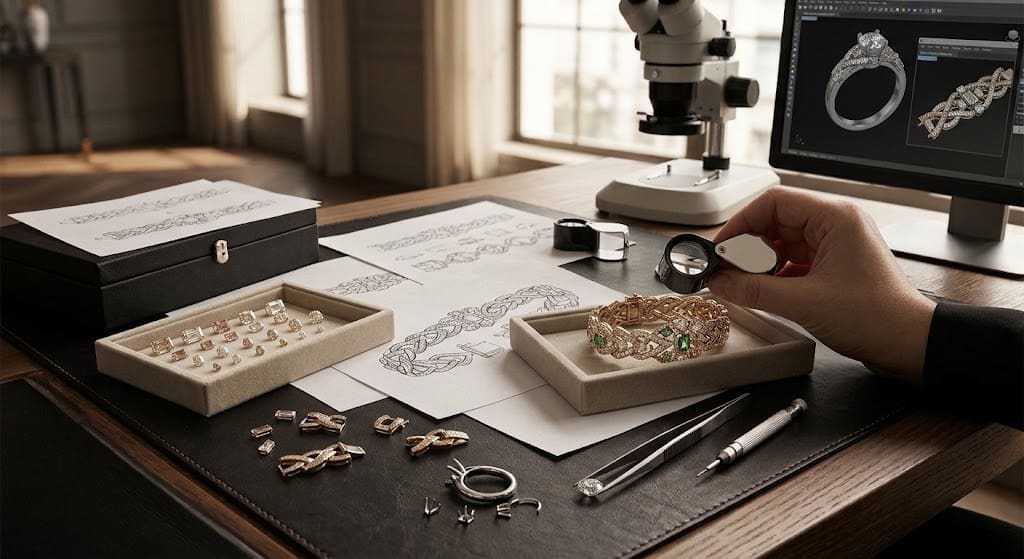
Custom fine jewelry is shaped, filed, and finished one piece at a time, guided by a craftsperson’s judgment at every step.
A key insight often overlooked: with mass production, a stamped pendant moves through the line in minutes. A custom piece can take hours of bench time. That time, that human skill, is what you are actually paying for.
How Each Is Actually Made
Understanding the two production methods explains everything that follows.
Mass Production
A single master mold stamps out thousands of identical pieces. Stones are pressure-set in batches with little individual attention. The goal is unit cost, speed, and uniformity.
Custom Hand Fabrication
The piece is built for you, often from scratch. Metal is hand-forged, prongs are individually worked and adjusted to your specific stone, and every surface is hand-finished.
Experience has shown that this difference is not cosmetic. It changes the physical integrity of the metal itself, and that determines how long your piece survives.
Quality Comparison: Custom vs. Mass-Produced
Here is the difference laid out plainly, based on how these pieces are genuinely built.
Custom vs. Mass-Produced Fine Jewelry
Factor | Custom Handcrafted | Mass-Produced |
Production | Built for one person | Stamped by the thousand |
Metal density | Hand-forged, denser, stronger | Cast in batches, can have porosity |
Metal weight | Built to full design spec | Often thinner gauge to cut cost |
Stone setting | Each stone hand-set and checked | Pressure-set in batches |
Finishing | Seams filed away, smooth throughout | May leave seams and rough interior |
Repairability | Fully repairable for life | Often cheaper to replace than fix |
Uniqueness | One of one | One of thousands |
A key insight often overlooked: the single cheapest test of build quality is weight. A quality handcrafted ring feels substantially heavier than a mass-market ring of the same external size, because it is not hollowed out to save metal.

Durability: Why Handcrafted Lasts Longer
This is where the difference stops being abstract and starts mattering for your wallet.
Hand-forged metal is denser and more compressed than batch-cast metal. That density means greater strength and resistance to bending and wear over decades.
Mass casting, by contrast, can introduce porosity, tiny air pockets in the metal. These create weak spots, especially in thin areas like prongs and shanks, where jewelry is most likely to fail.
A key insight often overlooked: many mass-market pieces use plating measured in fractions of a micron, which wears through at contact points within months. A solid, hand-built piece has no plating to wear off.
The Repairability Difference
Here is a point almost no one considers at purchase, yet it defines a piece’s true lifespan.
A handcrafted piece is built to be serviced. A skilled jeweler can resize it, resolder it, retip its prongs, and refinish it. A ring with twenty years of wear can return to the bench and leave looking new, without being new.
Mass-produced jewelry is often the opposite. Thin metal and batch construction can make repair impractical or impossible, so a broken piece is simply thrown away and replaced.
In our market observations, this is the hidden economics of fine jewelry. A custom piece costs more upfront but can last a lifetime. A cheaper piece replaced every few years often costs more in the end.
The Value That Cannot Be Mass-Produced
Beyond the metal and the mechanics, there is something a factory simply cannot make.
A custom piece reflects your vision, your story, and your taste. It is designed around you, not around a broad market. No one else on Earth has the same one.
Experience has shown that this is what clients treasure most over time. The uniqueness, the personal meaning, and the small hand-made variations are the point, not a flaw.
For heirlooms meant to pass through generations, individuality and durability are irreplaceable.
When Mass-Produced Makes Sense (An Honest Take)
We believe in transparency, so let us be fair about it.
Mass-produced jewelry is not worthless. For a trend piece, a fashion accessory, or a tight budget, it is affordable, accessible, and perfectly reasonable.
A key insight often overlooked: the question is not which is universally better. Which is right for the purpose. For a costume piece, mass-production is fine. For a wedding ring or an heirloom meant to last a lifetime, custom fine jewelry is worth every dollar.
How to Spot Truly Handcrafted Fine Jewelry
Use these expert tests to judge quality for yourself.
- Feel the weight. Quality handcrafted pieces are noticeably heavier and more substantial.
- Check the inner band. A faint ridge or seam inside signals a cast mold; a hand-finished piece is smooth.
- Inspect the back. Look behind the settings for excess glue, rough edges, or patchy plating.
- Examine the finish. Hand-finished pieces have smoothed edges, polished prongs, and clasps that open cleanly.
- Ask who made it. A true custom jeweler can tell you exactly how, and by whom, your piece was built.
Why Atlanta Trusts Regal Studio
When people search for custom fine jewelry in Atlanta, they want a genuine craftsman, not a chain that resells other brands’ mass-produced pieces.
That is exactly what we offer. Every piece is designed and handcrafted in-house by Mack, one at a time, built to last for generations.
Twenty years on Peachtree Road and more than 400 five-star reviews have made Regal Studio one of Atlanta’s most trusted names in fine jewelry. We do not mass-produce, and we never will.
Frequently Asked Questions
What is the difference between custom and mass-produced fine jewelry?
Custom fine jewelry is handcrafted one piece at a time for a specific person, using denser hand-worked metal and individually set stones. Mass-produced jewelry is cast in bulk from one mold and finished identically by the thousand, typically with thinner metal and less durability.
Is handcrafted jewelry really more durable than mass-produced?
Generally, yes. Hand-forged metal is denser and stronger, while batch casting can introduce porosity and weak spots. Handcrafted pieces are also fully repairable, whereas thin mass-produced pieces are often cheaper to replace than to fix.
Why is custom fine jewelry more expensive?
You are paying for hours of skilled bench time, higher metal integrity, and a one-of-a-kind design. The premium reflects craftsmanship and durability, not just materials. Over a lifetime, a repairable custom piece often costs less than replacing cheaper jewelry repeatedly.
How can I tell if jewelry is handcrafted or mass-produced?
Check the weight (handcrafted is heavier), the inner band (a seam signals casting), and the finishing behind the settings. Hand-finished pieces have smooth edges, polished prongs, and no rough interior or patchy plating.
Is mass-produced jewelry ever the right choice?
Yes, for trend pieces, fashion accessories, or tight budgets, it is affordable and reasonable. For a wedding ring, an heirloom, or any piece meant to last a lifetime, custom fine jewelry is the sounder investment.
Discover Custom Fine Jewelry in Atlanta
The difference between custom and mass-produced is the difference between a piece built for you and a piece built for everyone. One is meant to last a lifetime. The other is meant to sell by the thousand.
At Regal Studio in Buckhead, every piece is designed and handcrafted in-house by Mack, a GIA Certified Diamond Grader with over 45 years of experience and the trust of more than 400 five-star clients. From engagement rings to custom necklaces to restored heirlooms, we build one-of-a-kind pieces with integrity, transparency, and lasting quality.
Our motto says it all: “You Dream It, We Make It.”
Visit Regal Studio on Peachtree Road in Buckhead, or get in touch to book a consultation. Let a seasoned master jeweler create something made only for you.
Read More:
Lab Grown Diamond Price Drop 2026: How Much Have Prices Actually Fallen?
Best Custom Fine Jewelry in Atlanta: Shop Now