

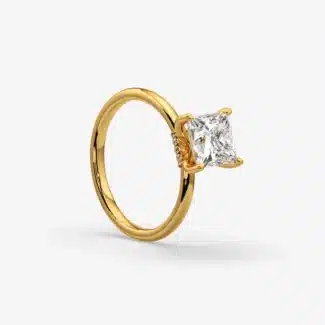
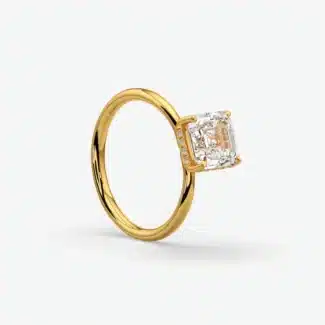


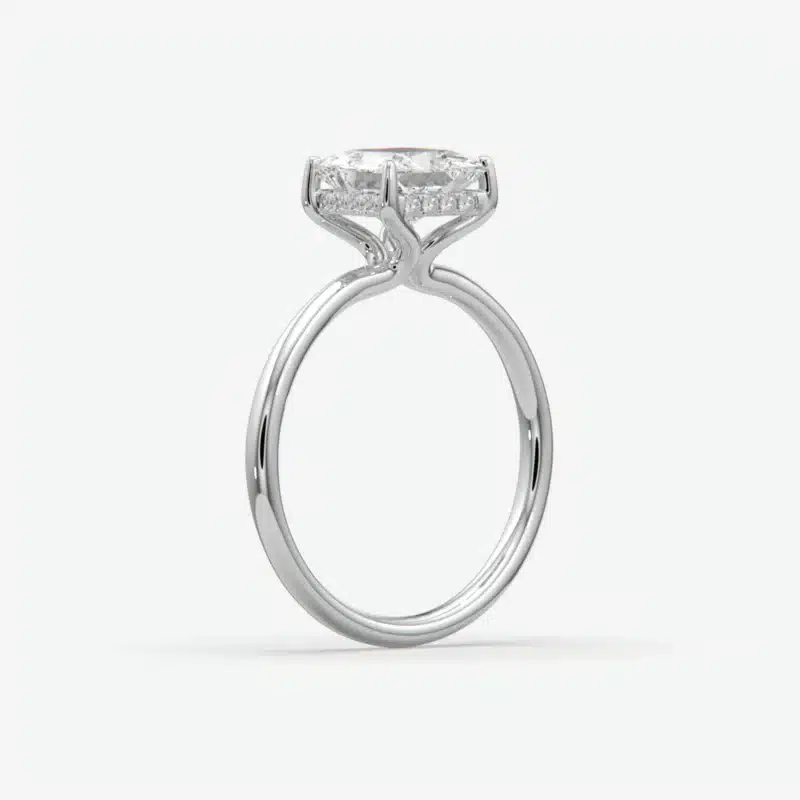

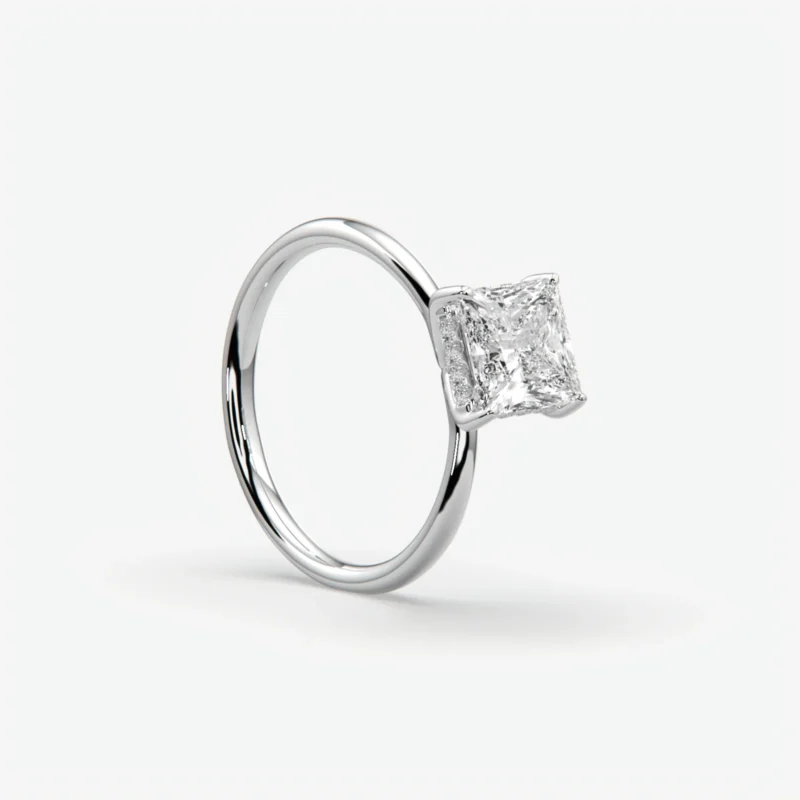


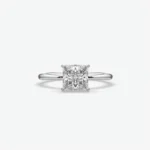
princess cut engagement ring
About princess cut engagement ring Design
The princess cut is one of the most distinctive square diamond shapes in fine jewelry. Developed in the 1960s to combine the brilliance of a round cut with a modern geometric outline, it’s defined by sharp, pointed corners and a faceting pattern that returns light in dramatic flashes across the surface of the stone. Princess cuts have remained among the top three engagement ring shapes by volume for decades, and the reason is simple, they read as both modern and unmistakable.
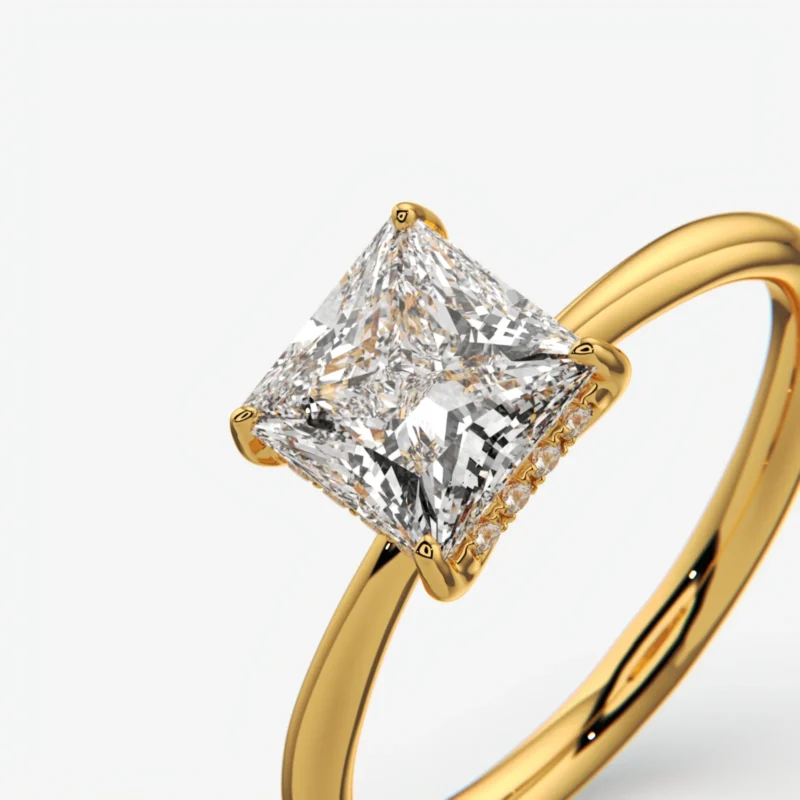
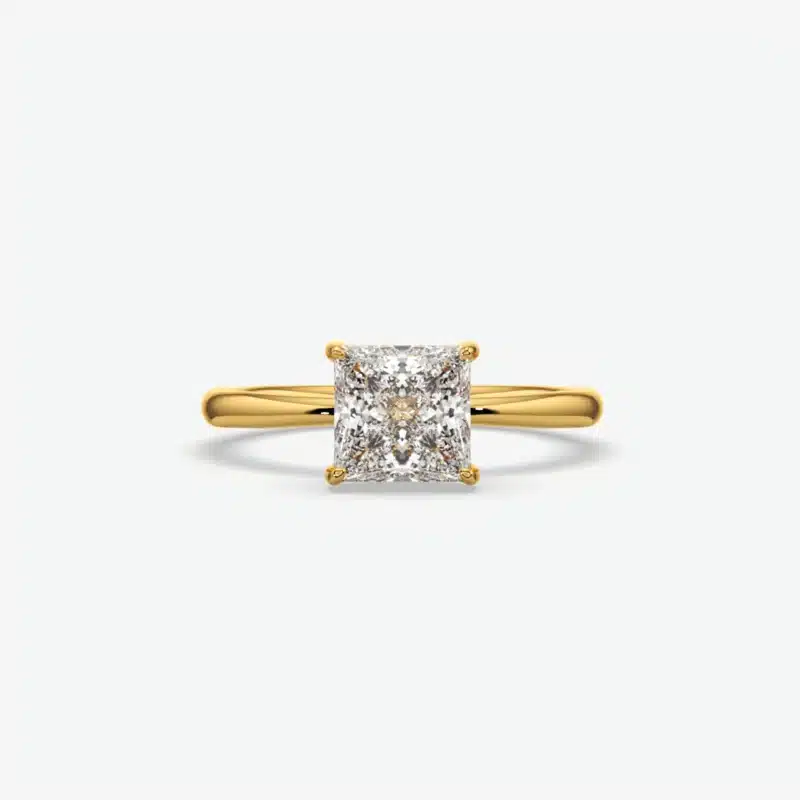
Solitaire Princess places this cut in a setting designed to support its geometry. Four prongs grip the stone at its corners, the most vulnerable points of any princess cut, where the sharp angles need protection from impact. The prong-at-each-corner configuration is standard for the cut and an essential structural choice rather than a stylistic one.
Beneath the diamond, a hidden halo of pavé stones wraps around the base of the princess, following the square silhouette of the center stone. From above, the halo is invisible, the ring reads as a pure princess solitaire with nothing competing with the cut’s clean geometry. From the profile, the halo reveals itself as a subtle band of additional brilliance, adding depth to the side view without altering the top.
The shank stays smooth and polished, tapering gently toward the back of the finger. There’s no pavé on the band, no decorative basket structure, no surface ornamentation. Every design choice serves the center stone.
It’s a princess solitaire for someone who appreciates the boldness of the cut and wants a modern detail tucked into the architecture, visible only when you look closely.
Customize This Ring
- Adjust or remove the hidden halo, keep it as designed to follow the square silhouette of the princess cut, or build the ring as a pure solitaire
- Modify the prong configuration, four-prong as designed at the corners (standard for princess cuts), or alternative styles like double prongs for added security
- Add pavé detailing along the band for sparkle visible from the top as well
- Adjust the band taper, gradual as designed or a uniform-width band for a more classic profile
- Choose between lab-grown or natural diamonds
- Adjust the center stone size, or switch to a different shape entirely
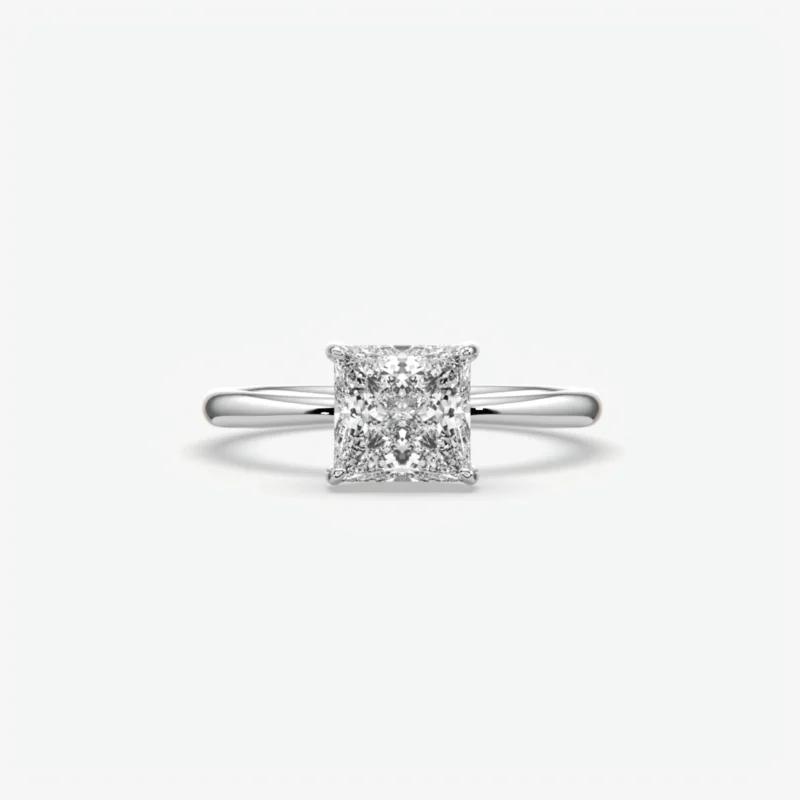
- Select your preferred metal: white gold, yellow gold, rose gold, or platinum
Explore our full custom engagement ring design process to start your own piece.
How Our Custom Design Process Works
- Free Consultation, share your vision, preferences, and budget
- CAD Design Preview, see a 3D render of your ring before it’s made
- Approval & Refinement, adjust every detail until it’s exactly right
- Crafting & Delivery, expertly handcrafted in our Atlanta studio
Why Choose Regal Studio
- Custom design expertise with full CAD preview before production
- Free in-person and virtual design consultations
- Both certified lab-grown and natural diamonds
- Atlanta showroom at 3384 Peachtree Rd NE #120
- Direct access to your designer throughout the process
Pricing & Timeline
Because every piece is handcrafted to your specifications, pricing depends on your chosen diamond, metal, and design details. Your consultation will include a clear, itemized quote before you commit.
Production typically takes 4 to 6 weeks after final approval.
A note on sizing: pricing may also vary with ring size, as gold weight changes accordingly. For designs with side stones, the total number of stones and total carat weight may vary based on size. Please also note that, depending on the style, some rings cannot be resized after they’re made. Your designer will walk you through this before the design is finalized.
Frequently Asked Questions
What’s the difference between a princess cut and an Asscher cut?
Both are square diamonds, but the differences are significant. Princess cuts have sharp, pointed corners and brilliant-style faceting, which creates rapid, scattered sparkle similar to a round diamond. Asscher cuts have deeply cropped corners (making them look almost octagonal) and step-cut faceting, which creates long, dramatic flashes of light rather than rapid sparkle. Princess cuts read modern; Asscher cuts read vintage.
Are the corners of a princess cut fragile?
The sharp corners are the most vulnerable parts of the stone, which is why all reputable princess settings place a prong at each corner for protection. With proper prong coverage, princess cuts are durable for everyday wear. The corners can chip if struck against a hard surface, but the four-prong corner setting significantly reduces that risk.
Why is the hidden halo shaped like a square?
A hidden halo follows the silhouette of the center stone, so on a princess cut the halo forms a square outline rather than a round or cushion shape. The pavé wraps tightly around the base of the diamond, visible from the profile but not from the top, which keeps the princess cut’s distinctive geometric outline as the focal point.
Do you offer lab-grown diamonds?
Yes, we work with both lab-grown and natural diamonds. Your designer can walk you through the differences in price, sourcing, and certification to help you choose what fits your priorities.
How long does it take to make Solitaire Princess?
Typically 4 to 6 weeks from final design approval to delivery.


