
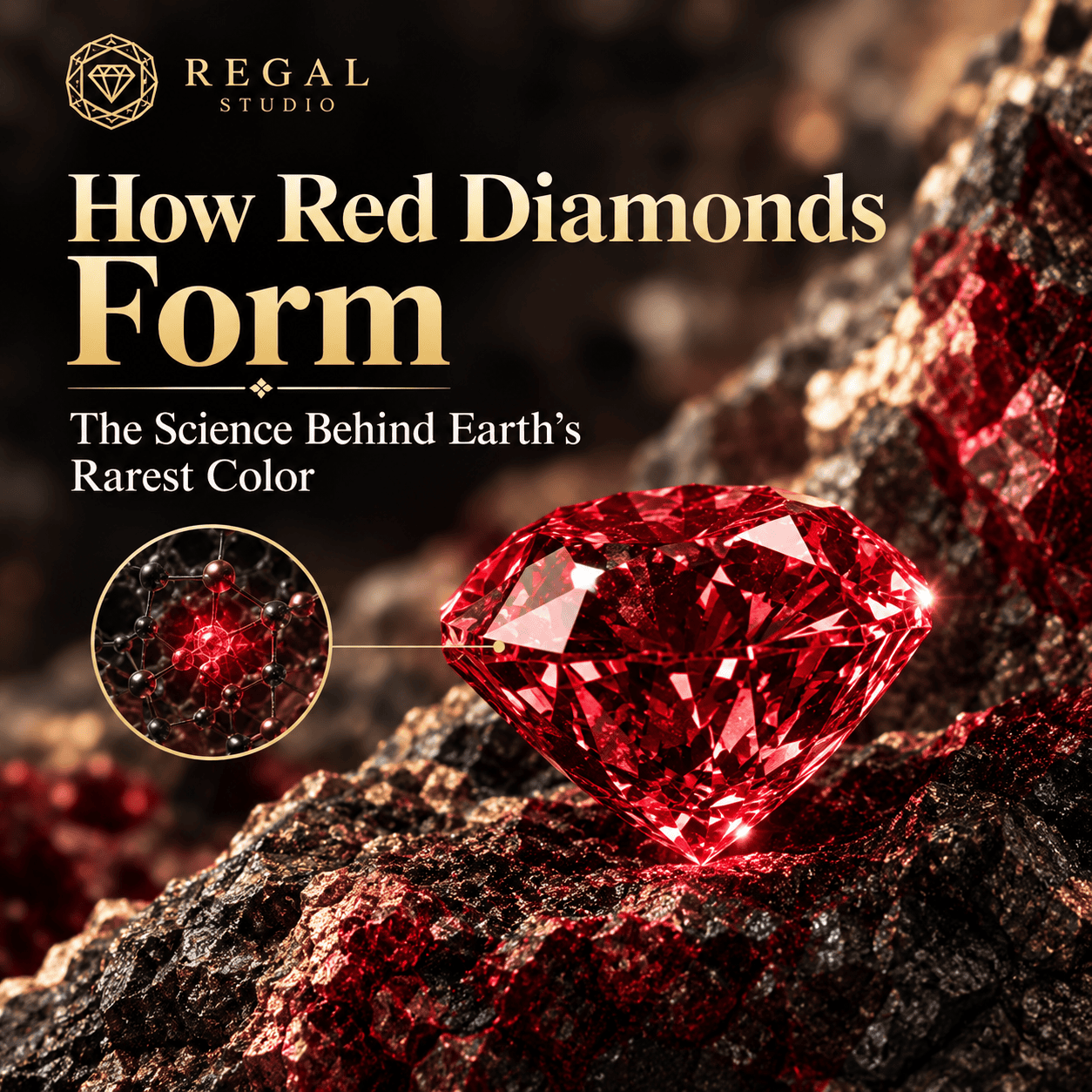


How Red Diamonds Form: The Science Behind Earth’s Rarest Color
Quick answer: Red diamonds form through a rare physical process called plastic deformation, not through chemical impurities like other colored diamonds. Under extreme pressure deep in Earth’s mantle, roughly 90 to 120 miles down, the diamond’s carbon crystal lattice twists and slips out of perfect alignment. This distortion changes how the stone absorbs light, producing red. Because the required deformation is so extreme and precise, fewer than 30 true red diamonds are known to exist worldwide.
So here is the actual science of how Earth’s rarest color forms, explained by a diamond expert.
A Note on Where This Analysis Comes From
This guide comes from Regal Studio in Buckhead, Atlanta. Our founder, Mack, began at the jeweler’s bench at just fourteen, trained across Europe, and is today a GIA Certified Diamond Grader with over 45 years of experience.
We have spent a career understanding what gives diamonds their color. Red is the one that still defies easy explanation.
So this is not a simplified summary. It is an expert’s look at genuine science, including what remains a mystery.
Why Red Is Different From Every Other Diamond Color
To understand red, you first have to understand how most diamond colors work. And red breaks the rule.
Nearly every colored diamond gets its hue from a chemical impurity, a foreign element trapped in the carbon during formation.
- Yellow comes from nitrogen.
- Blue comes from boron.
- Green comes from natural radiation.
A key insight often overlooked: red diamonds contain no such coloring element. They are made of pure carbon, chemically identical to a colorless diamond. Their color comes from something else entirely.
The Real Cause: Plastic Deformation
Here is the heart of science. Red comes from physics, not chemistry.
The cause is a phenomenon called plastic deformation. It is a physical distortion of the diamond’s atomic structure.
A diamond is carbon atoms locked in a perfect, rigid crystal lattice. During or after formation, immense pressure can force that lattice to slip and twist out of its ideal alignment.
These microscopic distortions change how the crystal interacts with light. Experience has shown that this is one of the few times in nature where a gem’s color is created by structure alone, not by what is inside it.
What Actually Happens to the Light
Let us go one level deeper, because this is the part that produces the red you see.
In a perfect diamond lattice, light passes through cleanly, and the stone appears colorless. When the lattice is deformed, that changes.
The distorted structure begins to absorb certain wavelengths of light, specifically green and yellow. The light that passes through and reflects back to your eye is what remains: red.
A key insight often overlooked: the color is not added to the diamond. It is what is left over after the deformed lattice subtracts other colors. Red is the diamond filtering light through its own damaged structure.
The Conditions Required to Form a Red Diamond
The geology behind this is extreme, which is exactly why red diamonds are so scarce.
Like all natural diamonds, red diamonds form deep in Earth’s mantle under staggering conditions:
- Depth: roughly 90 to 120 miles below the surface.
- Pressure: around 45,000 to 60,000 atmospheres.
- Temperature: approximately 900 to 1,300°C.
- Time: one to three billion years.
But red diamonds need something more. They require an additional burst of intense, directional pressure, often during formation or violent volcanic transport toward the surface, to deform the lattice.
In our market observations, this second requirement is the bottleneck. The base conditions form diamonds all the time. The extreme deformation that produces red almost never happens.
Red and Pink: The Same Mechanism, Different Degrees
This connection explains a great deal about why red is so rare.
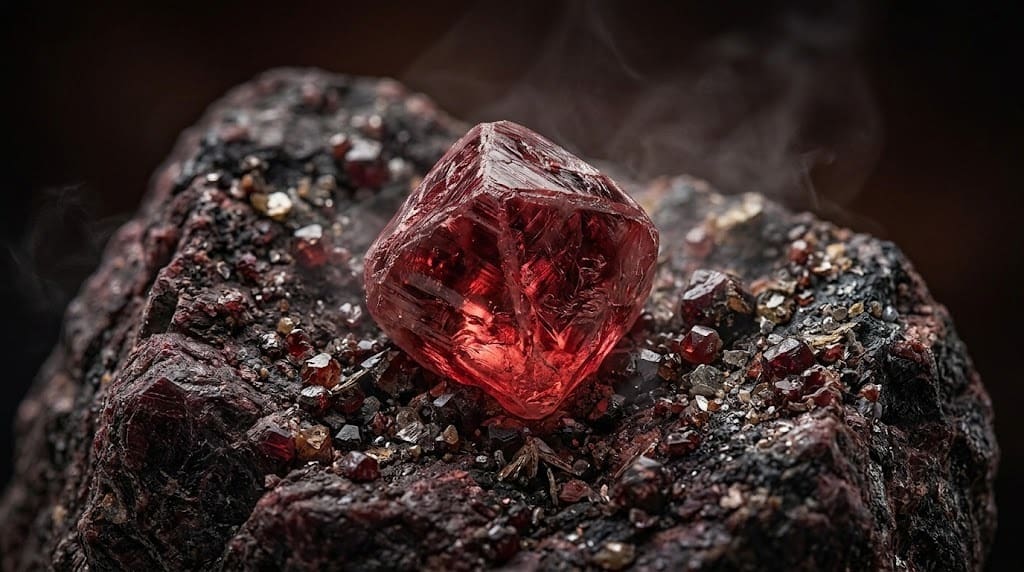
Pink diamonds form the same way, through plastic deformation of the lattice. Red and pink are points on a single spectrum.
The difference is intensity. Pink diamonds have moderate deformation. Red diamonds have deformation so extreme that the color saturates into full red.
A key insight often overlooked: many red diamonds first appear pink until closer analysis reveals red as the dominant hue. The GIA draws a firm line, and a stone that crosses into Fancy Red is categorically, and enormously, more valuable than even a Fancy Vivid Pink.
Why This Makes Red Diamonds Almost Impossibly Rare
Put the science together and the scarcity makes perfect sense.
- The deformation must be precise and extreme, not too little (pink), not so much the crystal shatters.
- It requires conditions that rarely align in nature.
- The result is fewer than 30 true red diamonds known worldwide, most under one carat.
Experience has shown that finding a red diamond over one carat is a once-in-a-generation event. The physics simply do not cooperate at larger sizes.
Where Red Diamonds Come From
The science needs geography to complete the picture.
The vast majority of red diamonds came from a single source: the Argyle Mine in Western Australia. It produced roughly 90% of the world’s known red and pink diamonds.
Argyle closed permanently in November 2020. With no comparable source discovered since, the supply of new red diamonds has effectively fallen to near zero.
A key insight often overlooked: Argyle’s unique geology, with the intense tectonic pressure its diamonds endured, is precisely why it produced the deformation needed for red. That geological accident may never be repeated.
The Mystery Science Hasn’t Fully Solved
Here is the honest expert truth. We do not understand red diamonds completely.
While plastic deformation is the leading and best-supported explanation, the exact atomic mechanism, and why some deformed diamonds turn red rather than pink or brown, remains debated among gemologists.
In our market observations, this lingering mystery is part of red’s allure. It is the one diamond color that still keeps scientists guessing.

Frequently Asked Questions
How do red diamonds form?
Through plastic deformation, a physical twisting of the carbon crystal lattice under extreme pressure deep in Earth’s mantle. This distortion causes the diamond to absorb green and yellow light and reflect red. Unlike other colors, no chemical impurity is involved.What makes red diamonds red instead of pink?
The same mechanism, plastic deformation, but taken to a far greater extreme. Pink diamonds have moderate lattice distortion; red diamonds have such intense distortion that the color saturates fully into red.Why are red diamonds so rare?
Because the required lattice deformation is extraordinarily precise and extreme, and forms only under rare geological conditions. Fewer than 30 true red diamonds are known worldwide, most weighing under one carat.Do red diamonds get their color from a chemical element?
No. Unlike yellow (nitrogen), blue (boron), or green (radiation) diamonds, red diamonds are pure carbon. Their color is purely structural, caused by physical distortion of the crystal lattice.Where do red diamonds come from?
Historically, about 90% came from the Argyle Mine in Western Australia, which closed in 2020. Small numbers have been found in Brazil, Africa, and Russia, but Argyle was the dominant source.
Discover Rare Fancy Color Diamonds in Atlanta
The science of red diamonds reveals a larger truth: a diamond’s true value lies in the rare natural forces that shaped it. Understanding that science is what separates an informed buyer from an ordinary one.
At Regal Studio in Buckhead, every piece is designed and handcrafted by Mack, a GIA Certified Diamond Grader with over 45 years of experience and the trust of more than 278 five-star clients. Whether you are fascinated by fancy color diamonds or seeking a flawless classic, we help you understand and source the finest stones with complete transparency.
Our motto says it all: “You Dream It, We Make It.”
Visit Regal Studio on Peachtree Road in Buckhead, or get in touch to book a consultation. Let a seasoned master jeweler help you find a diamond worthy of its own story.
Read More:
How Many Red Diamonds Are Left in the World? The Complete 2026 Count
How Much Is My Diamond Ring Worth? Atlanta Appraisal & Trade-In Guide (2026)