

Most advice on how to buy an engagement ring starts with the diamond. We think it should start earlier, with your budget, her taste and her finger size, because those three answers narrow every choice that follows. Settle them first and the later decisions get easier, and usually less expensive.
This engagement ring buying guide walks through eleven steps in the order we suggest to clients at our Buckhead studio. It is written to be useful wherever you end up shopping. Where a topic deserves more depth, we point you to a fuller guide.
How to buy an engagement ring in the right order
Each step below answers a question that the next step depends on. Skipping ahead, such as choosing a setting before the stone, is how buyers end up paying for compromises.
Step 1: How much should you spend on an engagement ring?
Ignore the rules about two or three months of salary. They trace back to jewelry advertising, not financial planning, and they say nothing about your savings, your debts or what else you are building together. The right number is one you can pay without regret and without carrying a balance into the marriage.
Set the figure before you look at a single stone, then decide what it covers. The center stone and setting are obvious, but sales tax, the first year of insurance and any engraving belong in the same number.
It helps to know which lever moves price fastest. Carat weight raises cost more quickly than any other factor, so a slightly smaller stone with a better cut often looks brighter and costs less. Our guide to custom engagement ring cost breaks down where the money goes in a made-to-order ring.
Step 2: How do you learn her style and ring size discreetly?
Reading her style
Look at the jewelry she wears every day, not the pieces saved for weddings. Daily choices show whether she leans toward yellow or white metal, fine or substantial pieces, clean lines or detail. Notice whether she wears rings at all: someone who rarely does may prefer a lower, smoother profile that does not catch.
A close friend, a sister or the images she saves online can fill the gaps. Photograph a piece she loves and bring the photo to your jeweler.
Finding her ring size
The most reliable method is to borrow a ring she wears on her left ring finger and have a jeweler measure it. A ring from another finger is only a rough guide, since fingers on the dominant hand often run a little larger. If you have to guess, guess slightly large: taking a plain band down a size is usually simpler than stretching it up.
Some designs are hard to resize, such as bands set with stones all the way around. If you are unsure of her size, choose a shank with a plain section at the base so a jeweler can adjust it after the proposal.
Step 3: Choose the diamond shape
Shape sets the character of the ring more than any other choice. Round brilliants return the most light and suit nearly every setting. Ovals, pears and marquise shapes spread their weight across a longer outline, so they look larger per carat and lengthen the finger.
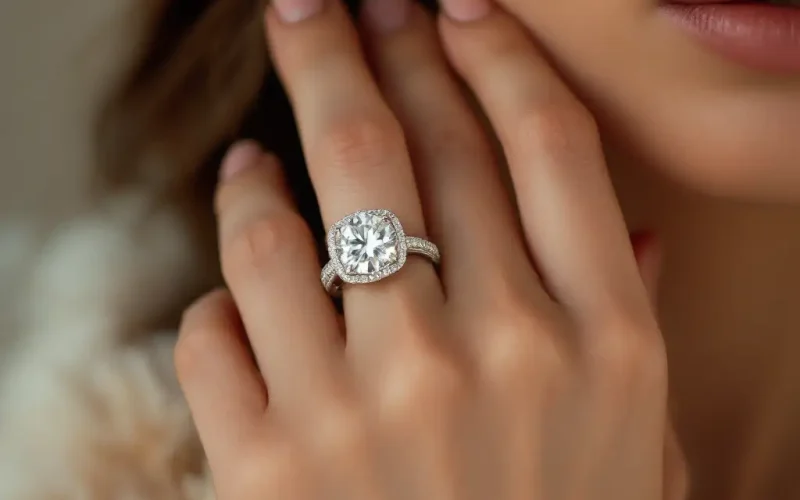
Emerald and Asscher cuts show long, calm flashes of light rather than sparkle, and they suit someone who prefers clean geometry to glitter. Cushions are soft and romantic, while princess cuts give a crisp modern square with corners that need protecting. If she has shown no preference, round or oval is the safest start. Our diamond shapes guide compares each shape in detail, including how it wears over time.
Step 4: Which of the 4Cs should you prioritize for your shape?
The 4Cs are cut, color, clarity and carat, the grading language standardized by GIA. They do not carry equal weight, and how much each one matters depends on the shape you chose. The principle is simple: spend where the eye notices and save where it cannot.
| The C | Where to spend | Where to save |
|---|---|---|
| Cut | Always buy the best cut you can. On a round diamond, look for an Excellent cut grade on the report. | Rarely worth it. A poorly cut stone looks dull at any size or color. |
| Color | Emerald, Asscher and larger elongated stones show color more, so stay near colorless in white metal. | G to I often faces up white in white metal. Yellow and rose gold flatter warmer grades. |
| Clarity | Step cuts such as emerald and Asscher reveal inclusions through their open facets, so aim higher. | In brilliant cuts, an eye-clean VS2 or SI1 often looks identical to a far pricier stone. |
| Carat | Spend on size only after the cut is right. | Stones just under round numbers, such as 0.90 instead of 1.00 carat, often cost noticeably less and look nearly the same. |
Round diamonds
GIA assigns an overall cut grade only to standard round brilliants, which makes rounds the easiest shape to judge on paper. Excellent cut, G or H color and eye-clean clarity is a sensible balance for most budgets.
Fancy shapes
Ovals, pears, marquise and cushions carry no overall cut grade, so you judge them by eye and by proportions. Elongated stones can show a dark bow tie across the center: a faint one is normal, a heavy one is a reason to keep looking. Compare the length-to-width ratio as well, so the outline looks the way she pictures it.
Step 5: Should you choose a lab-grown or natural diamond?
A lab-grown diamond is chemically, physically and optically a diamond. It is not a simulant like moissanite or cubic zirconia. The difference is origin, and origin affects price and resale far more than appearance.
Lab-grown stones typically cost much less than natural stones of the same size and grade, which lets you choose a larger or better-graded stone. The tradeoff is resale: lab-grown diamonds have little secondary market value, and their prices have fallen as production has grown. Natural diamonds hold some value and carry the meaning of a stone formed deep in the earth over billions of years, which matters a great deal to some couples and not at all to others.
Neither is the wrong answer. Decide together whether size, origin or long-term value matters most. Our comparison of lab-grown vs natural diamonds covers the details, and we set both.
Step 6: How do you check a diamond’s certification?
A grading report from an independent laboratory is the diamond’s identity document. GIA and IGI are the names you will see most often; IGI grades a large share of lab-grown stones, and GIA now reports on lab-grown diamonds in a simpler descriptive format rather than its full natural-diamond grading scale. A store’s own “certificate” is not a substitute.
Reading the report
Check the shape, measurements, carat weight, color, clarity and, for rounds, the cut grade. Look at the clarity plot, which maps the main inclusions, and confirm the report states whether the stone is natural or laboratory grown. Any treatment should be listed in writing.
Matching the inscription
Most graded diamonds carry their report number laser inscribed on the girdle, the thin outer edge. Ask the jeweler to show you that number under a loupe or microscope and compare it to the paper. The measurements should match too. This one check confirms you are buying the diamond you were shown.
Step 7: Choose a setting and metal for her lifestyle
The setting decides how the ring wears every day. A high-set solitaire shows the most of the stone but catches on sweaters and gloves. A bezel wraps the stone in metal and protects it well for nurses, surgeons, athletes and anyone who works with their hands, at the cost of a little light. A lower setting or a hidden halo is a sensible middle path.
Halos and pavé bands add sparkle and apparent size, but many small stones mean many small prongs. Plan on a yearly check of any ring with prongs.
Metal
Platinum is dense and naturally white. When it wears, the metal moves rather than wearing away, which keeps prongs substantial, and it never needs replating. White gold is lighter and less expensive, but it is usually rhodium plated and often needs replating every year or two to stay bright.
Yellow and rose gold need no plating and flatter warmer skin tones. 18k gold is 75 percent gold and 14k is 58.3 percent; 14k is a little harder and shrugs off daily wear better, while 18k has a richer color.
Step 8: Should you buy a custom or ready-made ring?
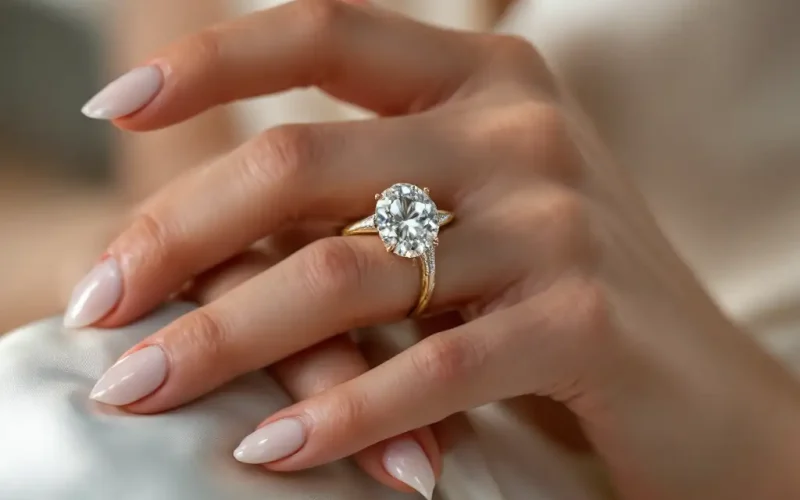
A ready-made ring is fast. You see exactly what you are getting and can often take it home within days. The limits are fit and choice: the proportions are already fixed, and many mass-produced settings are cast thin to control cost.
A custom ring is built around the stone you chose and the hand that will wear it. Every Regal design is previewed in 3D CAD, then made to order in our Buckhead studio and set and finished by our jewelers. Our master jeweler, Mack, trained in Europe, has 45+ years at the bench and is a GIA Diamond Grader, so stone selection and design happen in the same conversation.
If you are leaning custom, our walkthrough of how to design a custom engagement ring explains each stage, and our overview of custom engagement rings in Atlanta covers what to look for in a local maker.
Step 9: Plan the timeline back from the proposal date
Most of the stress in ring buying comes from starting late. Work backward from the day you want to propose and leave room for one revision and one surprise.
| Time before the proposal | What to do |
|---|---|
| 12 to 16 weeks | Set the budget, learn her style and size, narrow the shape |
| 10 to 12 weeks | Select and verify the diamond, review the CAD design |
| 8 to 10 weeks | Approve the design; custom production typically takes 4 to 6 weeks from here |
| 2 to 4 weeks | Collect the ring, check fit and finish, arrange the appraisal |
| Before you propose | Confirm insurance is active |
A ready-made ring shortens this, but still leave time to verify the stone and insure it.
Step 10: Arrange an appraisal and insurance
An appraisal documents the finished ring and its replacement value for insurance. It is different from a grading report: the report describes the loose diamond, while the appraisal describes the whole ring and what it would cost to replace. We provide appraisals, and any qualified independent appraiser can do the same.
Insure the ring before the proposal, not after. Coverage can come from a rider on a homeowners or renters policy or from a dedicated jewelry insurer. Ask whether the policy covers loss and mysterious disappearance as well as theft, and update the appraisal every few years. Our guide to engagement ring insurance compares the options.
Step 11: What are the red flags when buying an engagement ring?
| Red flag | Why it matters |
|---|---|
| No independent grading report | An in-house certificate or a verbal grade cannot be checked by anyone else. |
| Report details that do not match | A different inscription, weight or measurement means it may not be the stone on paper. |
| Undisclosed treatments | Fracture filling and other clarity enhancements must be disclosed in writing. |
| Vague origin | A seller should state in writing whether a stone is natural or lab-grown. |
| Pressure to decide today | Deadlines and one-day prices are sales tactics, not information. |
| An appraisal far above the price | Inflated appraisals are used to make an ordinary price look like a bargain. |
| No time with a loupe | A jeweler should let you inspect the stone yourself under magnification. |
For a fuller set of questions to put to any jeweler, see what to ask a custom jeweler before you buy.
Frequently Asked Questions
Should I propose with a finished ring or let her choose?
Both work. Some buyers propose with a finished ring, others with the loose diamond or a simple placeholder setting and design the final ring together afterward. If you are unsure of her taste, the second route removes the guesswork without spoiling the moment.
Which of the 4Cs matters most when choosing an engagement ring?
Cut. It decides how much light the diamond returns, and a well-cut stone looks livelier than a larger, poorly cut one. Once the cut is right, balance color, clarity and carat to fit the budget.
Can I buy the diamond first and choose the setting later?
Yes, and for custom work it is often the better order, since the setting can be drawn around the exact stone. Make sure the diamond has an independent report and that you have checked its inscription before you pay.
How long does a custom engagement ring take?
At Regal, production takes 4 to 6 weeks after you approve the CAD design. Add time for choosing the stone and refining the design, so starting three to four months before the proposal is comfortable.
What if the ring size turns out to be wrong?
Most solid gold and platinum rings can be resized, usually by a size or two, without affecting the design. Rings with stones set all the way around the band are the exception, which is why a plain section at the base is a sensible choice when the size is a guess.
Knowing how to buy an engagement ring is mostly a matter of order and verification. If you would like help with any step, from reading a grading report to choosing a setting, book a free consultation in person or virtually, or call us at (404) 846-2525.