


Hope Diamond Exposed: The Curse, Secrets & $250 Million Mystery
Few gemstones in history command the mystique, terror, and fascination of the Hope Diamond. This mesmerizing blue stone has allegedly brought tragedy to nearly everyone who owned it, yet millions travel each year just to glimpse its otherworldly glow through bulletproof glass at the Smithsonian.
You’ve probably heard whispers about its curse stories of beheadings, suicides, and mysterious deaths that seem to follow this jewel like a shadow. But how much of what you’ve heard is real, and how much is Hollywood fiction? Beyond the legends lies an extraordinary true story spanning four centuries, crossing three continents, and touching the lives of kings, thieves, socialites, and museum curators.
Whether you’re a gemstone enthusiast, history buff, or someone who simply loves a good mystery, the Hope Diamond’s tale offers something remarkable: a tangible connection to French royalty, Indian mines, American high society, and the enduring human fascination with both beauty and danger.
In this comprehensive guide, we’ll explore everything about this legendary gem. You’ll discover the authentic Hope Diamond history from its origins in India to its current home in Washington D.C. You’ll finally get the answer to why is the Hope Diamond famous beyond just its curse. And you’ll learn scientific facts that might surprise you more than any legend.
Let’s dive into the captivating world of history’s most notorious blue diamond.
What Makes the Hope Diamond Extraordinary?
Before exploring its notorious past, let’s understand what makes this particular diamond so scientifically remarkable.
The Physical Characteristics
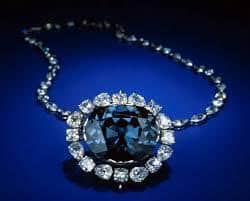
The Hope Diamond isn’t just famous it’s genuinely exceptional from a gemological perspective:
- Weight: 45.52 carats (9.104 grams)
- Color: Fancy Deep Grayish Blue (extremely rare)
- Cut: Cushion antique brilliant
- Dimensions: 25.60 × 21.78 × 12.00 mm
- Clarity: VS1 (Very Slightly Included)
- Current setting: Surrounded by 16 white diamonds, hanging from a chain with 45 more diamonds
What truly distinguishes this diamond is its color. The Hope Diamond displays an intense blue hue caused by trace amounts of boron within its crystal structure. This natural coloring is exceptionally rare; less than 0.1% of all diamonds exhibit any blue coloration, and the Hope’s intensity is even more uncommon.
The Mysterious Red Glow
Perhaps the most supernatural aspect of the Hope Diamond is actually rooted in science. When exposed to ultraviolet light, the diamond emits a strong red phosphorescent glow that persists for several seconds after the UV source is removed.
This phenomenon occurs due to the same boron impurities that create its blue color. When UV light excites the electrons in these boron atoms, they release energy as they return to their ground state producing that eerie red afterglow.
Imagine seeing this in the 18th century without modern scientific understanding. No wonder people believed it was cursed! The gem literally glows blood-red in the dark after exposure to sunlight. It’s easy to see how superstitions developed around such an unnatural-seeming property.
The Value Question
The Smithsonian officially values the Hope Diamond at $200-250 million, though experts acknowledge this is conservative. Its actual worth is essentially incalculable because:
Historical provenance – Few gems can claim such documented royal lineage
Scientific rarity – The specific combination of size, color intensity, and quality is virtually unique
Cultural significance – Decades as the world’s most famous diamond
Legal impossibility – The Smithsonian cannot sell it; it belongs to the American people
If the Hope Diamond could theoretically be auctioned, many experts believe it would shatter all previous gemstone records, potentially reaching $500 million or more.

Hope Diamond History: From Indian Mines to American Museum
The Hope Diamond history reads like an adventure novel, complete with theft, murder, mysterious disappearances, and international intrigue. Let’s trace its documented journey through the centuries.
The Tavernier Blue: Indian Origins (Pre-1668)
The Hope Diamond’s story begins in India’s Kollur mine in Golconda (present-day Andhra Pradesh), the same legendary source as the Koh-i-Noor. These mines produced the world’s finest diamonds for centuries until their depletion in the mid-1700s.
French merchant and gem trader Jean-Baptiste Tavernier acquired a massive 115-carat blue diamond during his travels in India around 1666. Historical accounts differ on exactly how he obtained it:
Official account – Tavernier purchased it legitimately from Indian diamond dealers
Legend – He stole it from the eye of a Hindu idol in a temple (almost certainly false)
Probable truth – He bought it through established trade networks, as he did with hundreds of other gems
Tavernier brought this enormous blue diamond known as the “Tavernier Blue” back to France in 1668. This stone would eventually become the Hope Diamond, though it would undergo significant transformations along the way.
The French Blue: Royal Tragedy (1668-1792)
In 1668, Tavernier sold his extraordinary blue diamond to King Louis XIV of France for an astronomical sum. The Sun King, known for his extravagant tastes, had it recut by court jeweler Sieur Pitau into a 67.125-carat triangular brilliant, now called the “French Blue.”
Key moments during French royal ownership:
1668-1715 – King Louis XIV owned and occasionally wore the diamond as a decorative order
1715-1774 – King Louis XV inherited it but rarely displayed it
1774-1792 – King Louis XVI and Queen Marie Antoinette possessed it during France’s most turbulent period
The diamond became part of the French Crown Jewels, stored in the Garde-Meuble (Royal Treasury) in Paris. Marie Antoinette allegedly wore it on special occasions, though definitive evidence is scarce.
The Theft and Disappearance (1792-1812)
In September 1792, amid the chaos of the French Revolution, thieves broke into the Royal Treasury and stole the French Crown Jewels including the French Blue diamond. This theft occurred during the same revolutionary fervor that would lead to Louis XVI and Marie Antoinette’s executions by guillotine in 1793.
The diamond vanished completely from historical records for 20 years.
What happened during this mysterious period?
Most historians believe the diamond was:
- Smuggled out of France to avoid detection
- Recut to disguise its identity and avoid prosecution (possessing stolen crown jewels was a capital offense)
- Possibly divided into multiple stones
- Sold through underground networks
This 20-year gap is where the Hope Diamond’s curse legends gained their strongest foothold. The timing Revolution, royal executions, decades of mystery provided perfect soil for supernatural storytelling.
The Emergence in England (1812-1839)
The diamond resurfaced in 1812 in the possession of London diamond merchant Daniel Eliason. Historical documents show he had a large blue diamond (now much smaller than the French Blue) that matches the Hope Diamond’s description.
The 20-year gap between the theft (1792) and reappearance (1812) is significant: French law stated that after 20 years, stolen goods couldn’t be reclaimed. This “coincidence” strongly suggests the diamond was deliberately hidden until the legal danger passed.
How did the recut diamond travel from revolutionary France to Georgian England? The most likely scenario involves:
- Professional criminals who specialized in jewel theft
- Recutting by master craftsmen to create a “new” diamond
- Sale through London’s thriving underground gem market
- Acquisition by wealthy collectors who knew not to ask questions
The Hope Family and the Diamond’s Name (1839-1901)
In 1839, the diamond appeared in the catalog of banker Henry Philip Hope’s gem collection. Hope was a serious collector who owned one of London’s finest private gem collections.
After Henry Philip Hope’s death, the diamond passed through his family via inheritance, giving the gem the name we know today: the Hope Diamond.
Hope family ownership timeline:
1839-1862 – Henry Philip Hope (original owner who gave it its name)
1862-1887 – His nephew Henry Thomas Hope inherited it
1887-1901 – Lord Francis Hope inherited it but faced financial troubles
Lord Francis Hope’s financial difficulties forced him to sell the diamond in 1901, after lengthy legal battles with his siblings over the estate. He married American actress May Yohé, and later blamed the diamond for his divorce and bankruptcy helping cement the curse narrative.
American Millionaires and the Curse Legend (1901-1949)
The diamond entered its most notorious period as it passed through American high society:
1901-1908: Simon Frankel – New York diamond merchant who displayed it at exhibitions
1908-1910: Selim Habib – Turkish sultan who allegedly lost his fortune (sold it to help pay debts)
1910-1911: Pierre Cartier – Parisian jeweler who acquired it and enhanced the curse stories to increase its appeal
1911-1949: Evalyn Walsh McLean – American socialite and heiress
Evalyn Walsh McLean’s ownership represents the peak of the curse mythology. Cartier allegedly embellished and possibly invented curse stories to make the diamond more appealing to McLean, who believed she could reverse curses.
McLean’s life did include genuine tragedies:
- Her first son was killed by a car at age 9
- Her daughter died from a sleeping pill overdose at age 25
- Her husband left her for another woman and was later declared insane
- She lost much of her fortune and died estranged from her family
However, these tragedies weren’t unusual for wealthy families in that era, and many resulted from the family’s troubled behaviors rather than supernatural forces. McLean wore the diamond constantly and even let her dog wear it for parties, hardly the behavior of someone who truly feared its power.
Harry Winston and the Smithsonian Donation (1949-1958)
When McLean died in 1949, famed jeweler Harry Winston purchased her entire jewelry collection, including the Hope Diamond. Winston used it as a centerpiece for his “Court of Jewels” exhibition, which toured across America to benefit various charities.
In an extraordinary act of generosity, Winston donated the Hope Diamond to the Smithsonian Institution in November 1958. He shipped it via registered mail in a plain brown package—insured for $1 million but costing only $2.44 in postage (with an additional $142.85 for insurance).
The mailman who delivered it, James Todd, later said the most exciting part was getting his picture in the newspaper. He didn’t believe in the curse.
The Smithsonian Era (1958-Present)
Since arriving at the Smithsonian’s National Museum of Natural History, the Hope Diamond has become the institution’s most popular exhibit. More than 100 million people have viewed it since 1958.
Significant moments in its museum life:
1958 – Initial display in simple setting
1975 – Briefly removed for security improvements
1982 – Examined for the Smithsonian’s 136th anniversary
1996 – Loaned to Harry Winston Inc. for temporary display and cleaning
2009 – Removed and replaced with a new setting designed by Harry Winston
2010-2011 – Traveled outside the museum for the first time in 50 years to London’s Natural History Museum
Present – Displayed in the Harry Winston Gallery (formerly Janet Annenberg Hooker Hall of Geology, Gems, and Minerals)
The diamond now belongs to the American people and serves an educational purpose, allowing millions to appreciate one of nature’s most remarkable creations.

Why Is the Hope Diamond Famous? Beyond the Curse
While the curse makes for captivating storytelling, the real answer to why the Hope Diamond is famous involves multiple factors that extend far beyond superstition.
1. Extraordinary Rarity and Beauty
The Hope Diamond’s fame begins with its physical qualities:
Color intensity – Its deep blue is among the most saturated ever seen in a diamond of this size
Size and quality – At 45.52 carats with excellent clarity, it’s exponentially rare
Phosphorescence – The red glow phenomenon is scientifically fascinating
Cut and brilliance – Despite being an antique cut, it displays remarkable fire and scintillation
Only a handful of large blue diamonds exist worldwide, and none combine size, color intensity, and quality quite like the Hope Diamond.
2. Verifiable Royal Provenance
Unlike many historical gems with questionable backgrounds, the Hope Diamond has extensively documented royal ownership:
- Owned by three French kings
- Part of the French Crown Jewels
- Connected to Marie Antoinette
- Possessed by British aristocracy
- Featured in American high society
This traceable lineage through history’s most famous figures creates inherent fascination. When you view the Hope Diamond, you’re looking at the same stone French royalty wore centuries ago.
3. The Perfect Storm of Storytelling
The diamond’s fame stems partly from narrative timing. Its story includes:
Romance – Kings, queens, and doomed lovers
Crime – Revolutionary theft and decades of mystery
Mystery – 20-year disappearance during tumultuous times
Tragedy – Real deaths and misfortunes among owners
Hollywood appeal – The curse narrative proved irresistible to filmmakers
The Hope Diamond became famous because it offered every element of a perfect story: beauty, royalty, theft, mystery, and danger.
4. Media and Popular Culture
Modern fame requires modern media, and the Hope Diamond benefited from:
Early 20th-century newspapers – Sensationalized the McLean family tragedies
Books and articles – Countless publications explored its history
Film and television – Featured in documentaries, dramas, and even “Titanic” (the Heart of the Ocean was inspired by it)
Museum prominence – Smithsonian marketing made it an iconic exhibit
Social media era – Continues to trend as visitors share photos and stories
Each generation rediscovers the Hope Diamond through contemporary media, keeping it perpetually relevant.
5. Scientific Importance
Beyond aesthetics, the Hope Diamond contributes to gemological science:
Type IIb classification – Rare category containing boron (less than 0.1% of all diamonds)
Phosphorescence research – Helps scientists understand diamond formation and properties
Geological insights – Offers clues about Earth’s deep mantle conditions
Technology applications – Boron-containing diamonds have semiconductor properties useful in electronics
The diamond serves as a natural laboratory for understanding rare geological processes.
6. Accessibility to the Public
Unlike most legendary gemstones locked in private collections or royal vaults, the Hope Diamond is freely accessible to anyone who visits the Smithsonian. This democratic availability contributes enormously to its fame.
Approximately 7 million people visit the Natural History Museum annually, and the Hope Diamond is consistently the most photographed exhibit. Its accessibility makes it “America’s diamond”—a shared treasure rather than a private prize.
7. The Curse Narrative
While we’ll explore this in detail later, the curse story undeniably amplifies the diamond’s fame. The tragic fates of Louis XVI, Marie Antoinette, and several subsequent owners created a compelling supernatural narrative that captures imagination even among skeptics.
The curse story works because:
- It provides simple explanations for complex historical events
- It adds moral dimension (greed punished) to an otherwise neutral object
- It creates delicious fear—safe to contemplate from behind museum glass
- It makes every viewer wonder, “Would I wear it despite the risk?”
The Curse of the Hope Diamond: Fact vs. Fiction
No discussion of this legendary gem is complete without examining its most famous attribute: the alleged curse that brings misfortune to all who own it.
Origins of the Curse Story
The Hope Diamond curse narrative appears to be largely a creation of early 20th-century marketing rather than ancient legend. Here’s how it developed:
Fiction mixed with fact – The curse story gained traction through:
- May Yohé (Lord Francis Hope’s ex-wife) blaming the diamond for her troubles in newspaper interviews
- Sensationalist journalists connecting unrelated tragedies
- Pierre Cartier allegedly embellishing stories to entice Evalyn Walsh McLean
- Popular books inventing details (some claimed Tavernier was eaten by wild dogs, though he actually died peacefully)
No historical curse before 1900 – Historical records show no curse mythology during French royal ownership. The concept emerged only after the diamond entered American hands.
The temple theft myth – The popular story that Tavernier stole the diamond from a Hindu idol’s eye is almost certainly fiction. Tavernier was a legitimate merchant who recorded his transactions, and this story appears nowhere in his detailed travel journals.
Examining the “Cursed” Owners
Let’s evaluate whether Hope Diamond owners actually faced unusual misfortune:
King Louis XIV (1668-1715)
- Alleged curse: None specifically attributed
- Reality: Died at age 77 of gangrene—a long life for that era
- Verdict: No unusual tragedy
King Louis XV (1715-1774)
- Alleged curse: None specifically attributed
- Reality: Died at 64 from smallpox—died after a successful 59-year reign
- Verdict: No unusual tragedy
King Louis XVI and Marie Antoinette (1774-1793)
- Alleged curse: Both executed by guillotine
- Reality: Victims of political revolution, not supernatural forces; thousands of French aristocrats faced the same fate regardless of diamond ownership
- Verdict: Tragic but politically motivated, not curse-related
The 1792 Thieves
- Alleged curse: Most supposedly died violently or miserably
- Reality: We don’t actually know who the thieves were or what happened to them
- Verdict: Pure speculation
Hope Family Members (1839-1901)
- Alleged curse: Lord Francis Hope faced bankruptcy and divorce
- Reality: His financial problems resulted from gambling and poor business decisions; his wife left him for an actor, not supernatural reasons
- Verdict: Self-inflicted troubles, not curse-related
Simon Frankel (1901-1908)
- Alleged curse: Lost his fortune
- Reality: He sold the diamond at a profit; later financial troubles had no connection to diamond ownership
- Verdict: No evidence of curse
Selim Habib (1908-1910)
- Alleged curse: Drowned in a shipwreck
- Reality: Died in 1922, twelve years after selling the diamond, of natural causes
- Verdict: Curse story is completely fabricated
Evalyn Walsh McLean (1911-1949)
- Alleged curse: Son killed by car, daughter’s overdose, husband’s infidelity and mental illness, financial difficulties
- Reality: These tragedies occurred across 38 years of ownership; wealthy families often experience troubles, especially those dealing with substance abuse issues (the family struggled with alcoholism)
- Verdict: Genuine tragedies but not statistically unusual for a troubled wealthy family over four decades
Harry Winston (1949-1958)
- Alleged curse: None claimed
- Reality: Successfully used it for charitable exhibitions, donated it generously, lived to age 82
- Verdict: Complete absence of curse
James Todd (postal carrier who delivered it)
- Alleged curse: Some claimed he faced troubles
- Reality: His only “tragedy” was a leg injury in an unrelated accident; he lived a normal life and dismissed curse stories
- Verdict: No curse
Smithsonian Institution (1958-present)
- Alleged curse: None
- Reality: The museum thrives; the diamond generates millions in visitor revenue
- Verdict: No curse (unless you count overcrowding in the gem hall)
The Psychology Behind Curse Beliefs
Why do curse stories persist despite lack of evidence?
Confirmation bias – We remember tragedies but forget ordinary lives
Pattern recognition – Humans naturally seek connections between events
Moral narrative – Curses satisfy our sense that greed should be punished
Entertainment value – Curse stories are simply more interesting than “rich people had normal lives”
Retrospective interpretation – Every life contains tragedies; curse believers selectively emphasize those of diamond owners
Scientific Perspective
From a scientific standpoint, curses are impossible. The Hope Diamond is simply crystallized carbon with boron impurities. It has no mechanism to influence events around it.
The red phosphorescence—while eerie—is just physics, not magic. It occurs because absorbed UV energy is re-emitted at a different wavelength. Spooky-looking? Yes. Supernatural? No.
The Hope Diamond Today: Visiting and Viewing
Want to see this legendary gem in person? Here’s everything you need to know about experiencing the Hope Diamond firsthand.
Location and Display Details
The Hope Diamond resides in the Smithsonian National Museum of Natural History in Washington, D.C., specifically in the Harry Winston Gallery on the second floor.
Current display features:
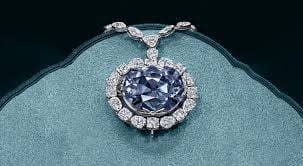
- Setting: Surrounded by 16 white pear-shaped and cushion-cut diamonds totaling 16.21 carats
- Necklace: Attached to a chain containing 45 white diamonds totaling 48.12 carats
- Case: Bulletproof glass with climate control
- Lighting: Specially designed to show the stone’s color and brilliance
- Rotation: The diamond slowly rotates for 360-degree viewing
- UV demonstration: Periodic displays show the red phosphorescence under ultraviolet light
The setting was designed by Harry Winston Inc. in 2009 and can be removed, allowing the Hope Diamond to be worn as either a pendant or a standalone diamond.
Museum Visit Information
Address: National Museum of Natural History 10th Street and Constitution Avenue NW Washington, DC 20560
Hours:
- Generally 10:00 AM to 5:30 PM daily (extended summer hours)
- Closed December 25
- Check official website for current hours
Admission:
- FREE (Smithsonian museums offer free entry)
- Timed entry passes recommended during peak season
Best times to visit:
- Weekday mornings (10:00-11:00 AM)
- Late afternoons after school groups depart
- Winter months (fewer tourists)
What to expect:
- Crowds year-round (the Hope Diamond is the museum’s #1 attraction)
- 2-5 minute typical viewing time
- Security presence (discrete but constant)
- No touching allowed (obviously)
- Photography permitted (flash may be restricted)
The Complete Gem Collection
While you’re there, don’t miss other extraordinary pieces in the Harry Winston Gallery:
The Dom Pedro Aquamarine – World’s largest cut aquamarine (10,363 carats)
The Hooker Emerald – 75-carat Colombian emerald once owned by Ottoman sultans
The Rosser Reeves Ruby – 138.7-carat star ruby
The Napoleon Diamond Necklace – 275 diamonds totaling 263 carats
The Blue Heart Diamond – 30.82-carat heart-shaped blue diamond (also has red phosphorescence)
Marie Antoinette’s Earrings – Diamond earrings that actually belonged to the French queen
The entire collection is worth billions and provides context for understanding the Hope Diamond’s place among legendary gems.
Virtual Viewing Options
Can’t visit Washington, D.C.? The Smithsonian offers impressive virtual alternatives:
Online high-resolution images – Downloadable photographs showing every angle
3D model – Interactive digital model allowing zoom and rotation
Virtual tour – Online walkthrough of the gem gallery
Educational videos – Documentaries about the diamond’s history and science
Live webcam – Occasionally available showing real-time view of the exhibit (check Smithsonian website)
Scientific Research and Modern Understanding
Beyond its historical and aesthetic appeal, the Hope Diamond continues to contribute to scientific knowledge.
Gemological Studies
The Smithsonian conducts ongoing research using the Hope Diamond:
Advanced spectroscopy – Analyzing light absorption patterns to understand boron incorporation
Crystallographic analysis – Studying crystal structure and formation conditions
Phosphorescence research – Investigating the mechanisms behind the red glow
Comparison studies – Comparing with other blue diamonds to identify unique characteristics
The Connection to the French Blue
For decades, experts debated whether the Hope Diamond was truly recut from the stolen French Blue. In 2005, researchers at the Museum of Natural History in Paris created a lead model of the French Blue based on 1791 documents and a 1749 drawing.
The model fit perfectly inside the Hope Diamond’s outline, with room for the additional stones that could have been cut from the remainder. This computer modeling essentially proved the Hope Diamond’s connection to the French crown jewels.
Type IIb Diamond Research
As a Type IIb diamond, the Hope Diamond helps scientists understand:
Geological formation – These diamonds form under specific deep-mantle conditions
Boron sources – How boron (rare in Earth’s mantle) incorporates into diamonds
Semiconductor applications – Boron-doped diamonds have unique electrical properties
Color science – Understanding why boron creates blue coloration
The Great Blue Diamonds
Several other major blue diamonds share the Hope’s characteristics, suggesting they may have originated from the same geological source:
The Blue Heart – Also at the Smithsonian, also shows red phosphorescence
The Wittelsbach-Graff – 35.56-carat blue diamond with Indian origins
The Tereschenko – 42.92-carat blue diamond, whereabouts unknown
Scientists study these diamonds collectively to understand the rare conditions that created such exceptional blue coloration.
Frequently Asked Questions About the Hope Diamond
1. Is the Hope Diamond the largest blue diamond in the world?
No, while the Hope Diamond is exceptionally large at 45.52 carats, it’s not the world’s largest blue diamond. The Oppenheimer Blue (14.62 carats, sold for $57.5 million in 2016) is smaller, but the unnamed blue diamond discovered in South Africa in 2021 weighs 39.34 carats in its cut form. However, the Hope Diamond remains the largest deep blue diamond on public display and is certainly among the most famous. Its combination of size, color intensity, clarity, and historical significance is unmatched. Other blue diamonds may be larger or more expensive at auction, but none carry the legendary status of the Hope Diamond throughout history.
2. Why is the Hope Diamond famous compared to other rare diamonds?
The Hope Diamond is famous for a perfect combination of factors that no other gem possesses. First, its royal provenance connects it to French kings including Louis XIV and Marie Antoinette, whose execution added tragic dimension to its story. Second, the mysterious 20-year disappearance after the French Revolution created intrigue that persists today. Third, the curse legend—while scientifically baseless—captured public imagination through real tragedies among wealthy owners. Fourth, its accessibility at the Smithsonian allows millions to view it annually, unlike privately-owned gems. Finally, its scientific properties like red phosphorescence and Type IIb classification make it genuinely extraordinary beyond just beauty. This unique combination of verifiable history, mystery, supernatural legend, accessibility, and scientific rarity explains why the Hope Diamond remains more famous than even larger or more expensive diamonds.
3. Can you touch or wear the Hope Diamond?
No, the general public cannot touch or wear the Hope Diamond. It remains secured behind bulletproof glass in a climate-controlled case at the Smithsonian National Museum of Natural History. Only authorized Smithsonian gemologists and conservators handle the diamond under strict security protocols, typically only when necessary for research, cleaning, or setting changes. The last time the Hope Diamond left its display case for extended public wearing was when Evalyn Walsh McLean owned it from 1911-1949. Harry Winston occasionally wore it during his “Court of Jewels” charity exhibitions (1949-1958), but since its donation to the Smithsonian, it has been handled only by museum professionals. The diamond is technically removable from its current setting and could theoretically be worn, but security, insurance, and preservation concerns make this impossible for visitors.
4. What is the Hope Diamond’s curse and is it real?
The Hope Diamond curse is a legend claiming that the gem brings misfortune, tragedy, and death to its owners—but there’s no credible evidence supporting its existence. The curse story emerged primarily in the early 1900s through sensationalist newspaper articles, embellished marketing by jeweler Pierre Cartier, and coincidental tragedies affecting wealthy owners. While Louis XVI and Marie Antoinette were executed, this resulted from political revolution affecting thousands of aristocrats, not supernatural forces. Evalyn Walsh McLean experienced genuine family tragedies, but these occurred over 38 years and weren’t statistically unusual for troubled wealthy families. Scientific analysis shows the Hope Diamond is simply crystallized carbon with boron—incapable of causing supernatural effects. The red phosphorescence is physics, not magic. Most tellingly, Harry Winston and the Smithsonian experienced no curse effects. The legend persists because humans naturally seek patterns and moral narratives, but the curse is fiction, not fact.
5. How much is the Hope Diamond worth and could it ever be sold?
The Smithsonian officially values the Hope Diamond at $200-250 million, though its actual worth is essentially incalculable and potentially far higher. Several factors make accurate valuation nearly impossible: its unique historical provenance connecting it to French royalty, its status as arguably the world’s most famous diamond, its exceptional Type IIb classification with rare boron content, and its one-of-a-kind phosphorescence. However, the Hope Diamond cannot legally be sold—it was donated to the Smithsonian Institution in 1958 and belongs to the American people as part of the national collection. Federal law prohibits the Smithsonian from selling donated artifacts. If it could theoretically be auctioned, experts believe it would shatter all gemstone records, potentially reaching $500 million to $1 billion, far exceeding the $71.2 million Pink Star diamond (current auction record holder). Its true value is infinite because it’s genuinely irreplaceable and will never be available for purchase.

Conclusion: The Enduring Legacy of the Hope Diamond
The Hope Diamond represents far more than extraordinary geological rarity—it embodies humanity’s complex relationship with beauty, wealth, power, and mortality. From Indian mines to French palaces, from revolutionary chaos to American high society, and finally to its permanent home as a gift to the nation, this remarkable blue gem has witnessed history’s most dramatic chapters.
Understanding the complete Hope Diamond history reveals truths more fascinating than any curse legend. We see how a natural wonder formed billions of years ago became entangled with human ambition, how revolutionary upheaval scattered royal treasures across Europe, how clever marketing created supernatural narratives, and how scientific inquiry replaced superstition with understanding.
The answer to why is the Hope Diamond famous transcends simple explanations. Yes, it’s visually stunning—that deep blue captures something primal in human aesthetic appreciation. Yes, it’s rare—Type IIb diamonds of this size and quality are virtually unprecedented. But its fame ultimately rests on something more profound: the diamond serves as a physical link to history itself. When you stand before it at the Smithsonian, you’re gazing at the same stone French kings wore, that survived revolution and theft, that American millionaires displayed at glittering parties, and that now belongs to everyone.
The curse, though fiction, reveals important truths about human psychology. We crave moral narratives where greed is punished. We seek patterns that explain life’s random tragedies. We love stories that make the world feel magical rather than merely mechanical. The Hope Diamond curse persists not because it’s real, but because it fulfills deep storytelling needs.
Perhaps most remarkably, this legendary gem now serves an entirely democratic purpose. Unlike the crown jewels of monarchies or the private treasures of billionaires, the Hope Diamond belongs to the American people and welcomes millions of visitors annually—free of charge. It stands as a reminder that extraordinary beauty need not be hoarded by the powerful, but can be shared with everyone.
Whether you believe in curses or trust in science, whether you’re drawn by the legends or the facts, the Hope Diamond invites contemplation. It asks us to consider what we value, why we’re fascinated by rare things, how we interpret history, and what we choose to preserve for future generations.
Ready to experience this legendary gem for yourself? Plan your visit to the Smithsonian National Museum of Natural History in Washington, D.C., where the Hope Diamond awaits your viewing—safely behind glass, glowing with that mysterious blue fire that has captivated humanity for centuries. And if you can’t visit in person, explore the Smithsonian’s online collection for stunning high-resolution images and fascinating educational content about this gem that continues to illuminate both the beauty and mystery of our natural world.
Read More: The Koh-i-Noor Diamond: Unraveling the Mysteries of the World’s Most Controversial Gem