Royal Diamonds Through the Ages: Power, Politics, and Precious Stones
A crown is not just a crown.
Every stone set into it was a decision, political, financial, symbolic. Every diamond that hung from a royal neck or was pressed into a scepter was communicating something to everyone who saw it: that the person wearing it had the resources to acquire it, the power to keep it, and the legitimacy to display it.
For most of recorded history, diamonds were not given as tokens of love. They were instruments of statecraft. They were moved between royal houses the way armies were moved across borders deliberately, strategically, with full awareness of what the gesture meant. A diamond given between monarchs was a message. A diamond seized from a defeated enemy was a statement. A diamond set into a coronation crown was a declaration that the person wearing it intended to be taken seriously.
This is the story of how diamonds shaped royal power and how royal power shaped diamonds.
The Mughal Courts: Where Diamonds First Met Monarchy at Scale
The story of royal diamonds begins, for most practical purposes, in India.
The Golconda region of what is now the Indian state of Telangana was, for over a thousand years, the only significant source of diamonds in the world. Every great diamond in European history that predates the late 19th century, every stone in the Crown Jewels of Britain, France, and Austria, every gem worn by the Medicis and the Habsburgs originated in Golconda’s alluvial deposits.
The Mughal emperors, who ruled much of the Indian subcontinent from the early 16th to the mid-18th century, were the first monarchs to systematically collect diamonds at a scale that transformed them into political instruments. Emperor Babur, the dynasty’s founder, wrote extensively about diamonds in his memoirs, one of the earliest detailed royal accounts of gem acquisition. Emperor Shah Jahan, who built the Taj Mahal as a monument to his late wife, is believed to have commissioned the Peacock Throne, a structure so encrusted with diamonds, rubies, emeralds, and pearls that contemporary accounts struggle to convey its excess. Estimates of its value in modern terms range into the billions.
The Mughals understood something that subsequent royal collectors would learn and relearn: diamonds were the most portable form of concentrated wealth in existence. An empire’s treasury could be looted, its grain burned, its gold melted down and restamped. But diamonds could be sewn into a hem, hidden in a turban, carried across a continent by a single trusted messenger. For rulers whose empires were perpetually contested, this was not a trivial consideration.
When Nader Shah of Persia sacked Delhi in 1739 and carried off the Peacock Throne along with the Koh-i-Noor and what contemporary accounts describe as a river of gems he was not simply looting. He was transferring the symbolic capital of one empire to another. The diamonds that had made the Mughals visually legible as the dominant power of the subcontinent now announced the dominance of Persia.
European Monarchy and the Diamond as Dynastic Tool
As diamonds began flowing from India into Europe through Portuguese and Dutch trading routes in the 15th and 16th centuries, European monarchs immediately grasped their political utility.
The Burgundian dukes were among the first European rulers to collect diamonds aggressively. Charles the Bold of Burgundy, who ruled in the second half of the 15th century, owned several of the most significant diamonds then known in Europe including the Sancy Diamond and the Beau Sancy, as well as the Florentine Diamond and the Sancy. He wore them into battle, reportedly believing in their protective properties. He lost them all. When Charles was killed at the Battle of Nancy in 1477, his diamond collection was looted from his tent and scattered across Europe stones appearing and reappearing in the inventories of Swiss soldiers, Italian merchants, and eventually the royal courts of France and Portugal.
Charles’s example established a pattern that would repeat itself for centuries: diamonds assembled through wealth and power could be dispersed in an afternoon by military defeat. They were simultaneously the most durable objects imaginable and the most vulnerable to the fragility of the dynasties that held them.
France’s royal family understood this tension better than most and compensated by making their diamond collection as large and visible as possible. Louis XIV, the Sun King, who ruled for 72 years and built Versailles as a theater of royal magnificence, purchased more significant diamonds than any other European monarch. His acquisition of the 115-carat blue stone from Jean-Baptiste Tavernier in 1669, later recut into the French Blue, was characteristic of his approach: he bought the finest available, had it cut to his specifications, and wore it as an accessory to his own legend.
His successors continued the collection. By the time of Louis XVI and Marie Antoinette, the French crown jewels were the most significant collection of diamonds in Europe, a visible demonstration of Bourbon wealth and permanence that was, ironically, about to be dismantled by revolution.
The Affair of the Diamond Necklace: When Jewelry Brought Down a Queen
Few objects in history have had as direct a political consequence as a diamond necklace that Marie Antoinette never actually wore.
In the early 1780s, the French crown jewelers Böhmer and Bassenge had created a spectacular diamond necklace comprising 647 diamonds weighing a total of approximately 2,800 carats. It had originally been commissioned for Louis XV’s mistress Madame du Barry, but Louis died before it was completed, leaving the jewelers with an extraordinarily expensive unsold piece.
They attempted to sell it to Marie Antoinette, who declined the price was staggering, and she was aware enough of public sentiment to know the optics were poor. France was heading toward financial crisis, and the queen purchasing a diamond necklace worth the equivalent of a naval warship was not a political move she was willing to make.
What happened next was one of history’s most consequential frauds. A con artist named Jeanne de la Motte convinced a cardinal that Marie Antoinette secretly wanted the necklace and needed him to broker the purchase discreetly. The cardinal, eager for royal favor, agreed. Jeanne arranged a midnight meeting in the gardens of Versailles between the cardinal and a woman he believed to be the queen, actually a prostitute hired for the evening. The cardinal handed over the first installment of the payment. The necklace was acquired. Jeanne sold the diamonds piecemeal in London. The fraud unraveled, the cardinal was arrested, and a trial ensued that dragged Marie Antoinette’s name through months of public scandal.
The queen was entirely innocent. She had never wanted the necklace. But in the court of public opinion, the Affair of the Diamond Necklace became a symbol of everything people already believed about royal excess and detachment from common suffering. Historians have since argued that the scandal meaningfully accelerated the collapse of public trust in the French monarchy, a collapse that culminated, six years later, in revolution.
A piece of jewelry that was never worn helped bring down a queen. That is the scale at which royal diamonds could operate politically.
The British Crown Jewels: Diamonds as Constitutional Theater
The British approach to royal diamonds has always been more institutional than personal. Where French monarchs collected stones as expressions of individual magnificence, the British Crown Jewels evolved into a constitutional artifact symbols not of a person’s power but of the office of the monarchy itself.
The collection as it exists today was substantially reassembled after Oliver Cromwell ordered the original Crown Jewels melted down and sold following the execution of Charles I in 1649. When Charles II was restored to the throne in 1660, new regalia were commissioned, some incorporating stones recovered from the previous collection, others newly acquired.
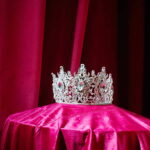
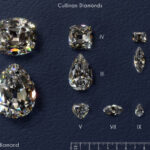
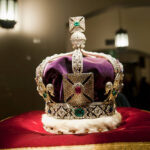
What has accumulated since then is the most visited collection of jewelry in the world. The Imperial State Crown alone contains 2,868 diamonds, including Cullinan II at 317.4 carats. The Sovereign’s Sceptre contains Cullinan I, the largest colorless cut diamond in existence at 530.2 carats. The Koh-i-Noor sits in the Queen Mother’s Crown.
These stones are not worn casually. They appear at coronations, state openings of Parliament, and moments of formal constitutional significance deployed deliberately, at intervals, as visual reminders of continuity and permanence. The diamonds in the British Crown Jewels are not accessories. They are arguments, made in carbon and light, for the legitimacy of an institution.
Diamonds as Diplomatic Currency
Beyond their use in crowns and scepters, diamonds served for centuries as one of the primary forms of diplomatic gift between royal houses.
A diamond given by one monarch to another was simultaneously a token of goodwill and a demonstration of resources. The implicit message was clear: I have access to enough wealth to give you this without meaningful sacrifice. It established hierarchy, acknowledged alliance, and communicated financial strength in a single gesture.
The practice shaped the movement of significant stones across Europe in ways that are still traceable today. Many of the diamonds in the Habsburg imperial collection arrived as diplomatic gifts. Several stones in the Russian imperial collection assembled aggressively under Catherine the Great, who was one of history’s most determined acquirers of fine gemstones arrived through the same channel.
Catherine’s collection eventually became the Kremlin Diamond Fund, which still exists and contains some of the most significant diamonds in the world including the Orlov Diamond, a 189.62-carat stone acquired by her lover Count Orlov as a gift intended, unsuccessfully, to rekindle her affection.
Even diamonds given for romantic reasons were, at the royal level, political acts. The distinction between personal and political barely existed in royal courts. Every gesture was observed, interpreted, and noted.
What Survived Them All
Empires ended. Dynasties were overthrown. Palaces were burned. The people who wore these diamonds, the kings and queens and emperors and empresses who used them to communicate power are long gone.
The diamonds remain.
Not all of them in royal hands, not all of them in the countries that originally claimed them, not all of them in one piece. But they are here in museum cases and auction houses and private collections carrying the compressed history of the courts and conflicts and political calculations that surrounded them.
The extraordinary durability of a diamond is not just physical. It is historical. These stones have witnessed more of human civilization than almost any other object passing from the hands of emperors to merchants to conquerors to bankers to museums, accumulating layers of meaning with each transfer.
What began as political theater has become, over centuries, something closer to testimony. The diamonds that once announced royal power now simply record evidence of courts and ambitions that time has otherwise erased.
The Same Standard, Without the Politics
At Regal Studio in Buckhead, Atlanta, master jeweler Mack has spent over 45 years working with the same material that shaped the politics of empires and applying to it a standard that has nothing to do with power and everything to do with craft.
His path began at fourteen, learning the fundamentals at a bench in his family’s jewelry business. It broadened through years of study in Europe, where the techniques for working with fine diamonds and precious metals have been refined over centuries. It deepened through four decades of designing custom pieces for private clients, celebrities, and professional athletes each one built with the understanding that a diamond deserves to be treated as what it is: one of the most remarkable objects in nature, worthy of genuine expertise and care.
As a GIA Certified Diamond Grader, Mack reads stones the way the great court jewelers of history read them, understanding not just what they look like, but what they are. The cut, the clarity, the origin, the way a specific stone handles light in a specific setting. These are not details that show up on a certificate. They come from experience.
Royal courts used diamonds to make political statements. At Regal Studio, the only statement is a simpler one: every stone deserves the best of what human craft can offer it.
Twenty years in Buckhead. Forty-five years at the bench. One standard, consistently applied.
Regal Studio · Buckhead, Atlanta Where the craft that served kings is available to everyone who values it.
Looking for a custom diamond piece or private consultation in Atlanta? Visit Regal Studio in Buckhead or contact us to arrange an appointment with Mack.
Read More:
How Many Red Diamonds Are Left in the World? The Complete 2026 Count
Where Did Red Diamonds Come From? The Mystery of Earth’s Rarest Gems