
Pink Diamonds Through History: Why Royalty Paid Fortunes for Them
Some gemstones are beautiful. Pink diamonds are something else entirely.
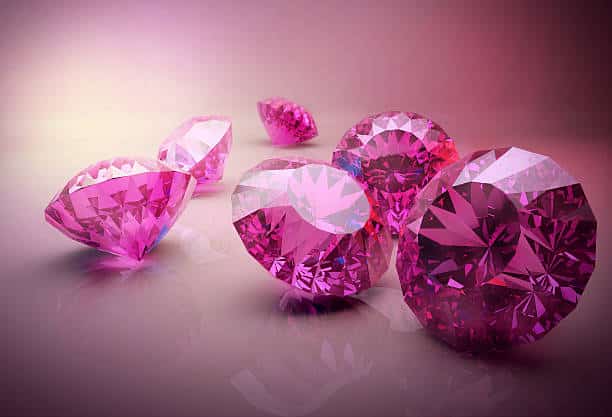
There is a quality to a fine pink diamond that stops people mid-sentence. It isn’t just the color though the color is extraordinary. It’s the combination of rarity, depth, and warmth that makes even experienced jewelers pause when a genuine specimen passes through their hands. These are not stones that exist in abundance. They never have. And after the permanent closure of the world’s most important pink diamond mine in 2020, they never will again, at least not in any volume that matters to the market.
But the fascination with pink diamonds didn’t begin with modern collectors or hedge fund managers treating gemstones as alternative assets. It began centuries ago, in the courts of Mughal emperors and European royalty, where these stones were recognized immediately as objects of singular power and beauty.
This is the story of pink diamonds through history, where they came from, who wore them, what they cost, and why the world’s most powerful people have always been willing to pay almost anything to possess them.
The Ancient Origins: India’s Golconda Mines
The history of pink diamonds begins where the history of almost all legendary diamonds begins in the alluvial fields and riverbeds of India’s Golconda region.
For over a thousand years, from roughly the 4th century BC through the early 18th century, India was the only known source of diamonds in the world. The Golconda mines are actually a collection of mining areas across the Deccan Plateau, named after the trading city that served as their commercial hub producing stones of legendary purity. Many were Type IIa diamonds, a classification that indicates an almost complete absence of nitrogen impurities, giving the stones an extraordinary transparency and optical performance.
Among the diamonds that emerged from Golconda’s fields were, almost certainly, the earliest recorded pink diamonds. The Mughal emperors who ruled India during the 16th through 18th centuries were sophisticated and obsessive collectors of extraordinary gemstones. Their treasury records — some of which survive — describe stones of pink and rose color that were prized above almost everything else in their collections.
The specific identification of these early stones as pink diamonds rather than pink sapphires or spinels is difficult to confirm with certainty from historical records alone. But the geological reality of Golconda — which produced colored diamonds across a wide range of hues — makes it virtually certain that pink diamonds passed through the hands of Mughal royalty centuries before Western jewelers had even encountered the category.
European Royalty and the Pink Diamond Obsession
When diamond trading expanded from India into Europe through Portuguese and Dutch trading networks in the 16th and 17th centuries, the most extraordinary colored stones were reserved for the most powerful buyers. Pink diamonds — when they appeared at all — went directly to royalty.
The French Royal Court
France under Louis XIV and his successors was arguably the most diamond-obsessed royal court in European history. The Sun King assembled a collection of extraordinary gemstones that formed the basis of what became the French Crown Jewels — a collection that included colored diamonds of remarkable quality.
Among the stones associated with the French court during this period were several pink diamonds of Indian origin, acquired through the trading networks that brought Golconda rough to European cutting centers in Antwerp and Amsterdam. The exact provenance of individual stones from this era is often incomplete — documentation was inconsistent and ownership changed through war, revolution, and theft — but the presence of pink diamonds among the treasures of the French monarchy is well established.
The Dresden Court in Saxony
The court of Augustus the Strong, Elector of Saxony and King of Poland in the early 18th century, assembled one of Europe’s most significant gemstone collections — housed in what became the famous Green Vault in Dresden.
Among the treasures Augustus acquired was the Dresden Green Diamond — a 41-carat natural green diamond of extraordinary provenance. But the Dresden collection also included pink diamonds of Indian origin, reflecting the same impulse that drove every major European court of the period: the recognition that natural colored diamonds represented the absolute pinnacle of rarity and, therefore, of status.
For rulers who expressed their power through material splendor, pink diamonds were not decorative objects. They were statements of a particular kind of dominance — the ability to possess something that almost no one else in the world could obtain.
The Nizam of Hyderabad and Eastern Royal Collections
While European courts were building their collections through trade networks, the Indian subcontinent continued to produce and accumulate pink diamonds at the source. The Nizams of Hyderabad — rulers of one of the wealthiest princely states in India — assembled gem collections that were, by almost any measure, among the greatest ever gathered in one place.
The Nizam’s treasury was legendary even by the extraordinary standards of Indian royal collections. It contained diamonds measured by the hundreds of carats, emeralds the size of eggs, and colored stones of a quality and quantity that British colonial administrators described with barely concealed disbelief when they gained access after Indian independence.
Pink diamonds featured prominently in collections of this kind — not just as jewelry but as currency, as gifts between rulers, and as assets that could be liquidated or pledged in the complex financial arrangements of pre-colonial Indian statecraft. A significant pink diamond was simultaneously an ornament, a statement, and a store of wealth that transcended the political instabilities of any given era.
The Argyle Revolution: How Australia Changed Everything
The discovery of diamond deposits in Western Australia’s Kimberley region in the 1970s and the subsequent opening of the Argyle mine in 1983 transformed the pink diamond market in ways that no one fully anticipated.
Argyle was a lamproite volcanic pipe rather than a conventional kimberlite formation, and its geological characteristics produced colored diamonds — particularly pinks, purples, violets, and reds — in concentrations that no other known deposit could match. At peak production, Argyle was processing over 35 million carats of rough diamond annually.
Of that enormous volume, the pink diamonds represented a fraction of a fraction. Approximately 80% of Argyle’s output was industrial grade. Of the gem-quality material, the overwhelming majority was brown. Pink diamonds — at every quality level from faint to vivid — constituted less than 0.1% of total output. And within that already tiny category, the finest Fancy Vivid Pinks were so scarce that Argyle held an annual tender specifically to market them — an invitation-only event for the world’s most serious colored diamond buyers.
The Argyle Pink Diamond Tender
From 1984 onward, the Argyle Pink Diamond Tender became one of the most anticipated events in the fine jewelry calendar. Each year, Argyle would present a curated selection of its finest pink, red, and violet rough and polished stones to a small group of qualified international buyers.
The tender stones were numbered, documented, and certified — and they sold at prices that established the benchmark for the global pink diamond market. Over the decades, the per-carat prices achieved at Argyle tenders increased consistently and dramatically, reflecting both the genuine scarcity of the material and the growing global awareness of what Argyle pinks represented.
The tender format also created something valuable beyond the sales themselves: a documented record of Argyle-origin stones that could be tracked, certified, and re-sold in the secondary market with a clear provenance history. An Argyle certificate became, over time, a mark of distinction that commanded a premium above and beyond the stone’s GIA grade.
The Argyle Closure and Its Historic Consequences
On November 3, 2020, the Argyle mine officially ceased operations after 37 years of production. The ore body had been exhausted. The mine that had supplied over 90% of the world’s pink diamond production — including the vast majority of all significant Fancy Vivid Pink stones that entered the market during the modern era — was gone.
The implications were immediate and structural. Unlike most commodity markets, where a supply disruption can eventually be addressed by finding new sources or increasing production elsewhere, there is no replacement for Argyle. No other known deposit produces pink diamonds in comparable quality or volume. The geological conditions that created Argyle’s unique colored output do not exist — in any currently identified formation — elsewhere on Earth.
What this means for existing Argyle-certified pink diamonds is straightforward: they are now part of a fixed and diminishing supply. Every stone that is lost, damaged, or permanently removed from the market reduces the total inventory. Every year that passes without a new comparable source increases the scarcity of what remains.
Prices for Argyle Fancy Vivid Pink diamonds have risen sharply since the closure announcement — and most analysts who track the colored diamond market expect that trajectory to continue.
Record Auction Sales: When Pink Diamonds Make History
The auction record for pink diamonds tells its own story about how the world values these stones.
The Pink Star — a 59.60-carat oval mixed-cut Fancy Vivid Pink diamond — sold at Sotheby’s Hong Kong in April 2017 for $71.2 million. It remains the most expensive diamond ever sold at auction and one of the most expensive gemstones in recorded history. The stone was grown from a rough diamond mined by De Beers in 1999, cut over two years, and graded by the GIA as internally flawless — the highest clarity grade. Its combination of size, color intensity, and quality represents a convergence that may never occur again.
The Graff Pink — an 24.78-carat Fancy Intense Pink diamond — sold at Sotheby’s Geneva in 2010 for $46.2 million, setting a record at the time that was subsequently broken only by the Pink Star. Jeweler Laurence Graff purchased it and reportedly had it recut slightly to improve its proportions before it was certified by the GIA.
The CTF Pink Star — the same stone as the Pink Star above, renamed after its purchase by Chow Tai Fook — set the current record with its 2017 sale. Its price per carat of approximately $1.19 million established a benchmark that remains the reference point for extraordinary pink diamonds.
These results are not anomalies. They are the logical outcome of a market where genuine scarcity meets genuine demand from buyers who understand exactly what they are acquiring.
Frequently Asked Questions
Q1. Why have royalty and powerful collectors always prized pink diamonds above other gemstones?
Pink diamonds combine extreme rarity with extraordinary visual beauty in a way that no other gemstone matches. Their color — which comes from a rare physical distortion of the crystal structure rather than any chemical impurity — cannot be reliably reproduced or predicted. For rulers and collectors throughout history, possessing a pink diamond meant possessing something that the vast majority of the world’s wealth could not simply purchase. That combination of beauty and inaccessibility has made them status objects across cultures and centuries.
Q2. What makes Argyle pink diamonds specifically so valuable?
Argyle pink diamonds carry a premium for two reasons. First, the Argyle mine — which closed permanently in 2020 — was responsible for over 90% of the world’s pink diamond supply, meaning Argyle-certified stones come from a source that no longer exists. Second, Argyle developed a rigorous internal grading and certification system for its finest stones, creating documented provenance that the secondary market values. An Argyle certificate attached to a Fancy Vivid Pink diamond is not just paperwork — it’s a verifiable link to the world’s most significant pink diamond source.
Q3. How is the color graded in a pink diamond?
The GIA grades pink diamonds on an intensity scale from Faint Pink through Fancy Light Pink, Fancy Pink, Fancy Intense Pink, and Fancy Vivid Pink at the top. Each step up the scale represents a significant increase in color saturation and a significant increase in value — a Fancy Vivid Pink can be worth many times more per carat than a Fancy Light Pink of identical size and clarity. Modifying colors — such as purplish-pink, orangy-pink, or brownish-pink — are also noted and affect value depending on desirability.
Q4. Will pink diamond prices continue to rise after the Argyle mine closure?
The fundamental supply argument is strong. No new source of comparable pink diamond production has been identified. Existing inventory is finite and diminishing. Global demand for rare colored diamonds — particularly from Asian markets — has grown consistently over the past two decades. Most gemological analysts and auction house specialists who track this market expect continued appreciation for top-quality Argyle-certified Fancy Vivid Pink diamonds. As with any illiquid asset, timing and liquidity are real considerations — but the underlying scarcity argument is as solid as any in the gemstone market.
Q5. What should I know before buying a pink diamond?
Four things matter most. First, insist on a GIA certificate that explicitly states the color grade and confirms natural color origin — treated or irradiated pink stones exist and are worth dramatically less. Second, understand the intensity grade — the difference between Fancy Pink and Fancy Vivid Pink is enormous in both visual impact and value. Third, for Argyle-origin stones, request the original Argyle certificate in addition to the GIA report. Fourth, work with a GIA-certified professional who can explain the certificate in plain language and help you understand exactly what you’re paying for and why.
Final Thoughts
The history of pink diamonds is, at its core, a story about human recognition of true rarity. Across centuries, cultures, and continents — from Mughal emperors examining alluvial stones in the fields of Golconda to modern collectors bidding by telephone at Sotheby’s Geneva — the response to a genuine pink diamond has always been the same. People understand instinctively that they are looking at something the world almost didn’t make.
That instinct was right then. It’s right now. And with the Argyle mine permanently closed and no replacement on the horizon, the window for acquiring fine pink diamonds at any price is narrower today than it has ever been.
The royalty of history paid fortunes for these stones because they understood their value. The collectors of today who understand the same thing are simply continuing a very long tradition.
Want to explore pink diamonds and rare colored stones with a true expert in Atlanta? At Regal Studio in Buckhead, Mack — a GIA Certified Diamond Grader with over 45 years of experience — brings the same depth of knowledge to every client conversation that has made Regal Studio one of Atlanta’s most trusted names in fine jewelry. Whether you’re exploring fancy colored diamonds for the first time or looking for guidance on a significant purchase, you’ll receive honest education, genuine expertise, and the personalized attention every extraordinary piece deserves. You Dream It, We Make It. Visit Regal Studio and let’s find the stone that belongs with you.
Read More:
How Many Red Diamonds Are Left in the World? The Complete 2026 Count
The Complete History of Red Diamonds: Earth’s Rarest Treasure Explained