Where Do Real Diamonds Come From? From Volcanoes to Royal Crowns
Most people have held a diamond at some point in a ring, on a necklace, in a jeweler’s palm extended across a velvet tray. And most people, at that moment, have no idea what they’re actually holding.
Not just a gemstone. Not just compressed carbon. What you’re holding is the end result of one of the most violent, improbable, and drawn-out journeys in the natural world a journey that begins over 100 miles underground, travels through explosive volcanic eruptions, survives billions of years of geological upheaval, and somehow ends up cut, polished, and set in a piece of jewelry worn by a human being.
The story of where real diamonds come from is one of the most fascinating in all of natural history. And understanding it changes how you see every single stone.
It All Starts Billions of Years Underground
To understand where diamonds come from, you have to go much deeper than most people imagine.
Real diamonds don’t form in the Earth’s crust, where we live and drill and mine for most things. They form in the lithospheric mantle — a layer of dense, hot rock sitting roughly 100 to 150 miles below the surface. Down there, temperatures reach between 1,650°F and 2,370°F, and the pressure is so extreme it’s nearly impossible to describe in relatable terms. We’re talking about pressures exceeding 725,000 pounds per square inch.
Under those conditions, pure carbon — the same element in graphite pencils and charcoal — doesn’t behave the way it does at the surface. Instead of forming soft, layered sheets, it locks into a rigid three-dimensional cubic crystal lattice. That locked structure is what makes diamond the hardest natural substance on Earth.
And then it just… sits there. For a very long time. Most natural diamonds spent somewhere between one billion and three billion years forming in the mantle before anything happened to bring them upward. Some of the oldest diamonds ever dated are over 3.5 billion years old — older than most surface rocks on the planet.
Where the Carbon Comes From
The carbon that becomes diamond has two main origins. Some of it is primordial carbon — elemental material that’s been inside the Earth since the planet formed 4.5 billion years ago. Some come from ancient organic material — remnants of early life forms that were pulled deep into the Earth by the movement of tectonic plates over geological timescales.
By the time that carbon becomes diamond, it has been completely and utterly transformed. There is no trace of what it once was. It is a pure, crystallized structure — one of the most stable arrangements of atoms that exists in nature.
The Volcanic Eruption That Changes Everything
Here’s where the story shifts from slow and ancient to fast and violent.
Diamonds don’t drift gradually toward the surface over millions of years. They are launched upward by a specific type of deep volcanic eruption — one of the rarest and most powerful geological events on Earth. These eruptions have a name: kimberlite eruptions, named after Kimberley, South Africa, where the geological evidence was first studied in the 19th century.
A kimberlite eruption originates far deeper in the Earth than ordinary volcanoes. It tears upward through the lithosphere at speeds estimated between 20 and 70 miles per hour, carrying chunks of mantle rock — including diamonds — along with it. The eruption punches through miles of solid rock and reaches the surface in a geological instant.
That speed is not a detail — it’s everything. If the diamond-bearing material rises too slowly, the drop in pressure causes the diamonds to destabilize and convert back into graphite. The eruption must be fast enough to essentially freeze the diamonds in their high-pressure crystal form before that transformation can occur. When the eruption reaches the surface and cools, it leaves behind a pipe-shaped column of rock called a kimberlite pipe — sometimes called a blue ground pipe because of the distinctive blue-gray color of the ore.
These ancient volcanic pipes are where most of the world’s diamonds are found today. Mining operations sink thousands of feet into these formations, following the pipe downward through rock that last saw the surface over 70 million years ago.
Lamproite Pipes and Alluvial Diamonds
Not every diamond reaches the surface through kimberlite. A smaller number come through lamproite eruptions — a related but distinct volcanic process. The Argyle mine in Western Australia, which until its closure in 2020 produced over 90% of the world’s pink and red diamonds, was a lamproite deposit rather than a kimberlite one.
Then there are alluvial diamonds — stones that eroded out of ancient volcanic formations over millions of years and were carried by rivers, streams, and glaciers sometimes thousands of miles from their original source. Some of history’s most famous diamonds, including legendary stones from India’s Golconda region, were originally discovered in riverbeds and alluvial gravels rather than in mining operations.
The World’s Most Important Diamond Sources
The geological journey of a diamond is shaped enormously by where on Earth it forms. Different regions produce dramatically different stones — in size, quality, and color.
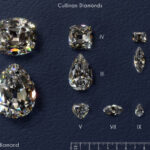
South Africa remains one of the most storied diamond origins in history. The Cullinan mine, still active today, has produced some of the largest gem-quality diamonds ever found — including the 3,106-carat Cullinan Diamond, which was cut into several stones now set in the British Crown Jewels. South African mines are particularly known for large white diamonds and rare blues.
Russia is the world’s largest diamond producer by volume. The Mir mine in Siberia — now inactive — was one of the most extraordinary open-pit mines ever constructed, nearly a mile wide and so deep that helicopter flights were restricted above it due to the downward air currents it created. Russian stones, particularly from the Yakutia region, supply a significant portion of the global rough diamond market.
Botswana produces fewer diamonds than Russia but arguably more valuable ones. The Jwaneng mine is widely considered the most valuable diamond mine in the world by total worth of its output. Botswana’s diamond wealth has funded infrastructure, education, and economic development that have made it one of Africa’s most stable nations — a rare and important story in the history of resource extraction.
Australia’s Argyle mine operated from 1983 to 2020 and transformed the pink diamond market entirely. At its peak, it produced over 35 million carats of rough diamonds annually. More importantly, it was the source of virtually every significant pink and red diamond in modern circulation. Its permanent closure has made existing Argyle-certified stones a fixed and diminishing supply — with profound implications for price.
Canada has become an increasingly important source for buyers who prioritize ethical and traceable provenance. The mines in Canada’s Northwest Territories operate under strict environmental standards and offer documented, mine-of-origin certification that no other major producing region can match with the same consistency.
India’s Golconda region holds a unique place in diamond history. For over a thousand years — from roughly the 4th century BC through the early 18th century — India was the only known source of diamonds in the world. The stones that emerged from Golconda’s alluvial fields are legendary: the Hope Diamond, the Koh-i-Noor, the Orlov, the Regent. What made Golconda stones special wasn’t just their origin — it was their exceptional purity, a characteristic now formally recognized in GIA grading as the Type IIa classification, which indicates an almost complete absence of nitrogen impurities.
From Rough Stone to Royal Crown: The Human Journey
Once a diamond reaches the surface — whether through a mining operation, a riverbed find, or an artisanal dig — its journey through human hands begins. And that journey is nearly as extraordinary as its geological one.
Rough Diamond Sorting and Valuation
Raw diamonds don’t look like jewelry. Fresh from the ore, a rough diamond typically resembles a pale, waxy, rounded crystal — often entirely unspectacular in appearance. The process of sorting, grading, and valuing rough diamonds is a highly specialized trade. Major diamond producers sort their rough by size, shape, quality, and color before selling it to manufacturers and cutters through a tightly controlled supply chain.
The Art of Diamond Cutting
Diamond cutting is one of the most demanding skilled trades in fine jewelry. A cutter must analyze each rough stone — its internal inclusions, crystal orientation, potential yield — and make decisions that are entirely irreversible. One wrong decision can crack a stone worth hundreds of thousands of dollars.
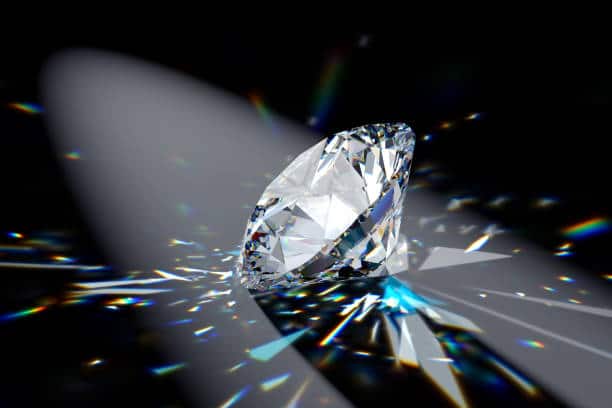
The goal of cutting is to maximize the stone’s optical performance: the way it captures, bends, and returns light. A well-cut diamond creates brilliance (white light return), fire (spectral color flashes), and scintillation (the sparkle pattern when the stone moves). These qualities are entirely dependent on the precision of the angles and proportions the cutter chooses.
Famous Diamonds and the Crowns They Reached
The most extraordinary rough diamonds in history have ended up in the most extraordinary places.
The Cullinan I — also called the Great Star of Africa, cut from the 3,106-carat Cullinan rough — is a 530-carat pear-shaped stone set in the British Sovereign’s Sceptre. The Koh-i-Noor, mined in Golconda centuries ago, sits in the Crown of Queen Mary as part of the British Crown Jewels. The Hope Diamond, a 45.52-carat Fancy Deep Blue, traveled from Indian mines through French royalty, European traders, American socialites, and eventually to the Smithsonian Institution, where it remains on public display.
These stones didn’t just happen to end up in crowns and museum cases. Their rarity, their size, and the almost supernatural beauty of their cut made them objects that powerful people — rulers, collectors, institutions — felt compelled to possess and preserve. They represent the far end of the spectrum that starts with a carbon atom locked in the Earth’s mantle over a billion years ago.
Frequently Asked Questions
Q1. Where do real diamonds actually come from on the Earth? Real diamonds form in the Earth’s lithospheric mantle, roughly 100 to 150 miles below the surface, under temperatures between 1,650°F and 2,370°F and extreme pressure. They are carried to the surface by rare, deep volcanic eruptions called kimberlite or lamproite eruptions, which deposit the stones in pipe-shaped formations of volcanic rock. This is where the majority of the world’s diamonds are mined today.
Q2. How old are natural diamonds? Most natural diamonds formed between one billion and three billion years ago. Some specimens recovered from ancient cratons — the oldest stable sections of the Earth’s crust — have been dated at over 3.5 billion years old. This makes natural diamonds among the oldest physical objects a human being can hold.
Q3. What made India’s Golconda diamonds so special? Golconda diamonds are renowned for their exceptional chemical purity — specifically their near-total absence of nitrogen, which classifies them as Type IIa diamonds under GIA standards. This purity gives them an extraordinary transparency and brilliance that distinguishes them from stones of other origins. The Hope Diamond and the Koh-i-Noor are both Golconda stones.
Q4. Why did the closure of the Argyle mine matter so much? The Argyle mine in Australia produced over 90% of the world’s pink and red diamond supply. When it closed permanently in November 2020, it effectively ended the primary source for these colors. No comparable replacement source has been found. This means the existing supply of Argyle-certified pink and red diamonds is now finite and diminishing — which has driven significant and ongoing price appreciation for these stones.
Q5. Does a diamond’s country of origin affect its value? Origin can matter in several important ways. Golconda diamonds command a premium for their historical significance and Type IIa purity. Argyle-certified pink diamonds carry premium value due to supply scarcity. Canadian diamonds attract buyers who prioritize documented ethical sourcing. For standard white diamonds, the GIA grade matters far more than origin to most buyers — but provenance documentation adds a layer of authenticity and story that meaningful purchases deserve.
Final Thoughts
A real diamond is not simply a beautiful object. It is a geological event — a convergence of ancient carbon, incomprehensible pressure, violent volcanic force, and billions of years of patience — compressed into something small enough to hold between two fingers.
From the depths of the Earth’s mantle to the riverbeds of ancient India, from the kimberlite pipes of South Africa and Siberia to the cutting rooms of Antwerp and New York, and from there to the royal crowns of history and the jewelry boxes of everyday people who save up for something that matters — the diamond’s journey is unlike anything else.
That journey is part of what you’re buying. And it’s worth knowing.
Looking for diamonds in Atlanta with a jeweler who understands every part of that journey? At Regal Studio in Buckhead, Mack — a GIA Certified Diamond Grader with over 45 years of experience — has spent a lifetime studying, sourcing, and crafting with exceptional stones. Whether you’re buying your first diamond or designing a custom piece around something extraordinary, Regal Studio offers the kind of honest, educated guidance that turns a significant purchase into a confident one. You Dream It, We Make It. Visit Regal Studio in Atlanta and let’s find the stone that tells your story.
Read More:
How Many Red Diamonds Are Left in the World? The Complete 2026 Count